
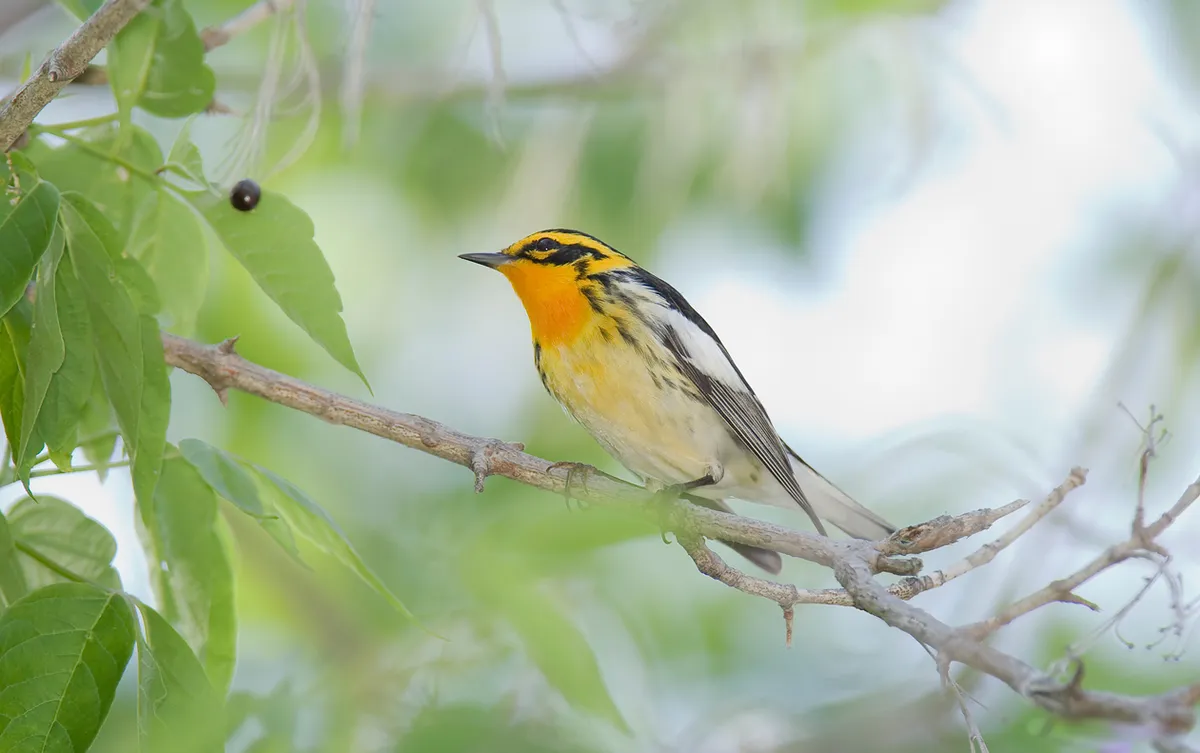
Paruline à gorge orangée— Quebec wildlife
Setophaga fusca
ParulidaeNo period published by Québec.ca
Québec.ca publishes no hunting or trapping period for this species. Check the official regulations.
Wikipedia
Paruline à gorge orangée
The Blackburnian warbler (Setophaga fusca) is a small New World warbler. They breed in eastern North America, from southern Canada, westwards to the southern Canadian Prairies, the Great Lakes region and New England, to North Carolina. They are migratory, wintering in southern Central America and South America, and are very rare vagrants to western Europe. The common name honors the English botanist Anna Blackburne.
Description
Blackburnian warblers are small passerines and average-sized wood-warblers. They measure around 11 to 13 cm (4.3 to 5.1 in) long, with a 20 to 22 cm (7.9 to 8.7 in) wingspan, and weigh 8 to 13 g (0.28 to 0.46 oz). The average mass of an adult bird is 9.7 g (0.34 oz), although is slightly higher in fall due to fat reserves, averaging 10.2–10.4 g (0.36–0.37 oz). Among standard measurements, the wing chord is 6.3 to 7.3 cm (2.5 to 2.9 in), the tail is 4.2 to 5 cm (1.7 to 2.0 in), the bill is 0.9 to 1 cm (0.35 to 0.39 in) and the tarsus is 1.6 to 1.8 cm (0.63 to 0.71 in). In summer, male Blackburnian warblers display dark gray backs and double white wing bars, with yellowish rumps and dark brown crowns. The underparts of these birds are white and are tinged with yellow and streaked black. The head is strongly patterned in yellow and black, with a flaming-orange throat. It is the only North American warbler with this striking plumage. Other plumages, including the fall male and adult female, are washed-out versions of the summer male, and in particular, lack the bright colors and strong head pattern. The Blackburnian warbler is practically unmistakable if seen well, even the female due to her dull-yellow supercilium, contrasting with greyish cheeks and yellow throat contrasting with the dark streaky sides and back. The only other wood-warbler with an orange throat is the flame-throated warbler of Central America, which is very distinctive, lacking the contrasting blackish streaking about the head and whitish underside of a male Blackburnian. Basic plumages show weaker yellows and gray in place of black in the breeding male. Blackburnian warblers' songs are a simple series of high swi notes, which often ascend in pitch. Transliterations have included zip zip zip zip zip zip zip zip, titititi tseeeeee or teetsa teetsa teetsa teetsa. Their call is a high sip. Genetic research has shown that their close living relative is the bay-breasted warbler, the latter species perhaps specialized to forage in the same coniferous trees at lower levels. Hybridization in the wild has been recorded once each with a bay-breasted warbler (in West Virginia), with a black-and-white warbler (in Pennsylvania), and possibly a wintering hybrid with a Kirtland's warbler (in Hispaniola).
Text from Wikipedia — Blackburnian warbler, revision 1345419453, CC BY-SA 4.0, retrieved 2026-09-04. Encyclopedic text reused under CC BY-SA 4.0. Sentences about hunting or regulation are removed: on this site, the rule comes from Québec.ca.
Other names
French
Former scientific names
Presence in Quebec
- Origin
- Indigène
- Occurrence
- Régulier
- Population status
- Reproducteur
- Certainty
- Confirmé
Conservation
Québec.ca
Official periods
Source: Québec.ca — tables reproduced as published (retrieved 2026-08-30).
Regulations change. Always check Québec.ca before hunting or trapping.
Where this data comes from
This species is listed in an official government dataset. The identification and status shown in the data sheet are reproduced from it.
Source: List of Quebec’s vertebrate wildlife (LFVQ) — Ministère de l’Environnement, de la Lutte contre les changements climatiques, de la Faune et des Parcs. File LFVQ_25_03_2026.csv, retrieved 2026-08-30 · CC BY 4.0.
Measurements, habitat, diet and reproduction are not shown: no official source is attached to them yet.