
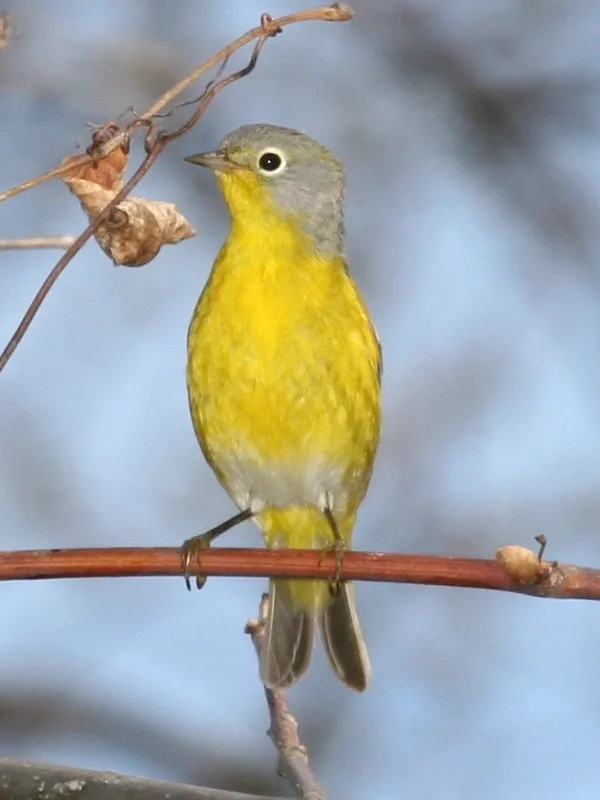
Paruline à joues grises— Quebec wildlife
Leiothlypis ruficapilla
ParulidaeNo period published by Québec.ca
Québec.ca publishes no hunting or trapping period for this species. Check the official regulations.
Wikipedia
Paruline à joues grises
The Nashville warbler (Leiothlypis ruficapilla) is a small songbird in the New World warbler family, found in North and Central America. It breeds in parts of the northern and western United States and southern Canada, and migrates to winter in southern California and Texas, Mexico, and the north of Central America. It has a gray head and a green back, and its underparts are yellow and white.
Description
The Nashville warbler is a small warbler. Both male and female Nashville warblers have a gray head fading into a greenish back and wings, a white belly and a yellow throat and breast. They have a complete white eye ring, no wing bars, and a thin pointed black bill. Adult males have a rusty brown patch on their crown, which is usually hard to see and often covered by gray feathers. Males will raise it slightly when agitated. Females and immature birds have a duller olive-grey head, and less bold yellow on their throat. The Nashville warbler is closely related to Virginia's warbler, Lucy's warbler, and the Colima warbler, the four sharing generally similar plumage. Measurements: Length: 4.3–5.1 in (11–13 cm) Weight: 0.2–0.5 oz (5.7–14.2 g) Wingspan: 6.7–7.9 in (17–20 cm)
Text from Wikipedia — Nashville warbler, revision 1359674944, CC BY-SA 4.0, retrieved 2026-09-04. Encyclopedic text reused under CC BY-SA 4.0. Sentences about hunting or regulation are removed: on this site, the rule comes from Québec.ca.
Other names
French
Former scientific names
Presence in Quebec
- Origin
- Indigène
- Occurrence
- Régulier
- Population status
- Reproducteur
- Certainty
- Confirmé
Conservation
Québec.ca
Official periods
Source: Québec.ca — tables reproduced as published (retrieved 2026-08-30).
Regulations change. Always check Québec.ca before hunting or trapping.
Where this data comes from
This species is listed in an official government dataset. The identification and status shown in the data sheet are reproduced from it.
Source: List of Quebec’s vertebrate wildlife (LFVQ) — Ministère de l’Environnement, de la Lutte contre les changements climatiques, de la Faune et des Parcs. File LFVQ_25_03_2026.csv, retrieved 2026-08-30 · CC BY 4.0.
Measurements, habitat, diet and reproduction are not shown: no official source is attached to them yet.