
No period published by Québec.ca
Québec.ca publishes no hunting or trapping period for this species. Check the official regulations.
Wikipedia
Paruline à poitrine baie
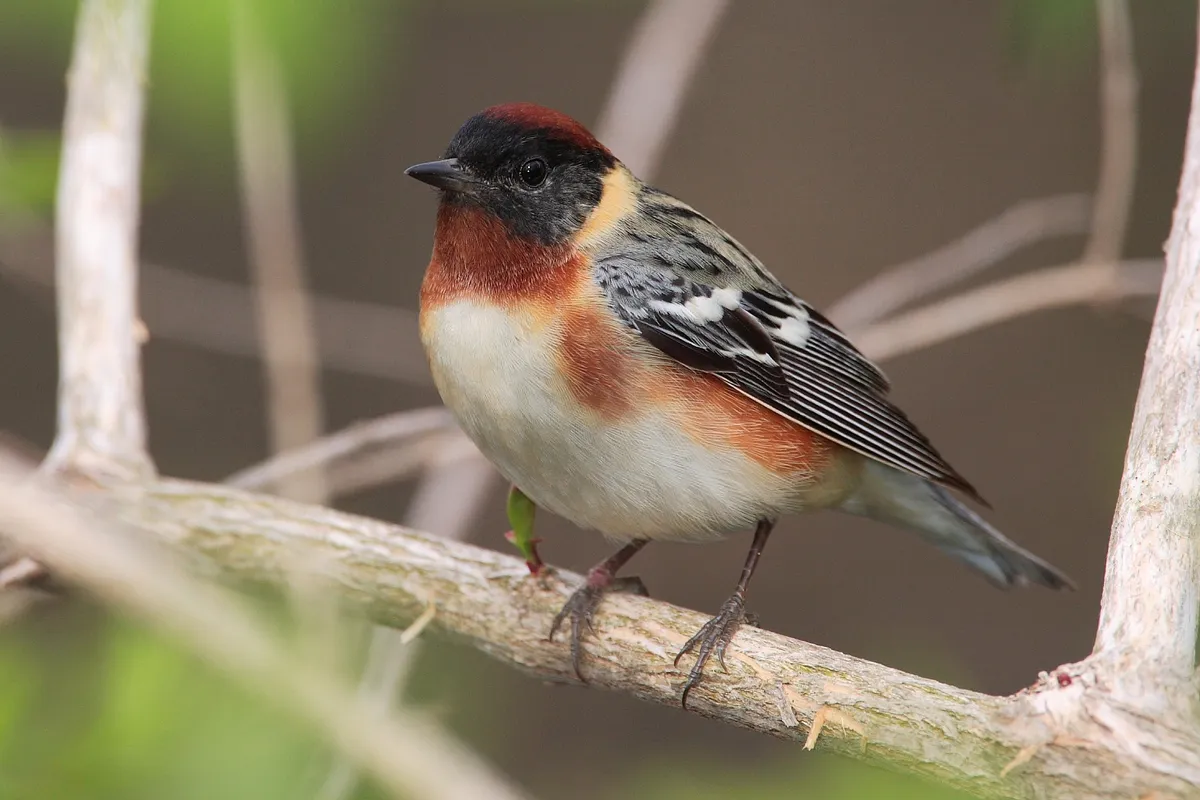
The bay-breasted warbler (Setophaga castanea) is a small species of songbird in the New World warbler family, Parulidae. It is one of 35 species in the diverse genus Setophaga. Like all songbirds, or passerines, the species is classified in the order Passeriformes.
Description
Adult males in breeding plumage are primarily greyish above, with two white wing bars, dark streaks on the back, and a creamy neck patch. The face is black, and the crown, throat, and sides are a dark chestnut colour. Breeding females are similar in overall pattern to the males, but are paler and duller. In the nonbreeding season, both sexes gain olive-green feathers on the back, nape, and head. The rufous on the flanks is limited and may even fade away entirely in nonbreeding females. The two white wing bars are present in all plumages. In breeding plumage, the bay-breasted warbler may be confused with the chestnut-sided warbler (Setophaga pensylvanica), which has similar chestnut colour on the sides. Chestnut-sided warblers may be easily differentiated by the extent of the chestnut, which does not reach the throat or crown. Chestnut-sided warblers also have a bright yellow crown, dark mask, and white cheek and throat in breeding plumage. In fall, nonbreeding bay-breasted warblers may look very similar to the blackpoll warbler (Setophaga striata). However, blackpoll warblers never have a hint of chestnut colour on the flanks, and also have yellowish feet, unlike the black feet of the bay-breasted warbler. Due to this similarity, the two birds sometimes are collectively called "baypoll warblers".
Habitat and range
Bay-breasted warblers breed in the boreal spruce-fir forests of eastern and central Canada (Newfoundland, west to northeastern British Columbia), as well as the far northeast of the United States. The species winters in the wet lowland forests of northeastern South America, the Caribbean, and southern Central America, and may be seen during spring and fall migration across the eastern half of the United States in a variety of vegetative communities. Many individuals cross the Gulf of Mexico on their long-distance migration, although some travel north and south along the Mexican shore. It is a rare vagrant west to the west coast of North America, and has also been recorded in Greenland.
Text from Wikipedia — Bay-breasted warbler, revision 1359478484, CC BY-SA 4.0, retrieved 2026-09-04. Encyclopedic text reused under CC BY-SA 4.0. Sentences about hunting or regulation are removed: on this site, the rule comes from Québec.ca.
Other names
French
Former scientific names
Presence in Quebec
- Origin
- Indigène
- Occurrence
- Régulier
- Population status
- Reproducteur
- Certainty
- Confirmé
Conservation
Québec.ca
Official periods
Source: Québec.ca — tables reproduced as published (retrieved 2026-08-30).
Regulations change. Always check Québec.ca before hunting or trapping.
Where this data comes from
This species is listed in an official government dataset. The identification and status shown in the data sheet are reproduced from it.
Source: List of Quebec’s vertebrate wildlife (LFVQ) — Ministère de l’Environnement, de la Lutte contre les changements climatiques, de la Faune et des Parcs. File LFVQ_25_03_2026.csv, retrieved 2026-08-30 · CC BY 4.0.
Measurements, habitat, diet and reproduction are not shown: no official source is attached to them yet.