
No period published by Québec.ca
Québec.ca publishes no hunting or trapping period for this species. Check the official regulations.
Wikipedia
Paruline à tête cendrée
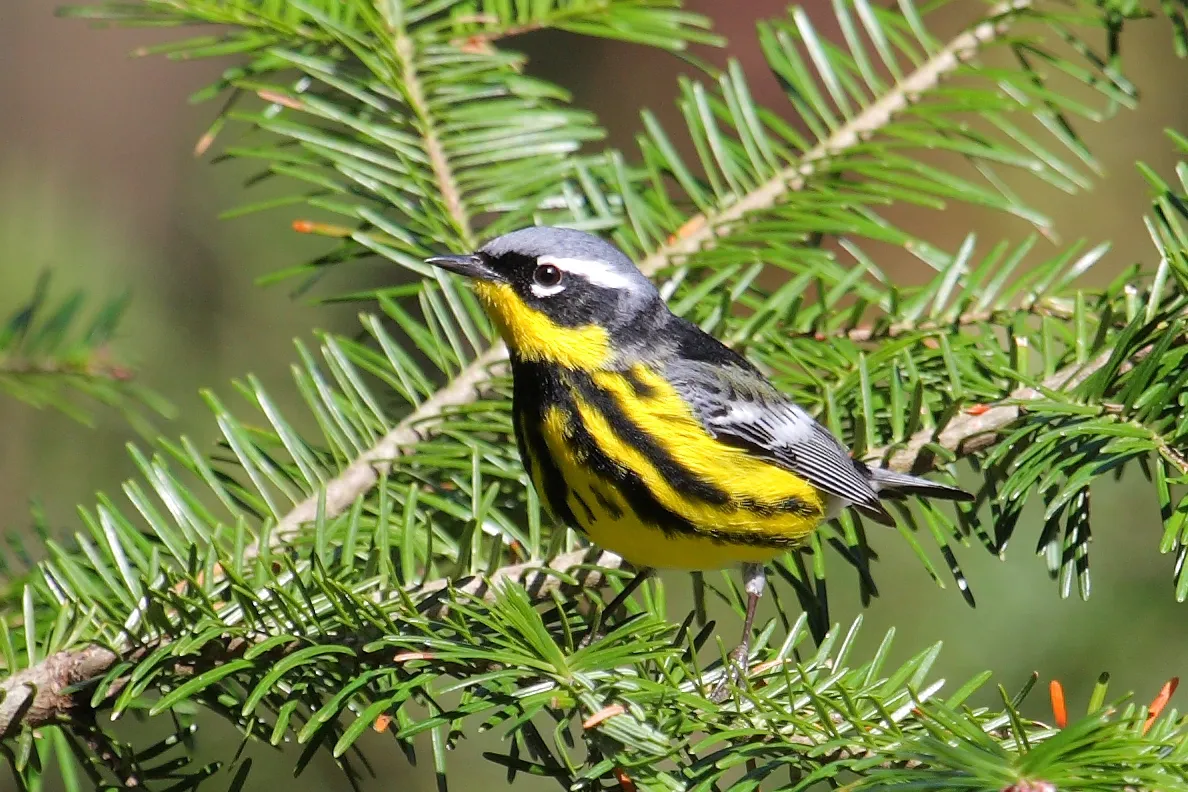
The magnolia warbler (Setophaga magnolia) is a member of the wood warbler family Parulidae.
Description
This species is a moderately small New World warbler. It measures 11 to 13 cm (4.3 to 5.1 in) in length and spans 16 to 20 cm (6.3 to 7.9 in) across the wings. Body mass in adult birds can range from 6.6 to 12.6 g (0.23 to 0.44 oz), though weights have reportedly ranged up to 15 g (0.53 oz) prior to migration. Among standard measurements, the wing chord is 5.4 to 6.4 cm (2.1 to 2.5 in), the tail is 4.6 to 5.2 cm (1.8 to 2.0 in), the bill is 0.8 to 1 cm (0.31 to 0.39 in) and the tarsus is 1.7 to 1.85 cm (0.67 to 0.73 in). The magnolia warbler can be distinguished by its coloration. The breeding males often have white, gray, and black backs with yellow on the sides; yellow and black-striped stomachs; white, gray, and black foreheads and beaks; distinct black tails with white stripes on the underside; and defined white patches on their wings, called wing bars. Breeding females usually have the same type of coloration as the males, except that their colors are much duller. Immature warblers also resemble the same dull coloration of the females. The yellow and black-striped stomachs help one to distinguish the males from other similar birds, like the prairie warbler and Kirtland's warbler (which, however, have a breeding range to the south and east of the magnolia warbler's).
Reproduction
The magnolia warbler undergoes multiple molts during its lifetime. The first molts begin while the young offspring are still living in the nest, while the rest take place on or near their breeding grounds. The warblers molt, breed, care for their offspring, and then migrate. Chicks hatch after a two-week incubation period, and can fledge from the nest after close to another two weeks when their feathers are more developed. After about a month, the chicks can leave the nest to begin living (and later breeding) on their own since they are solitary birds. Magnolia warblers typically live up to seven years.
Text from Wikipedia — Magnolia warbler, revision 1326939492, CC BY-SA 4.0, retrieved 2026-09-04. Encyclopedic text reused under CC BY-SA 4.0. Sentences about hunting or regulation are removed: on this site, the rule comes from Québec.ca.
Other names
French
Former scientific names
Presence in Quebec
- Origin
- Indigène
- Occurrence
- Régulier
- Population status
- Reproducteur
- Certainty
- Confirmé
Conservation
Québec.ca
Official periods
Source: Québec.ca — tables reproduced as published (retrieved 2026-08-30).
Regulations change. Always check Québec.ca before hunting or trapping.
Where this data comes from
This species is listed in an official government dataset. The identification and status shown in the data sheet are reproduced from it.
Source: List of Quebec’s vertebrate wildlife (LFVQ) — Ministère de l’Environnement, de la Lutte contre les changements climatiques, de la Faune et des Parcs. File LFVQ_25_03_2026.csv, retrieved 2026-08-30 · CC BY 4.0.
Measurements, habitat, diet and reproduction are not shown: no official source is attached to them yet.