
Paruline à tête jaune— Quebec wildlife
Setophaga occidentalis
ParulidaeNo period published by Québec.ca
Québec.ca publishes no hunting or trapping period for this species. Check the official regulations.
Wikipedia
Paruline à tête jaune
The hermit warbler (Setophaga occidentalis) is a small perching bird. It is a species of New World warbler or wood-warbler. They are a migratory bird, the breeding range spanning the majority of the west coast of the United States. Their winter range includes parts of Mexico and Central America as well as parts of the southern California coast.
Description
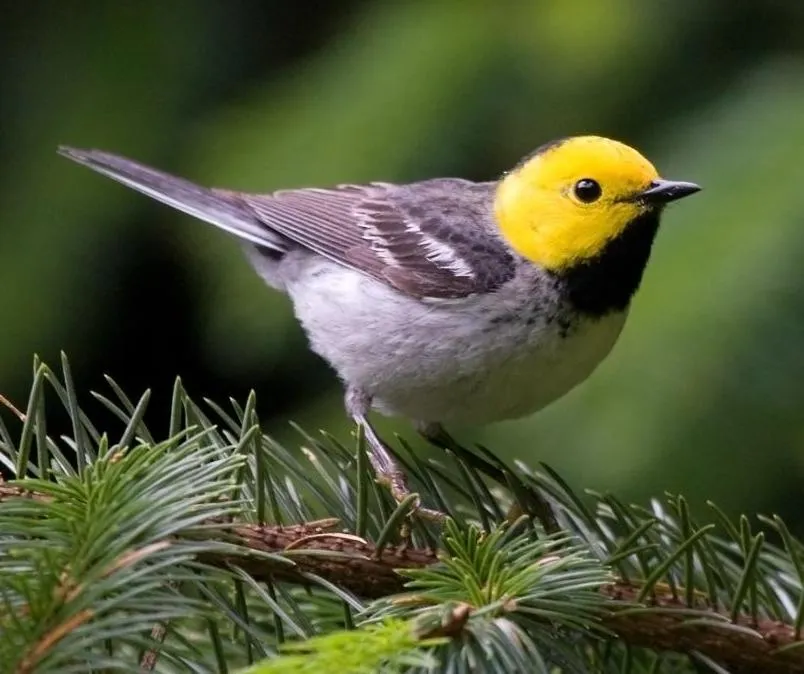
Hermit warblers are dark gray in coloration on top, and white below, and their flanks are streaked with black. The wings have two diagonal white wing bars. The majority of the hermit warbler's head is yellow, and males have a dark black throat, while females have much less black on their throat bib and immature birds have no black throat. Both males and females measure 5.5 inches (14 cm) in length, 0.3 to 0.5 oz (8.5 to 14.2 g) in weight, and 7.9 in (20 cm) in wingspan.
Habitat and range
Hermit warblers are common, but incredibly shy, birds that dwell in open coniferous forests. They are also found in wetter habitats for nesting, and in various mountain habitats. Their summer breeding range is the majority of the west coast of the United States up to Washington. They will sometimes winter in south-west California, but they are migratory and will winter in Central America as far south as Panama. Other nesting habits are mostly unknown. During migration they can be found in both coniferous and deciduous habitats as well as water lined wooded areas, desert oases, and in suburban areas. You can usually find these birds in Tall Coniferous forest, Douglas fir, Pine, Redwood, and in the mountain like areas.
Text from Wikipedia — Hermit warbler, revision 1326873614, CC BY-SA 4.0, retrieved 2026-09-04. Encyclopedic text reused under CC BY-SA 4.0. Sentences about hunting or regulation are removed: on this site, the rule comes from Québec.ca.
Other names
French
Former scientific names
Presence in Quebec
- Origin
- Indigène
- Occurrence
- Accidentel/non régulier
- Population status
- Migrateur
- Certainty
- Confirmé
Conservation
Québec.ca
Official periods
Source: Québec.ca — tables reproduced as published (retrieved 2026-08-30).
Regulations change. Always check Québec.ca before hunting or trapping.
Where this data comes from
This species is listed in an official government dataset. The identification and status shown in the data sheet are reproduced from it.
Source: List of Quebec’s vertebrate wildlife (LFVQ) — Ministère de l’Environnement, de la Lutte contre les changements climatiques, de la Faune et des Parcs. File LFVQ_25_03_2026.csv, retrieved 2026-08-30 · CC BY 4.0.
Measurements, habitat, diet and reproduction are not shown: no official source is attached to them yet.