
No period published by Québec.ca
Québec.ca publishes no hunting or trapping period for this species. Check the official regulations.
Wikipedia
Paruline azurée
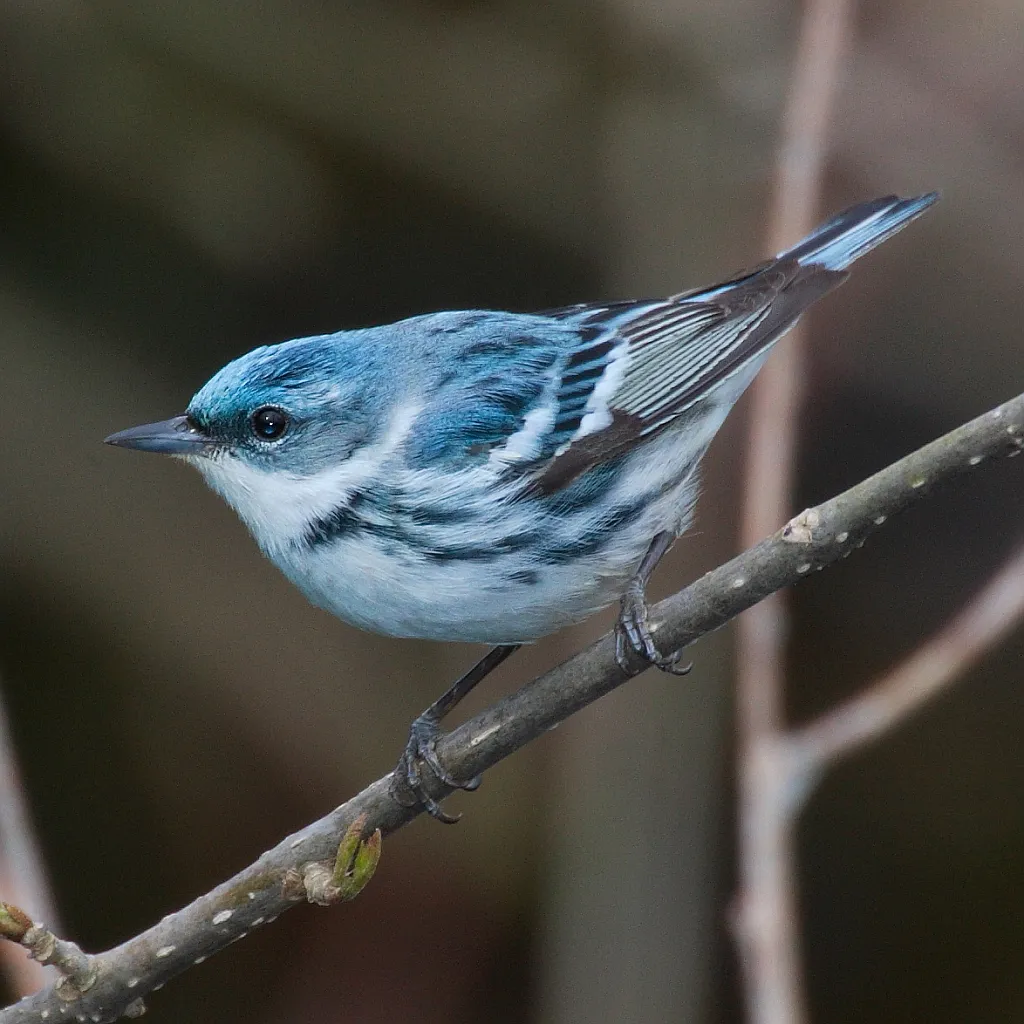
The cerulean warbler (Setophaga cerulea) is a small songbird in the family Parulidae. It is a long-distance migrant, breeding in eastern North American hardwood forests and wintering on the Eastern slope of the Andes in South America during non-breeding season, preferring subtropical forests. It displays strong sexual dichromatism: Adult males have cerulean blue and white upperparts, with a black necklace across the breast and black streaks on the back and flanks. Females and immature birds have bluish-green upperparts, a pale stripe over the eye, no streaking, and are yellow below. All have two white wing bars and a thin, pointed bill. The cerulean warbler is insectivorous and predominantly feeds on insect larvae, though it also comsumes winged insects. It forages for prey and nests high in forest canopies. Individuals are strongly territorial; males will defend areas of forests. Males arrive on breeding grounds about one to two weeks earlier than females. Breeding and incubation take place from late May to early June. The species is rated as near threatened on the International Union for Conservation of Nature (IUCN)'s Red List of endangered species, indicating it is under risk of becoming vulnerable in the near future. The population of the cerulean warbler has been under rapid decline, though in recent years this decline has slowed. Deforestation in its non-breeding range continues to reduce its available habitat.
Description
The cerulean warbler is one of the smallest Setophaga wood-warblers, about 11 cm (4.3 in) long, weighing 8–10 g (0.28–0.35 oz), and having a wingspan of 20 cm (7.9 in). Males are slightly larger than females, and older males tend to also be larger. Wing chord measures 62–66 mm (2.4–2.6 in), while the tail is 40.6–42.7 mm (1.60–1.68 in) long. The culmen, or upper edge of the beak, measures 9.5–9.8 mm (0.37–0.39 in) long, 3.5 mm (0.14 in) wide and 3.5 mm (0.14 in) height. The cerulean warbler is strongly sexually dichromatic. Adult males are a deep, cerulean blue over the entire back, and are white below. There are prominent dark streaks across the flanks. A "necklace" or breast band, a line of color across the neck, varies from blue to near black. Older individuals have stronger colors across the entire body, including brighter whites, darker streaking, and wider breast bands. Adult females are yellow underneath, while the back and crown have a blue-green tint. Females also possess a distinct pale supercilium, or eye stripe, just above the eye. Immature individuals are generally similar to adult females, though the back may be more yellowish. All fledged individuals, regardless of their age or sex, have two prominent white wing-bars and white spots on the tail. The beak and legs of the cerulean warbler vary in color depending on an individual's age and sex. Adult males have a black beak, with the lower half a slightly lighter dark gray. Adult females have dark gray beaks that may become dark brown on the lower half.
Text from Wikipedia — Cerulean warbler, revision 1321164282, CC BY-SA 4.0, retrieved 2026-09-04. Encyclopedic text reused under CC BY-SA 4.0. Sentences about hunting or regulation are removed: on this site, the rule comes from Québec.ca.
Other names
French
Former scientific names
Presence in Quebec
- Origin
- Indigène
- Occurrence
- Régulier
- Population status
- Reproducteur
- Certainty
- Confirmé
Conservation
Québec.ca
Official periods
Source: Québec.ca — tables reproduced as published (retrieved 2026-08-30).
Regulations change. Always check Québec.ca before hunting or trapping.
Where this data comes from
This species is listed in an official government dataset. The identification and status shown in the data sheet are reproduced from it.
Source: List of Quebec’s vertebrate wildlife (LFVQ) — Ministère de l’Environnement, de la Lutte contre les changements climatiques, de la Faune et des Parcs. File LFVQ_25_03_2026.csv, retrieved 2026-08-30 · CC BY 4.0.
Measurements, habitat, diet and reproduction are not shown: no official source is attached to them yet.