
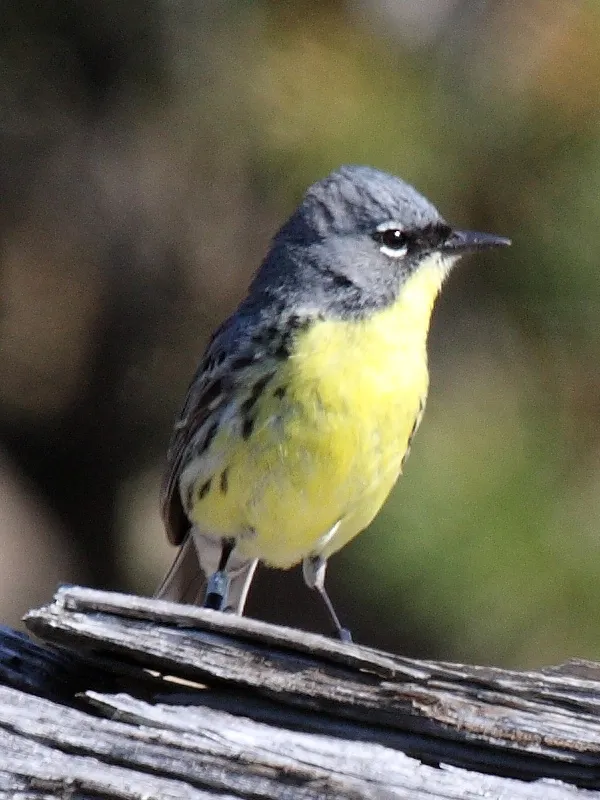
Paruline de Kirtland— Quebec wildlife
Setophaga kirtlandii
ParulidaeNo period published by Québec.ca
Québec.ca publishes no hunting or trapping period for this species. Check the official regulations.
Wikipedia
Paruline de Kirtland
Kirtland's warbler (Setophaga kirtlandii), also known in Michigan by the common name jack pine bird, or the jack pine warbler, is a small songbird of the New World warbler family (Parulidae). Nearly extinct just years ago, populations have recovered due to the conservation efforts of the Kirtland's Warbler Conservation Team and its members. The birds require large areas, greater than 160 acres (65 hectares), of dense young jack pine for breeding habitat. This habitat was historically created by wildfire, but today is created through the harvest of mature jack pine (Pinus banksiana), and planting of jack pine seedlings. The population of the species spends the spring and summer in its breeding range in the Great Lakes region of Canada (Ontario) and the United States (Wisconsin and Michigan, especially in the northeastern Lower Peninsula), and winters in the West Indies.
Description
Male Kirtland's warblers have bluish-grey upper body parts, with dark streaks on the back, yellow bellies, and dark streaks on the flanks and sides. It has black lores (cheeks) and a distinctive, large and conspicuous broken white eye ring, which it only shares with Setophaga coronata. Females and juveniles are similar, but are browner on the wings and back and are not as boldly or brightly marked. It frequently bobs its tail up and down, which is uncommon in northern warblers. At 14–15 cm (5.5–5.9 in) and 12.3–16 g (0.43–0.56 oz), it is the largest of the numerous warblers formerly classified in the genus Dendroica and is now the largest of the 35 or so species in the currently-accepted Setophaga genus. The Kirtland warbler has a wingspan of 22 cm (8.7 in). Its mating song is a loud chip-chip-chip-too-too-weet-weet often sung from the top of a snag (dead tree) or northern pin oak (Quercus ellipsoidalis) clump. This song can be heard over 400m away in good conditions. In its overwintering grounds it does not sing but makes loud "chip" noises from low in dense bushes. The eggs are a "delicate" pinkish white when fresh, fading to a dull white after a time. There are a few scattered sprinkles in various shades of brown and pink, these sprinkles and blotches concentrated at the top or form a sort of wreath at the larger end. The egg is not very glossy. It is 18 by 14mm in size. The shell is very thin.
Habitat and range
It was originally only known from Kirtland's home state of Ohio. In the mid 20th century the breeding range of Kirtland's warbler was reduced to a very limited area in the north of the Lower Peninsula of Michigan. In recent years, breeding pairs have been found in the Upper Peninsula of Michigan, Wisconsin, and southern Ontario due to the expanding population. The birds winter in Cuba, The Bahamas and the nearby Turks and Caicos Islands, where they are found on all islands investigated. A number also overwinter on Hispaniola, in the Dominican Republic. Overwintering birds have been collected and sighted a number of times in Florida.
Text from Wikipedia — Kirtland's warbler, revision 1363079969, CC BY-SA 4.0, retrieved 2026-09-04. Encyclopedic text reused under CC BY-SA 4.0. Sentences about hunting or regulation are removed: on this site, the rule comes from Québec.ca.
Other names
French
Former scientific names
Presence in Quebec
- Origin
- Indigène
- Occurrence
- Accidentel/non régulier
- Population status
- Migrateur
- Certainty
- Confirmé
Conservation
Québec.ca
Official periods
Source: Québec.ca — tables reproduced as published (retrieved 2026-08-30).
Regulations change. Always check Québec.ca before hunting or trapping.
Where this data comes from
This species is listed in an official government dataset. The identification and status shown in the data sheet are reproduced from it.
Source: List of Quebec’s vertebrate wildlife (LFVQ) — Ministère de l’Environnement, de la Lutte contre les changements climatiques, de la Faune et des Parcs. File LFVQ_25_03_2026.csv, retrieved 2026-08-30 · CC BY 4.0.
Measurements, habitat, diet and reproduction are not shown: no official source is attached to them yet.