
No period published by Québec.ca
Québec.ca publishes no hunting or trapping period for this species. Check the official regulations.
Wikipedia
Paruline des prés
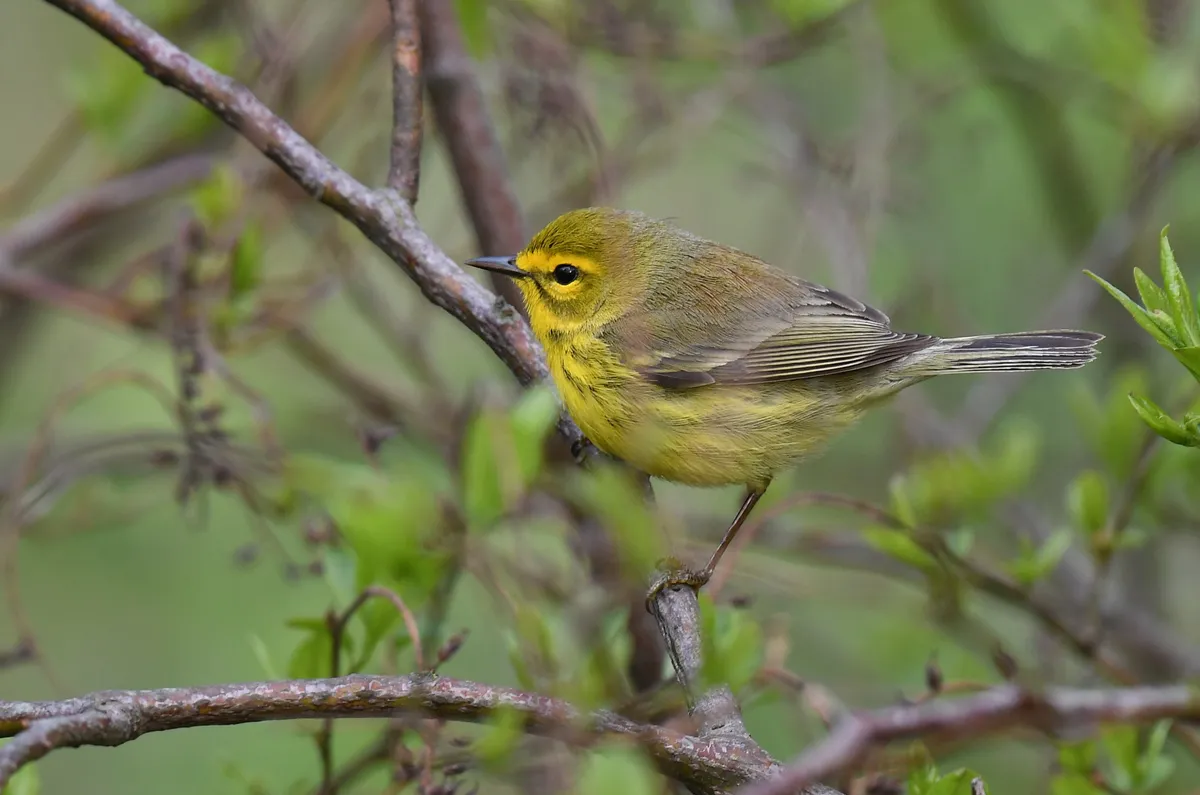
The prairie warbler (Setophaga discolor) is a small songbird of the New World warbler family.
Description
These birds have yellow underparts with dark streaks on the flanks. In males, the back is olive green with chestnut or rufuos streaks. A black stripe runs through the eye, and another black stripe runs from the beak down the throat. This semicircular stripe gives them a distinctive "tired" look. They have two faint wing bars. Their tails have large white areas, and they have dark legs. Coloring is duller in females and immature birds, and streaks are fainter or absent. The subspecies S. d. paludicola is also duller overall.
Habitat and range
The full breeding range of the subspecies S. d. discolor includes much of the eastern United States, with the highest population density in the southeast. Isolated populations have been observed as far west as Kansas, Iowa, and Michigan. Their reach extends as far north as Ontario and New Brunswick in Canada. The winter range of S. d. discolor includes the southern portion of Florida, the Bahamas, the Greater Antilles, and the eastern coast of Mexico and further along the coast of Central America as far south as Honduras. The subspecies S. d. paludicola inhabits the coasts of Florida year-round.
Text from Wikipedia — Prairie warbler, revision 1361540645, CC BY-SA 4.0, retrieved 2026-09-04. Encyclopedic text reused under CC BY-SA 4.0. Sentences about hunting or regulation are removed: on this site, the rule comes from Québec.ca.
Other names
French
English
Former scientific names
Presence in Quebec
- Origin
- Indigène
- Occurrence
- Accidentel/non régulier
- Population status
- Migrateur
- Certainty
- Confirmé
Conservation
Québec.ca
Official periods
Source: Québec.ca — tables reproduced as published (retrieved 2026-08-30).
Regulations change. Always check Québec.ca before hunting or trapping.
Where this data comes from
This species is listed in an official government dataset. The identification and status shown in the data sheet are reproduced from it.
Source: List of Quebec’s vertebrate wildlife (LFVQ) — Ministère de l’Environnement, de la Lutte contre les changements climatiques, de la Faune et des Parcs. File LFVQ_25_03_2026.csv, retrieved 2026-08-30 · CC BY 4.0.
Measurements, habitat, diet and reproduction are not shown: no official source is attached to them yet.