
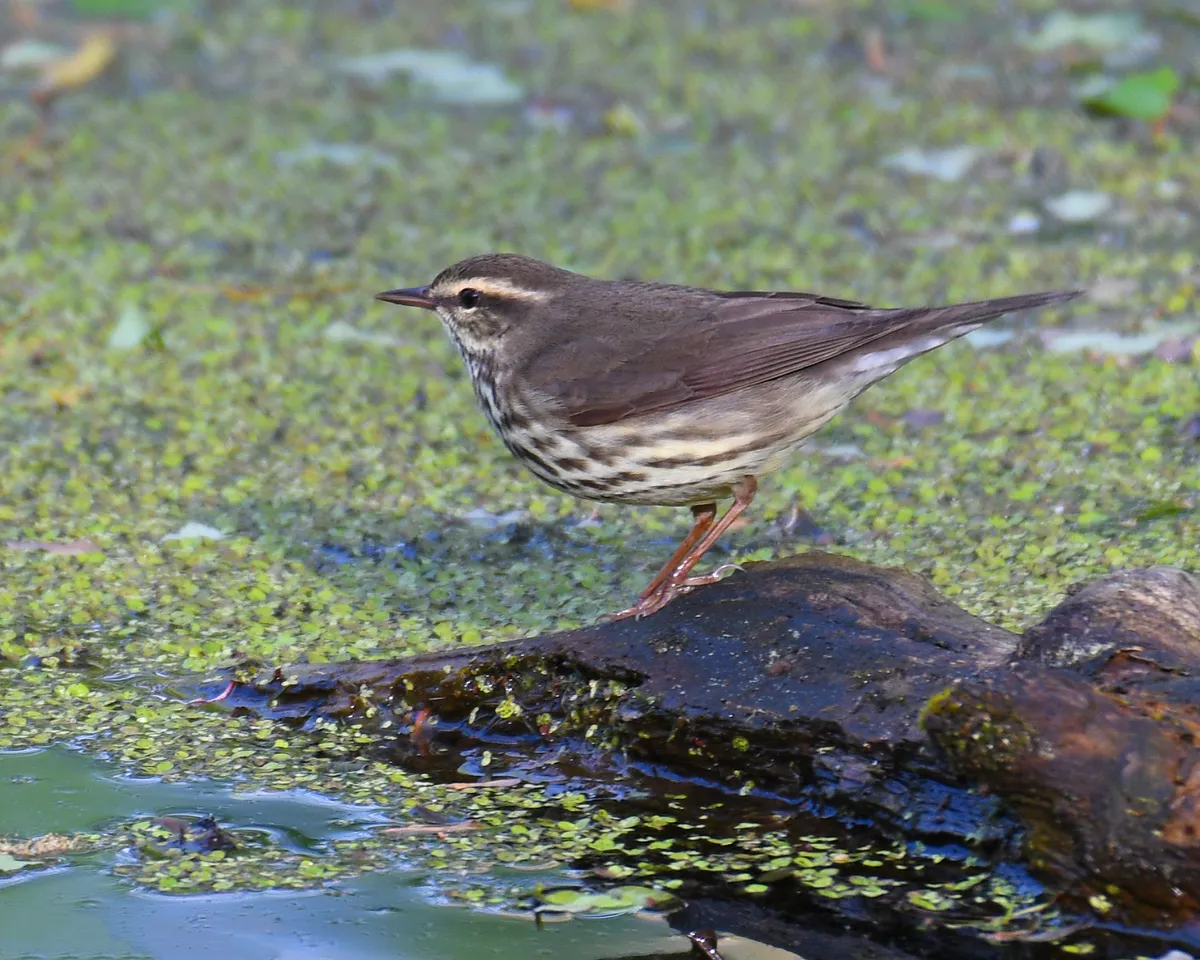
Paruline des ruisseaux— Quebec wildlife
Parkesia noveboracensis
ParulidaeNo period published by Québec.ca
Québec.ca publishes no hunting or trapping period for this species. Check the official regulations.
Wikipedia
Paruline des ruisseaux
The northern waterthrush (Parkesia noveboracensis) is a species of ground-feeding migratory New World warbler of the genus Parkesia. It breeds in the northern part of North America, in Alaska, Canada, and the northern United States; it winters in Florida, Central America, the West Indies, Venezuela, Colombia, and Ecuador. It is a rare vagrant to other South American countries and to western Europe. Its closest relative is the Louisiana waterthrush.
Description
The northern waterthrush is a large New World warbler (and not a thrush, despite the name). It has a length of 12–15 cm (4.7–5.9 in), wingspan of 21–24 cm (8.3–9.4 in) and weighs between 13 and 25 g (0.46 and 0.88 oz) Among standard measurements, the wing chord is 6.8 to 8.2 cm (2.7 to 3.2 in), the tail is 4.5 to 5.7 cm (1.8 to 2.2 in), the bill is 1.1 to 1.2 cm (0.43 to 0.47 in) and the tarsus is 1.9 to 2.3 cm (0.75 to 0.91 in). On the head, the crown is brown with a white supercilium. The bill is pointed and dark. The throat is lightly streaked brown to black with heavier streaking continuing onto the breast and flanks. The back is evenly brown. Sexes are morphologically similar. Young birds have buff, rather than white underparts. The song of loud, emphatic, clear chirping notes generally falling in pitch and accelerating; loosely paired or tripled, with little variation. Call a loud, hard spwik rising with a strong K sound. The flight call is a buzzy, high, slightly rising zzip. The species may be visually confused for the closely related Louisiana waterthrush (Parkesia motacilla), which has buff flanks, a buff undertail, and bright pink legs. The Louisiana waterthrush also has a whiter throat with fewer streaks. More subtle clues include smaller size and smaller bill, a narrower and darker eye-line, and different call note and habits. Both waterthrush species walk rather than hop, and seem to teeter, since they bob their rear ends as they move along.
Text from Wikipedia — Northern waterthrush, revision 1357683454, CC BY-SA 4.0, retrieved 2026-09-04. Encyclopedic text reused under CC BY-SA 4.0. Sentences about hunting or regulation are removed: on this site, the rule comes from Québec.ca.
Other names
French
English
Former scientific names
Presence in Quebec
- Origin
- Indigène
- Occurrence
- Régulier
- Population status
- Reproducteur
- Certainty
- Confirmé
Conservation
Québec.ca
Official periods
Source: Québec.ca — tables reproduced as published (retrieved 2026-08-30).
Regulations change. Always check Québec.ca before hunting or trapping.
Where this data comes from
This species is listed in an official government dataset. The identification and status shown in the data sheet are reproduced from it.
Source: List of Quebec’s vertebrate wildlife (LFVQ) — Ministère de l’Environnement, de la Lutte contre les changements climatiques, de la Faune et des Parcs. File LFVQ_25_03_2026.csv, retrieved 2026-08-30 · CC BY 4.0.
Measurements, habitat, diet and reproduction are not shown: no official source is attached to them yet.