
No period published by Québec.ca
Québec.ca publishes no hunting or trapping period for this species. Check the official regulations.
Wikipedia
Paruline flamboyante
The American redstart (Setophaga ruticilla) is a New World warbler. It is only distantly related to the Old World (common) redstart, with both belonging to the order Passeriformes.
Description
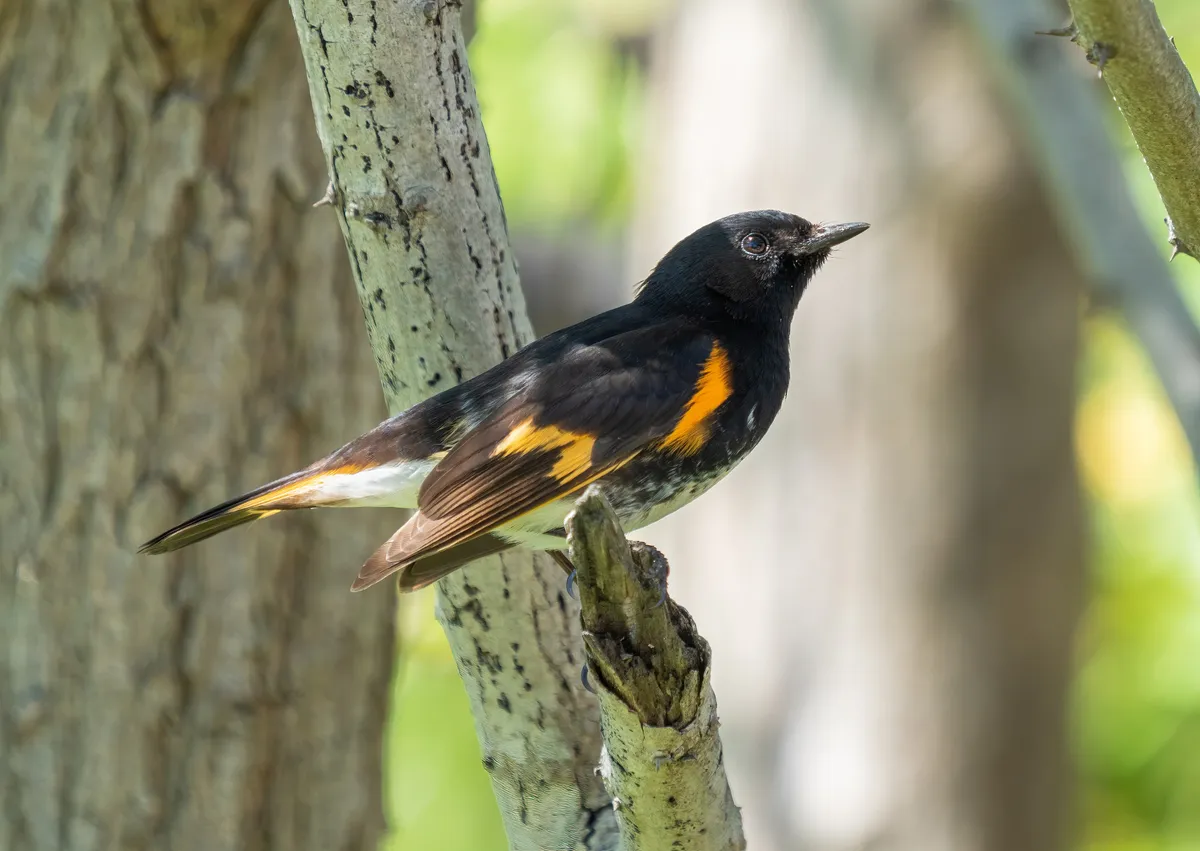
The American redstart is a smallish warbler. It measures 11 to 14 cm (4.3 to 5.5 in) in total length and has a wingspan of 16 to 23 cm (6.3 to 9.1 in). Its length is boosted by a relatively long tail and it is one of the lightest birds in its family. Weight is considerably less in winter than in summer. Males weigh an average of 8.6 g (0.30 oz) in summer but drop to 7.2 g (0.25 oz) in winter, while females drop even more from an average of 8.7 g (0.31 oz) to an average of 6.9 g (0.24 oz). Among standard measurements, the wing chord is 5.5 to 6.9 cm (2.2 to 2.7 in), the tail is 4.9 to 5.8 cm (1.9 to 2.3 in), the bill is 0.7 to 0.9 cm (0.28 to 0.35 in) and the tarsus is 1.5 to 1.9 cm (0.59 to 0.75 in). The breeding males are unmistakable, jet black above apart from large orange-red patches on their wings and tails. Their breast sides are also orange, with the rest of their underparts white. In their other plumages, American redstarts display green in their upperparts, along with black central tails and grey heads. The orange patches of the breeding males are replaced by yellow in the plumages of the females and young birds. Orange and yellow coloration is due to the presence of carotenoids; males possess the red carotenoid canthaxanthin and the yellow carotenoids canary xanthophyll A and B, all of which mix together to produce an orange color, while the females possess only the yellow carotenoids. Recent research indicates that an age and sex effect on observed color attributes of hue, brightness, and saturation exists in American redstarts, with the exception for saturation, which only showed an age effect. Their song is a series of musical see notes. Their call is a soft chip.
Text from Wikipedia — American redstart, revision 1357692116, CC BY-SA 4.0, retrieved 2026-09-04. Encyclopedic text reused under CC BY-SA 4.0. Sentences about hunting or regulation are removed: on this site, the rule comes from Québec.ca.
Other names
French
English
Presence in Quebec
- Origin
- Indigène
- Occurrence
- Régulier
- Population status
- Reproducteur
- Certainty
- Confirmé
Conservation
Québec.ca
Official periods
Source: Québec.ca — tables reproduced as published (retrieved 2026-08-30).
Regulations change. Always check Québec.ca before hunting or trapping.
Where this data comes from
This species is listed in an official government dataset. The identification and status shown in the data sheet are reproduced from it.
Source: List of Quebec’s vertebrate wildlife (LFVQ) — Ministère de l’Environnement, de la Lutte contre les changements climatiques, de la Faune et des Parcs. File LFVQ_25_03_2026.csv, retrieved 2026-08-30 · CC BY 4.0.
Measurements, habitat, diet and reproduction are not shown: no official source is attached to them yet.