
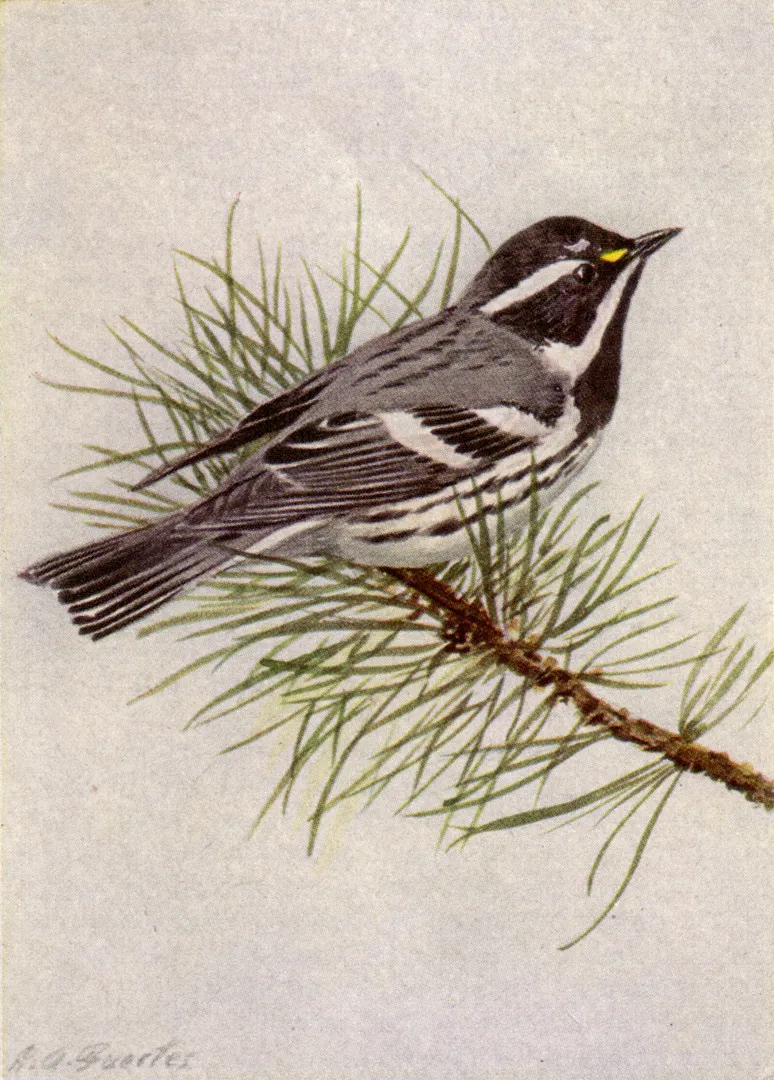
Paruline grise— Quebec wildlife
Setophaga nigrescens
ParulidaeNo period published by Québec.ca
Québec.ca publishes no hunting or trapping period for this species. Check the official regulations.
Wikipedia
Paruline grise
The black-throated gray warbler or black-throated grey warbler (Setophaga nigrescens) is a passerine bird of the New World warbler family Parulidae. It is 13 cm (5.1 in) long and has gray and white plumage with black markings. The male has the bold black throat of its name, and black stripes on its head, as well as black streaks on its flanks; the female is a paler version of the male, with a white throat and less distinct black markings on the flanks and wings. It breeds in western North America from British Columbia to New Mexico, and winters in Mexico and the southwestern United States. The habitats it prefers are coniferous and mixed forests and scrubland, especially those with pinyon pines, junipers, sagebrush, and oaks. Its nest is an open cup of plant fibers lined with feathers, built a few metres from the ground in the branches of a tree or shrub. Three to five eggs are laid, and young are fed by both parents. Common in its breeding range, it does not seem to be seriously threatened by human activities, unlike many migratory warblers.
Description
The black-throated gray warbler has mostly black, gray, and white plumage, which is soft, lacking gloss. With its striping and the small yellow spot between its eye and bill, it is a distinctive bird. The sexes differ slightly, both having gray upperparts with black streaks, and white underparts with black streaks on the flanks. The adult male is striped with black on the crown, throat, and below the eye, and has white around its chin and above its eye. The adult female has more dingy plumage on its head, with a white throat and dark gray cheeks. The most similar birds to the black-throated gray warbler are the black-and-white and blackpoll warblers, which although marked in black have entirely different plumage patterns. It is typically 13 cm (5.1 in) long, weighing 8.4 g (0.30 oz). Wing lengths are 5.6–6.9 cm (2.2–2.7 in), tail lengths 4.7–5.5 cm (1.9–2.2 in), bill lengths 8.4–9.6 mm (0.33–0.38 in), and tarsus lengths 1.66–1.88 cm (0.65–0.74 in), with females slightly smaller than males. Wingspan ranges from 7.5–7.8 in (19–19.7 cm). This bird gives a sharp tup or thick call, like that of Townsend's warbler but flat and unmusical, as well as a high see flight call. The male's song is a series of buzzy notes, with the earlier notes doubled and the next to last note high. This song has three variations, including a quiet "soft song" given by the males while following females gathering material for a nest.
Text from Wikipedia — Black-throated gray warbler, revision 1314291263, CC BY-SA 4.0, retrieved 2026-09-04. Encyclopedic text reused under CC BY-SA 4.0. Sentences about hunting or regulation are removed: on this site, the rule comes from Québec.ca.
Other names
French
Former scientific names
Presence in Quebec
- Origin
- Indigène
- Occurrence
- Accidentel/non régulier
- Population status
- Migrateur
- Certainty
- Confirmé
Conservation
Québec.ca
Official periods
Source: Québec.ca — tables reproduced as published (retrieved 2026-08-30).
Regulations change. Always check Québec.ca before hunting or trapping.
Where this data comes from
This species is listed in an official government dataset. The identification and status shown in the data sheet are reproduced from it.
Source: List of Quebec’s vertebrate wildlife (LFVQ) — Ministère de l’Environnement, de la Lutte contre les changements climatiques, de la Faune et des Parcs. File LFVQ_25_03_2026.csv, retrieved 2026-08-30 · CC BY 4.0.
Measurements, habitat, diet and reproduction are not shown: no official source is attached to them yet.