
Paruline hochequeue— Quebec wildlife
Parkesia motacilla
ParulidaeNo period published by Québec.ca
Québec.ca publishes no hunting or trapping period for this species. Check the official regulations.
Wikipedia
Paruline hochequeue
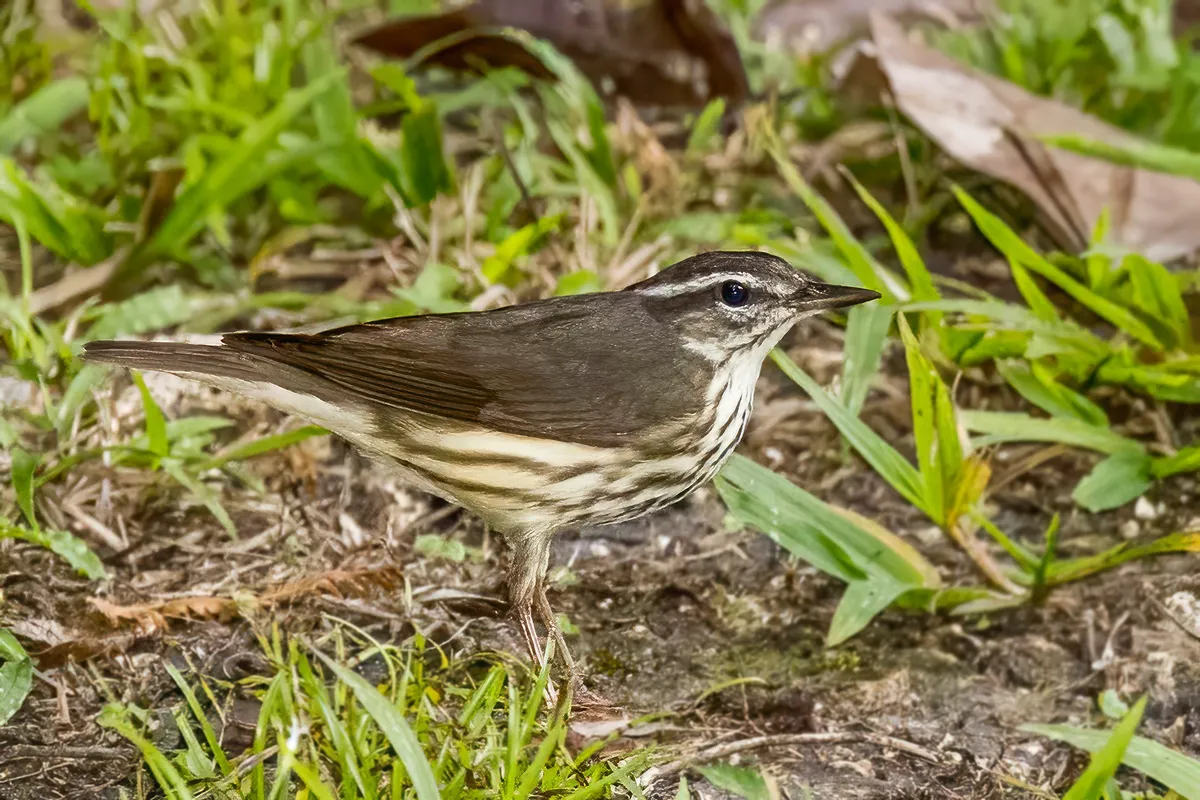
The Louisiana waterthrush (Parkesia motacilla) is a New World warbler, that breeds in eastern North America and winters in the West Indies and Central America. Plain brown above, it is white below, with black streaks and with buff flanks and undertail, distinguishing it from the closely related northern waterthrush. The habitats it prefers are streams and their surroundings, and other wet areas.
Description
The Louisiana waterthrush has a plain brown back and white underparts streaked with black. The flanks and undertail are buff. There is a strong white flared supercilium, and the legs are bright pink. All plumages are similar, but young birds have buff underparts rather than white. The main confusion species is the closely related northern waterthrush (Parkesia noveboracensis), which has white flanks and undertail, a striped throat, a slightly smaller bill, a shorter supercilium and duller pink legs. In a study of the two waterthrushes in Connecticut nesting grounds, the Louisiana waterthrush, at an average of 20.6 g (0.73 oz), was rather larger than the Northern, at an average of 16.2 g (0.57 oz). The Louisiana waterthrush is the largest species of wood warbler. It measures 14–17 cm (5.5–6.7 in) in length and spanning 21–25.4 cm (8.3–10.0 in) across the wings. The weight of adult birds can vary from 17.4 to 28 g (0.61 to 0.99 oz). Among standard measurements, the wing chord is 7.4 to 8.5 cm (2.9 to 3.3 in), the tail 4.4 to 5.4 cm (1.7 to 2.1 in), the bill is 1.2 to 1.5 cm (0.47 to 0.59 in) and the tarsus is 2 to 2.3 cm (0.79 to 0.91 in). The male's song is a musical, distinctive series of descending notes followed by a warble. The pitch of the beginning notes of the Louisiana's song usually descend, just as does the hilly stream that is its preferred habitat, whereas in the northern waterthrush the song does not vary in pitch as much. The call is a hard chink. Like the closely related northern waterthrush, the Louisiana waterthrush frequently bobs its tail.
Text from Wikipedia — Louisiana waterthrush, revision 1322226750, CC BY-SA 4.0, retrieved 2026-09-04. Encyclopedic text reused under CC BY-SA 4.0. Sentences about hunting or regulation are removed: on this site, the rule comes from Québec.ca.
Other names
French
Former scientific names
Presence in Quebec
- Origin
- Indigène
- Occurrence
- Régulier
- Population status
- Reproducteur
- Certainty
- Confirmé
Conservation
Québec.ca
Official periods
Source: Québec.ca — tables reproduced as published (retrieved 2026-08-30).
Regulations change. Always check Québec.ca before hunting or trapping.
Where this data comes from
This species is listed in an official government dataset. The identification and status shown in the data sheet are reproduced from it.
Source: List of Quebec’s vertebrate wildlife (LFVQ) — Ministère de l’Environnement, de la Lutte contre les changements climatiques, de la Faune et des Parcs. File LFVQ_25_03_2026.csv, retrieved 2026-08-30 · CC BY 4.0.
Measurements, habitat, diet and reproduction are not shown: no official source is attached to them yet.