
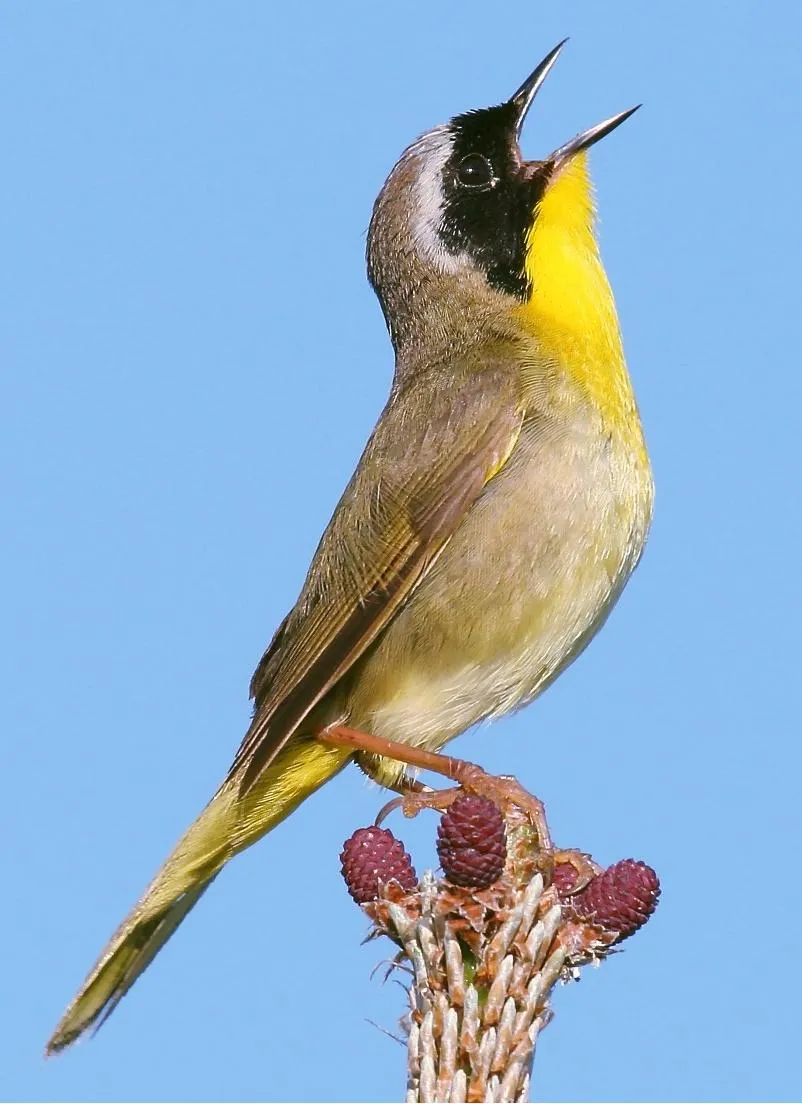
Paruline masquée— Quebec wildlife
Geothlypis trichas
ParulidaeNo period published by Québec.ca
Québec.ca publishes no hunting or trapping period for this species. Check the official regulations.
Wikipedia
Paruline masquée
The common yellowthroat (Geothlypis trichas) is a New World warbler. It is an abundant breeder in North America, ranging from southern Canada to central Mexico. In the northern parts of its range the birds are migratory, wintering in the southern parts of the breeding range, Central America and the West Indies. Southern forms are largely resident. Historically, it has also been known as the "yellow bandit", Maryland yellow-throat, and yellow-breasted warbler.
Description
Common yellowthroats are small songbirds that have olive backs, wings and tails, yellow throats and chests, and white bellies. Adult males have black face masks which stretch from the sides of the neck across the eyes and forehead, which are bordered above with white or gray. Females are similar in appearance, but have paler underparts and lack the black mask. Immature birds are similar in appearance to the adult female. First-year males have a faint black mask which darkens completely by spring. The subspecies mainly differ in the males' facial patterns and the brightness of the yellow underparts. The southwestern subspecies of this bird are the brightest and the yellowest below. The song is a loud twichety twichety twichety twich. Its call is a soft jip. Measurements: Length: 11–13 cm (4.3–5.1 in) Wingspan: 15–19 cm (5.9–7.5 in) Weight: 7.6–15.5 g (0.27–0.55 oz)
Text from Wikipedia — Common yellowthroat, revision 1353178253, CC BY-SA 4.0, retrieved 2026-09-04. Encyclopedic text reused under CC BY-SA 4.0. Sentences about hunting or regulation are removed: on this site, the rule comes from Québec.ca.
Other names
French
English
Presence in Quebec
- Origin
- Indigène
- Occurrence
- Régulier
- Population status
- Reproducteur
- Certainty
- Confirmé
Conservation
Québec.ca
Official periods
Source: Québec.ca — tables reproduced as published (retrieved 2026-08-30).
Regulations change. Always check Québec.ca before hunting or trapping.
Where this data comes from
This species is listed in an official government dataset. The identification and status shown in the data sheet are reproduced from it.
Source: List of Quebec’s vertebrate wildlife (LFVQ) — Ministère de l’Environnement, de la Lutte contre les changements climatiques, de la Faune et des Parcs. File LFVQ_25_03_2026.csv, retrieved 2026-08-30 · CC BY 4.0.
Measurements, habitat, diet and reproduction are not shown: no official source is attached to them yet.