
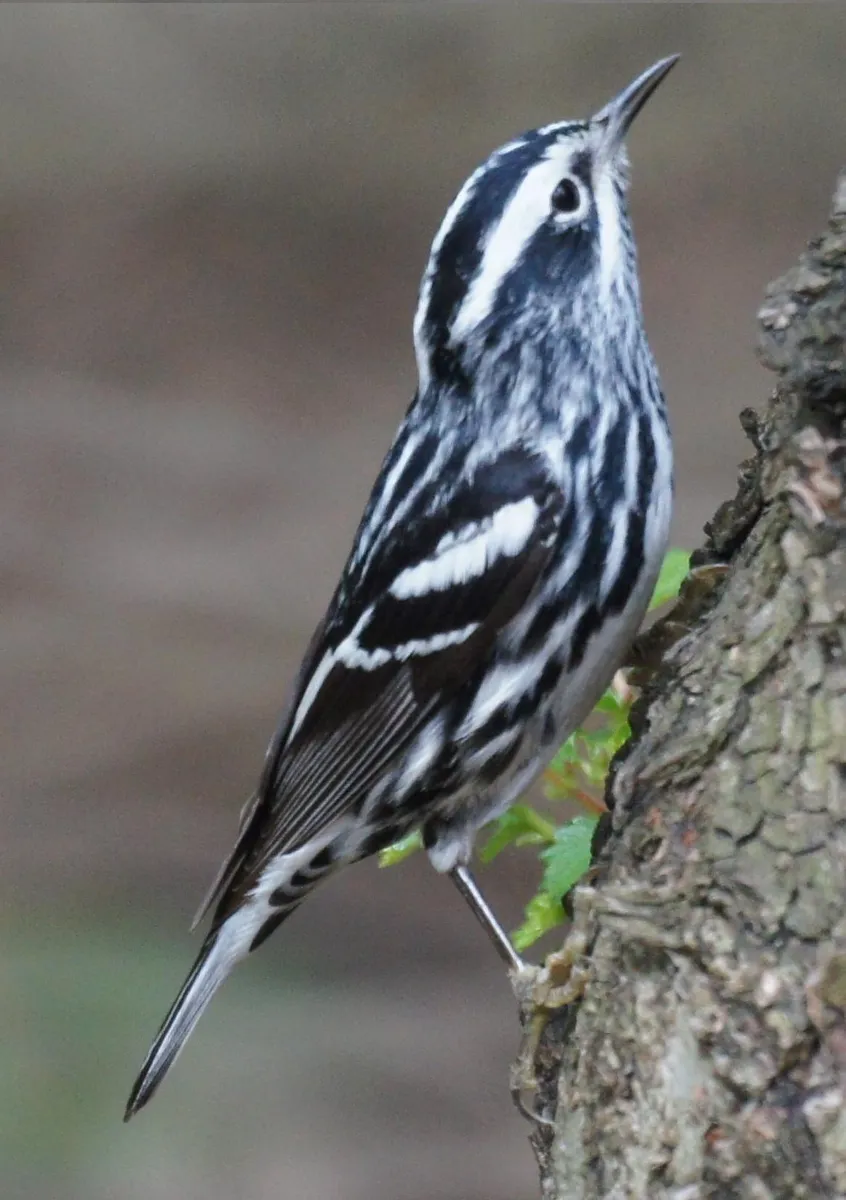
Paruline noir et blanc— Quebec wildlife
Mniotilta varia
ParulidaeNo period published by Québec.ca
Québec.ca publishes no hunting or trapping period for this species. Check the official regulations.
Wikipedia
Paruline noir et blanc
The black-and-white warbler (Mniotilta varia) is a species of New World warbler, and the only member of its genus, Mniotilta. It breeds in northern and eastern North America and winters in Florida, Central America, and the West Indies down to Peru. It has been recorded as a vagrant in Northern Europe, especially Britain and Ireland. Relative to other New World warblers, it is not well studied.
Description
The black-and-white warbler is 11 cm (4.3 in) to 13 cm (5.1 in) in length with a mass of 8 g (0.28 oz) to 15 g (0.53 oz) grams. Wingspan ranges from 7.1 to 8.7 in (18–22 cm). True to their name, black-and-white warblers are black and white in colour. Both sexes have black and white crowns with a white eyebrow, black streaking on a white belly, black wings with two white wing bars, a black tail, a black-and-white streaked back, streaky undertail coverts, and grey-black legs and feet. Breeding males have a black-and-white streaked throat and black cheek, while females have a grey cheek and a white-cream coloured throat and sides. First fall males are very similar to adult females in colour and patterning, while first fall females resemble adult females but with less streaking and a more noticeable buffy wash. Juveniles are heavily spotted, but are similar to first fall individuals otherwise. This species is 12 cm (5 in) long and weighs 11 g (0.39 oz). The summer male black-and-white warbler is boldly streaked in black and white, and the bird has been described as a flying humbug. Each wing is black with two white wing bars. Female and juvenile plumages are similar, but duller and less streaky than males. This warbler can be confused with the blackpoll warbler (Setophaga striata). The blackpoll warbler is also black and white in its summer plumage, but has a solid black cap. The black-and-white warbler can also be confused behaviourally with the pine warbler (Setophaga pinus) and yellow-throated warbler (Setophaga dominica).
Text from Wikipedia — Black-and-white warbler, revision 1355737345, CC BY-SA 4.0, retrieved 2026-09-04. Encyclopedic text reused under CC BY-SA 4.0. Sentences about hunting or regulation are removed: on this site, the rule comes from Québec.ca.
Other names
French
English
Presence in Quebec
- Origin
- Indigène
- Occurrence
- Régulier
- Population status
- Reproducteur
- Certainty
- Confirmé
Conservation
Québec.ca
Official periods
Source: Québec.ca — tables reproduced as published (retrieved 2026-08-30).
Regulations change. Always check Québec.ca before hunting or trapping.
Where this data comes from
This species is listed in an official government dataset. The identification and status shown in the data sheet are reproduced from it.
Source: List of Quebec’s vertebrate wildlife (LFVQ) — Ministère de l’Environnement, de la Lutte contre les changements climatiques, de la Faune et des Parcs. File LFVQ_25_03_2026.csv, retrieved 2026-08-30 · CC BY 4.0.
Measurements, habitat, diet and reproduction are not shown: no official source is attached to them yet.