
No period published by Québec.ca
Québec.ca publishes no hunting or trapping period for this species. Check the official regulations.
Wikipedia
Paruline obscure
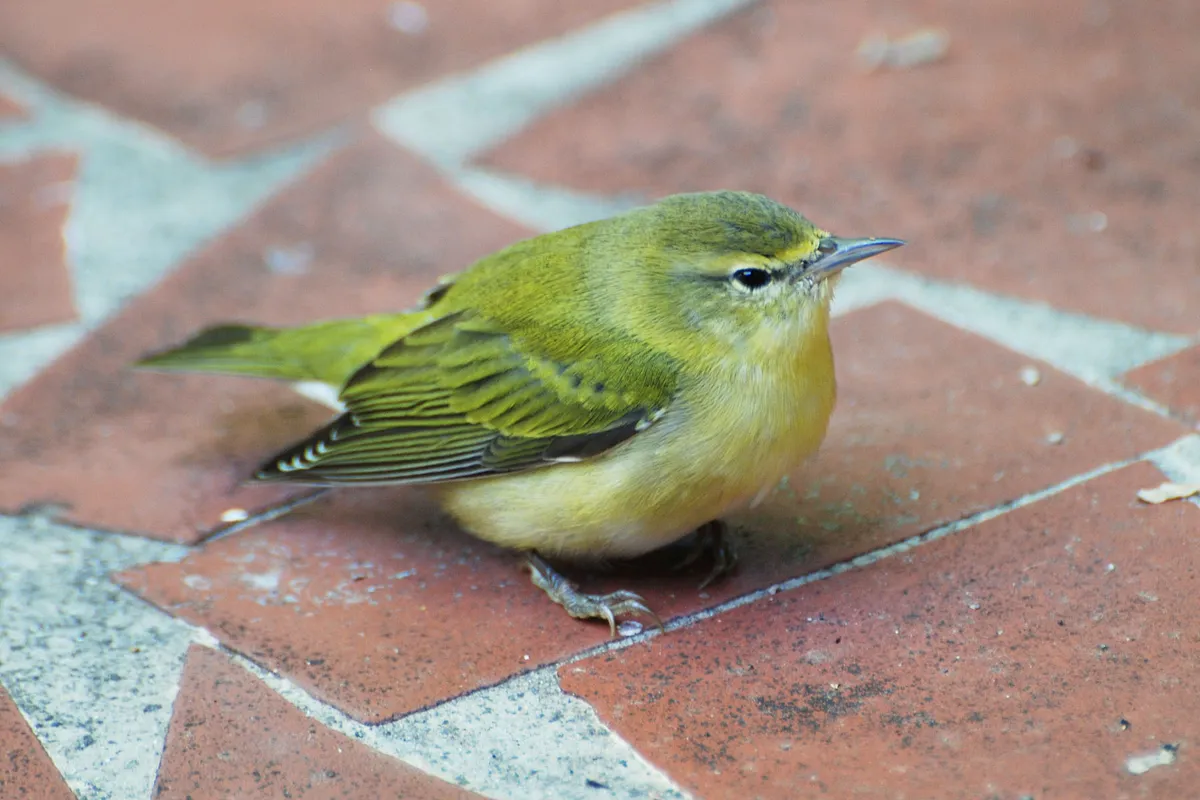
The Tennessee warbler (Leiothlypis peregrina) is a New World warbler that breeds in eastern North America and winters in southern Central America, the Caribbean, and northern South America. The specific name peregrina is from Latin peregrinus "wanderer".
Description
The Tennessee warbler is 11.5 cm (4.5 in) long, has a 19.69 cm (7.75 in) wingspan, and weighs roughly 10 g (0.35 oz). The breeding male has olive back, shoulders, rump and vent. The flight feathers are brownish-black. It has a slate gray neck, crown and eyeline. The underside is a gray-white. The female is similar to the male, but is much duller and is tinged with yellow and olive overall, especially on the underside. The Tennessee warbler has long wings, short tail and a thin, pointy bill. Juveniles and first-year birds are quite similar to the female. In winter and fall, adult male resembles juvenile and spring adult female but shows more yellow below: the grey neck and crown turn into an olive green while the underside takes a yellow hue. On the face the yellow supraocular line stands out. Both sexes have white undertail coverts all year long. Tennessee warblers resemble female black-throated blue warblers. The only difference is that the black-throated blue has a darker cheek and two white wing spots. This bird can be confused with the red-eyed vireo, which is larger, moves more deliberately and sings almost constantly. The orange-crowned warbler can also look similar, but lacks the white eyebrow, is greyer-brown above and has yellow undertail coverts.
Habitat and range
The Tennessee warbler breeds or is resident in the north-eastern and northern Mid-West of the United States and across much of Canada. It is migratory, wintering in southern Central America, the Caribbean, and northern Colombia and Venezuela, with a few stragglers going as far south as Ecuador. It is a very rare vagrant to western Europe. The bird was named by Alexander Wilson, who discovered an individual by Tennessee's Cumberland River in 1832, although this location is outside of the species's usual range. It breeds from the Adirondack Mountains in New York through northern Vermont, New Hampshire, and Maine north and west throughout much of Canada. It is also found breeding in northeast Minnesota and northern Upper Peninsula of Michigan. This bird was named from a specimen collected in Tennessee, where it may appear during migration.
Text from Wikipedia — Tennessee warbler, revision 1342781971, CC BY-SA 4.0, retrieved 2026-09-04. Encyclopedic text reused under CC BY-SA 4.0. Sentences about hunting or regulation are removed: on this site, the rule comes from Québec.ca.
Other names
French
Former scientific names
Presence in Quebec
- Origin
- Indigène
- Occurrence
- Régulier
- Population status
- Reproducteur
- Certainty
- Confirmé
Conservation
Québec.ca
Official periods
Source: Québec.ca — tables reproduced as published (retrieved 2026-08-30).
Regulations change. Always check Québec.ca before hunting or trapping.
Where this data comes from
This species is listed in an official government dataset. The identification and status shown in the data sheet are reproduced from it.
Source: List of Quebec’s vertebrate wildlife (LFVQ) — Ministère de l’Environnement, de la Lutte contre les changements climatiques, de la Faune et des Parcs. File LFVQ_25_03_2026.csv, retrieved 2026-08-30 · CC BY 4.0.
Measurements, habitat, diet and reproduction are not shown: no official source is attached to them yet.