
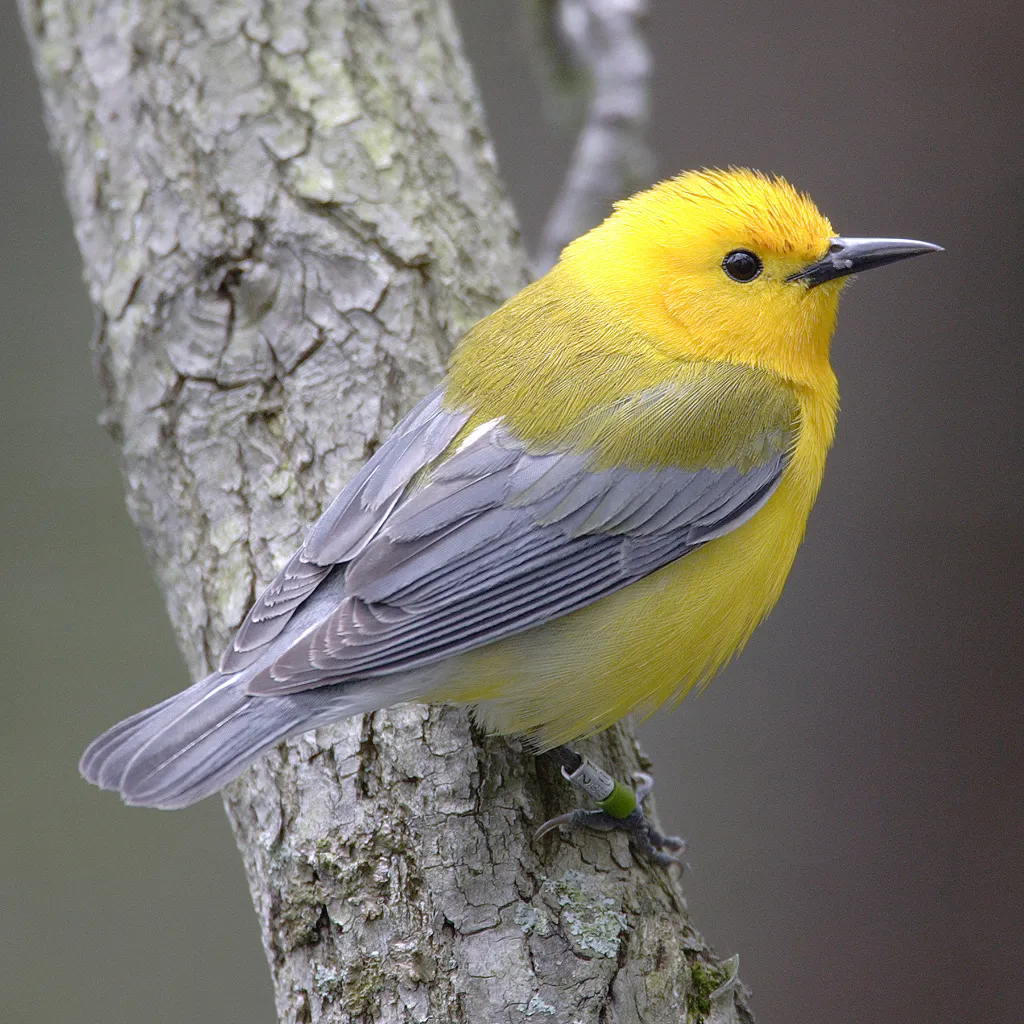
Paruline orangée— Quebec wildlife
Protonotaria citrea
ParulidaeNo period published by Québec.ca
Québec.ca publishes no hunting or trapping period for this species. Check the official regulations.
Wikipedia
Paruline orangée
The prothonotary warbler (Protonotaria citrea) is a small songbird of the New World warbler family. It is named for its plumage, which resembles the yellow robes once worn by papal clerks (named prothonotaries) in the Roman Catholic Church. The prothonotary warbler is the only member of the genus Protonotaria and the only eastern warbler that nests in natural or artificial cavities. These warblers often move with quick, jerky, movements and will even crawl upside down on sticks or trees. During the spring they are often seen in wetlands gathering nesting material, or food, for their mate.
Description
The prothonotary warbler is 13 cm (5.1 in) long, weighs a mean 14.3 g (0.50 oz), and has a wingspan of 22 cm (8.75 in). It has an olive-coloured back with blue-grey wings and tail, yellow underparts, a relatively long pointed bill, and black legs. The adult male has a bright orange-yellow head. Females and immature birds are duller and have a yellow head. In flight from below, the short, wide tail has a distinctive two-toned pattern, white at the base and dark at the tip.
Text from Wikipedia — Prothonotary warbler, revision 1372209529, CC BY-SA 4.0, retrieved 2026-09-04. Encyclopedic text reused under CC BY-SA 4.0. Sentences about hunting or regulation are removed: on this site, the rule comes from Québec.ca.
Other names
French
Presence in Quebec
- Origin
- Indigène
- Occurrence
- Accidentel/non régulier
- Population status
- Migrateur
- Certainty
- Confirmé
Conservation
Québec.ca
Official periods
Source: Québec.ca — tables reproduced as published (retrieved 2026-08-30).
Regulations change. Always check Québec.ca before hunting or trapping.
Where this data comes from
This species is listed in an official government dataset. The identification and status shown in the data sheet are reproduced from it.
Source: List of Quebec’s vertebrate wildlife (LFVQ) — Ministère de l’Environnement, de la Lutte contre les changements climatiques, de la Faune et des Parcs. File LFVQ_25_03_2026.csv, retrieved 2026-08-30 · CC BY 4.0.
Measurements, habitat, diet and reproduction are not shown: no official source is attached to them yet.