
No period published by Québec.ca
Québec.ca publishes no hunting or trapping period for this species. Check the official regulations.
Wikipedia
Paruline rayée
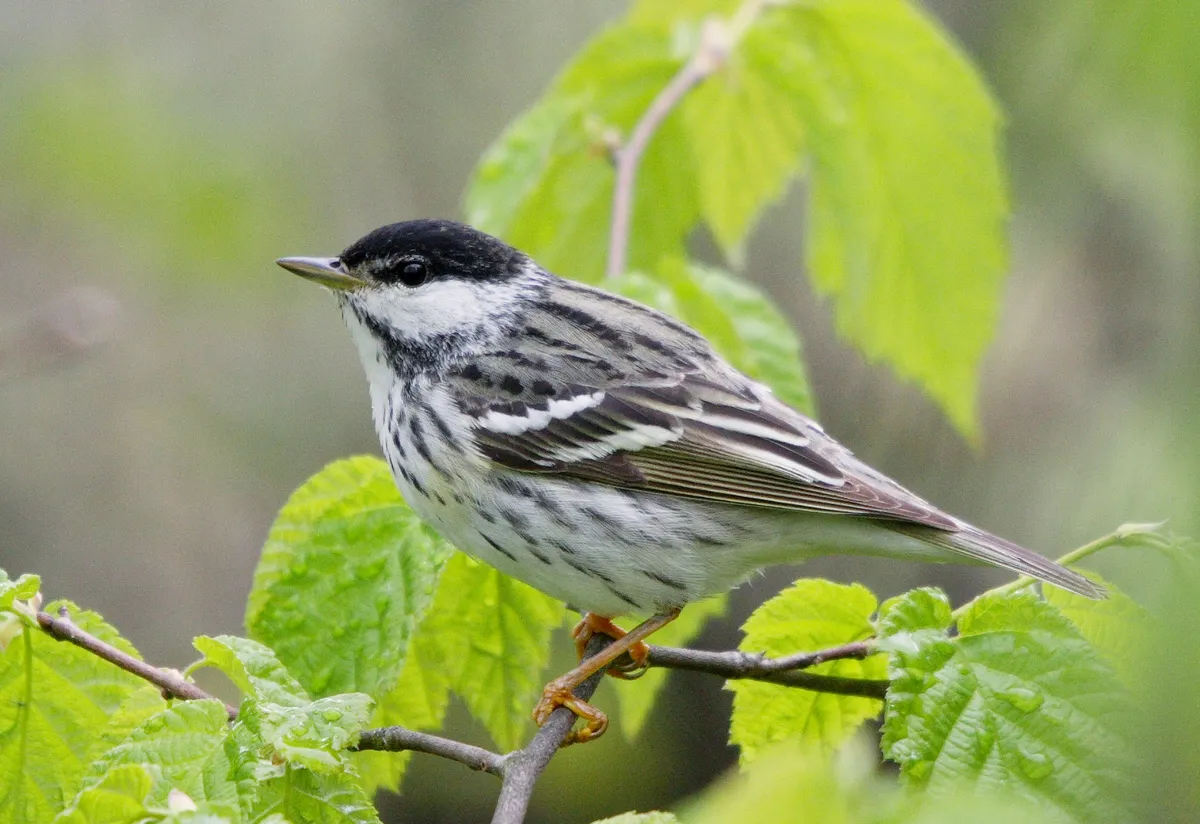
The blackpoll warbler (Setophaga striata) is a New World warbler. Breeding males are mostly black and white. They have a prominent black cap, white cheeks, and white wing bars. The blackpoll breeds in forests of northern North America, from Alaska throughout most of Canada, to the Adirondack Mountains of New York as well as New England in the Northeastern United States. They are a common migrant throughout much of North America. In fall, they fly south to the Greater Antilles and the northeastern coasts of South America in a non-stop long-distance migration over open water, averaging 2,500 km (1,600 mi), one of the longest-distance non-stop overwater flights ever recorded for a migratory songbird. Rare vagrants to western Europe, they are one of the more frequent transatlantic passerine wanderers.
Description
The blackpoll warbler is a fairly small bird which attains the weight of a ballpoint pen. However, it is one of the larger of the diverse genus Setophaga (formerly Dendroica). In the species, body length can vary from 12.5 to 15 cm (4.9 to 5.9 in) and wingspan can range from 20 to 25 cm (7.9 to 9.8 in). Body mass can vary from 9.7 to 21 g (0.34 to 0.74 oz), with an average bird anywhere between 12 and 15 g (0.42 and 0.53 oz). Among standard measurements, the wing chord is 6.6 to 8 cm (2.6 to 3.1 in), the tail is 4.5 to 5.4 cm (1.8 to 2.1 in), the bill is 0.8 to 1.2 cm (0.31 to 0.47 in) and the tarsus is 1.8 to 2 cm (0.71 to 0.79 in). The summer male blackpoll warblers have dark-streaked brown backs, white faces, and black crowns. Their underparts are white with black streaks, and they display two white wing bars. The adult females essentially resemble washed-out versions of the summer males, and in particular, the females lack the strong head patterns, and their crowns and faces are shades of gray. Another outstanding physical characteristic of the species is the bright orangish-pink legs. Non-breeding birds of this species have greenish heads, dark-streaked greenish upperparts, and yellowish breasts, with the yellow extending to the belly in young birds. Their wing bars are always present. The plumage of the blackpoll warbler is substantionally similar in appareance to the bay-breasted warbler during fall migration, resulting in the two birds sometimes being collectively called "baypoll warblers".
Text from Wikipedia — Blackpoll warbler, revision 1359478396, CC BY-SA 4.0, retrieved 2026-09-04. Encyclopedic text reused under CC BY-SA 4.0. Sentences about hunting or regulation are removed: on this site, the rule comes from Québec.ca.
Other names
French
English
Former scientific names
Presence in Quebec
- Origin
- Indigène
- Occurrence
- Régulier
- Population status
- Reproducteur
- Certainty
- Confirmé
Conservation
Québec.ca
Official periods
Source: Québec.ca — tables reproduced as published (retrieved 2026-08-30).
Regulations change. Always check Québec.ca before hunting or trapping.
Where this data comes from
This species is listed in an official government dataset. The identification and status shown in the data sheet are reproduced from it.
Source: List of Quebec’s vertebrate wildlife (LFVQ) — Ministère de l’Environnement, de la Lutte contre les changements climatiques, de la Faune et des Parcs. File LFVQ_25_03_2026.csv, retrieved 2026-08-30 · CC BY 4.0.
Measurements, habitat, diet and reproduction are not shown: no official source is attached to them yet.