
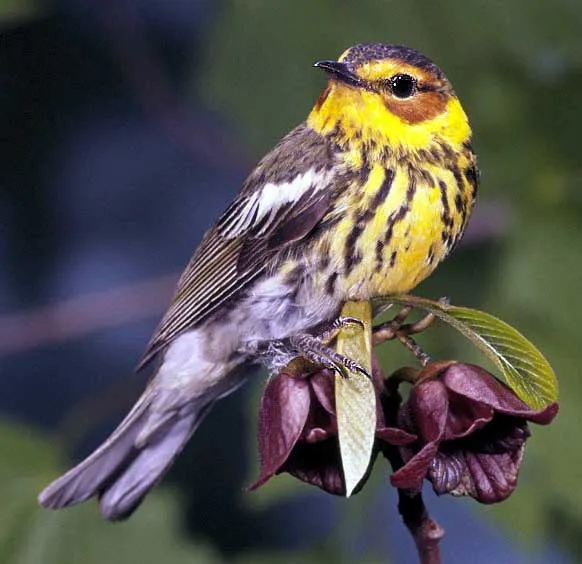
Paruline tigrée— Quebec wildlife
Setophaga tigrina
ParulidaeNo period published by Québec.ca
Québec.ca publishes no hunting or trapping period for this species. Check the official regulations.
Wikipedia
Paruline tigrée
The Cape May warbler (Setophaga tigrina) is a species of New World warbler. It breeds in northern North America. Its breeding range spans all but the westernmost parts of southern Canada, the Great Lakes region, and New England. It is migratory, wintering in the West Indies. This species is a very rare vagrant to western Europe, with two records in Britain as of October 2013. The English name refers to Cape May, New Jersey, where George Ord collected the specimen that was later described by Alexander Wilson.
Description
This bird is a small passerine and is a mid-sized New World warbler. Length can vary from 12–14 cm (4.7–5.5 in), wingspan is 19–22 cm (7.5–8.7 in), and body mass can range from 9–17.3 g (0.32–0.61 oz). Among standard measurements, the wing chord is 6.1–7.3 cm (2.4–2.9 in), the tail is 4.3–5 cm (1.7–2.0 in), the bill is 0.9–1.2 cm (0.35–0.47 in) and the tarsus is 1.7–1.9 cm (0.67–0.75 in). The adult male Cape May warbler has a brown back, yellowish rump and dark brown crown. The underparts are yellow streaked with black, giving rise to the bird's scientific name. The throat and nape are bright yellow and the face has a striking chestnut patch framed in yellow with a black eyestripe. There is a narrow white wing bar. Plumages of the female and immature male resemble washed-out versions of the adult male, lacking the strong head pattern. The yellowish rump, and at least indications of the white wing bar, are always present.
Text from Wikipedia — Cape May warbler, revision 1321180062, CC BY-SA 4.0, retrieved 2026-09-04. Encyclopedic text reused under CC BY-SA 4.0. Sentences about hunting or regulation are removed: on this site, the rule comes from Québec.ca.
Other names
French
Former scientific names
Presence in Quebec
- Origin
- Indigène
- Occurrence
- Régulier
- Population status
- Reproducteur
- Certainty
- Confirmé
Conservation
Québec.ca
Official periods
Source: Québec.ca — tables reproduced as published (retrieved 2026-08-30).
Regulations change. Always check Québec.ca before hunting or trapping.
Where this data comes from
This species is listed in an official government dataset. The identification and status shown in the data sheet are reproduced from it.
Source: List of Quebec’s vertebrate wildlife (LFVQ) — Ministère de l’Environnement, de la Lutte contre les changements climatiques, de la Faune et des Parcs. File LFVQ_25_03_2026.csv, retrieved 2026-08-30 · CC BY 4.0.
Measurements, habitat, diet and reproduction are not shown: no official source is attached to them yet.