
No period published by Québec.ca
Québec.ca publishes no hunting or trapping period for this species. Check the official regulations.
Wikipedia
Paruline triste
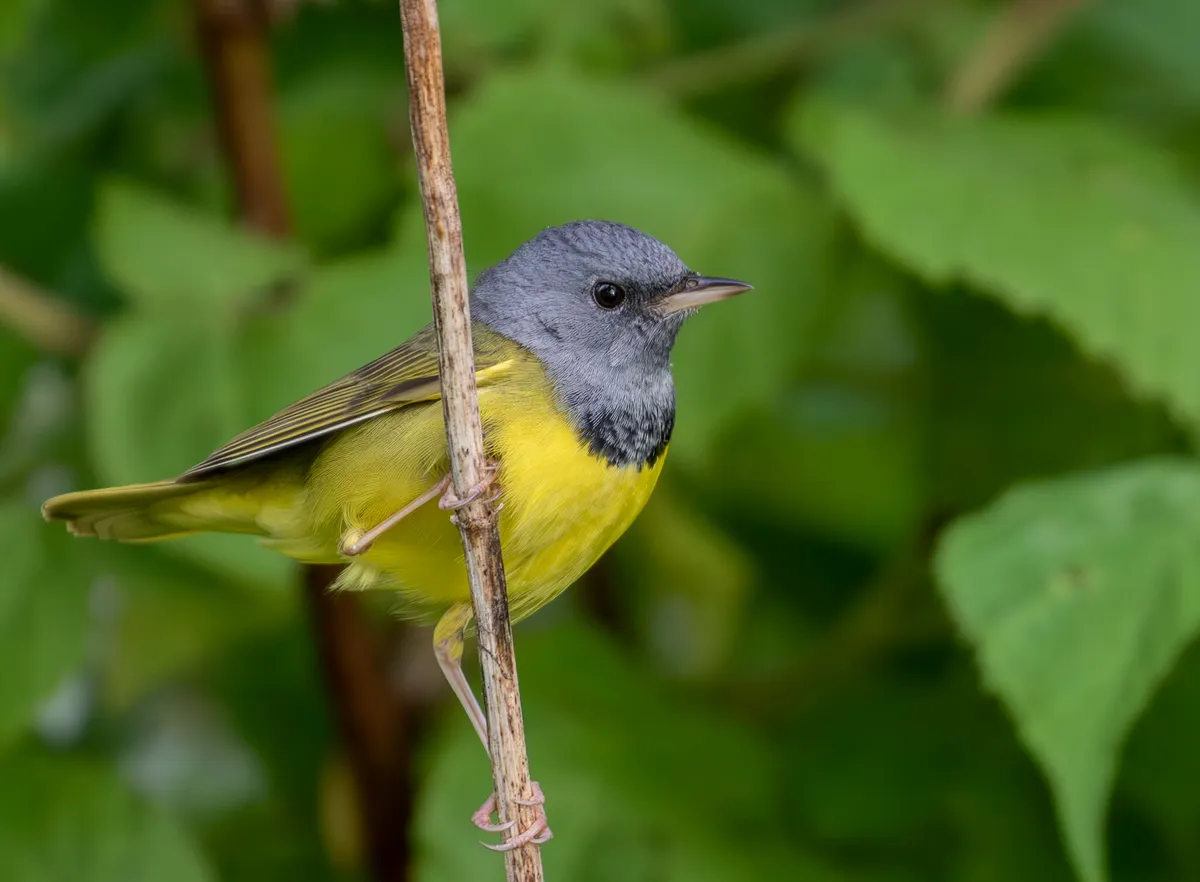
The mourning warbler (Geothlypis philadelphia) is a small songbird of the New World warbler family. Mourning warblers are neotropical migrants native to eastern and central North America and wintering in Central and South America. They tend to be found in dense second growth forests. They are very similar to the MacGillivray's warbler in appearance, especially in females and immature birds, but their breeding range does not overlap into the west. The "mourning" in this bird's name refers to the male's hood, thought to resemble a mourning veil.
Description
Mourning warblers are small songbird with yellow underparts, olive-green upperparts, a thin pointed bill and pink legs. Adult males have a gray hood, black lores and a black patch on the throat and breast. In the fall, this pattern becomes less bright and harder to distinguish from similar species; however they never have a broken eye ring. Females and immatures are gray-brown on the head with an incomplete eye-ring. They have a yellow-gray throat with a brown or olive tint to their breast. Both sexes can range from 10 to 15 cm (3.9–5.9 in) in length and 11–13 g (0.4–0.5 oz) in weight. Their wingspan is 18 cm (7.1 in). Other than the MacGillivray's Warbler, similar species include the Connecticut warblers which have a complete eye ring, not to be confused with a broken eye ring seen on immature mourning warblers. Immature Connecticut warblers also have a whiter chest compared to the yellow chest on immature mourning warblers. Nashville warblers are also commonly confused; however they have a yellow throat unlike the black or grey throats of mourning warblers, females have a grey back, and they are smaller and less active than mourning warblers.
Text from Wikipedia — Mourning warbler, revision 1348888155, CC BY-SA 4.0, retrieved 2026-09-04. Encyclopedic text reused under CC BY-SA 4.0. Sentences about hunting or regulation are removed: on this site, the rule comes from Québec.ca.
Other names
French
Former scientific names
Presence in Quebec
- Origin
- Indigène
- Occurrence
- Régulier
- Population status
- Reproducteur
- Certainty
- Confirmé
Conservation
Québec.ca
Official periods
Source: Québec.ca — tables reproduced as published (retrieved 2026-08-30).
Regulations change. Always check Québec.ca before hunting or trapping.
Where this data comes from
This species is listed in an official government dataset. The identification and status shown in the data sheet are reproduced from it.
Source: List of Quebec’s vertebrate wildlife (LFVQ) — Ministère de l’Environnement, de la Lutte contre les changements climatiques, de la Faune et des Parcs. File LFVQ_25_03_2026.csv, retrieved 2026-08-30 · CC BY 4.0.
Measurements, habitat, diet and reproduction are not shown: no official source is attached to them yet.