
Paruline vermivore— Quebec wildlife
Helmitheros vermivorum
ParulidaeNo period published by Québec.ca
Québec.ca publishes no hunting or trapping period for this species. Check the official regulations.
Wikipedia
Paruline vermivore
The worm-eating warbler (Helmitheros vermivorum) is a small New World warbler that breeds in the Eastern United States and migrates to southern Mexico, the Caribbean, and Central America for the winter. It is the only species in the genus Helmitheros.
Description
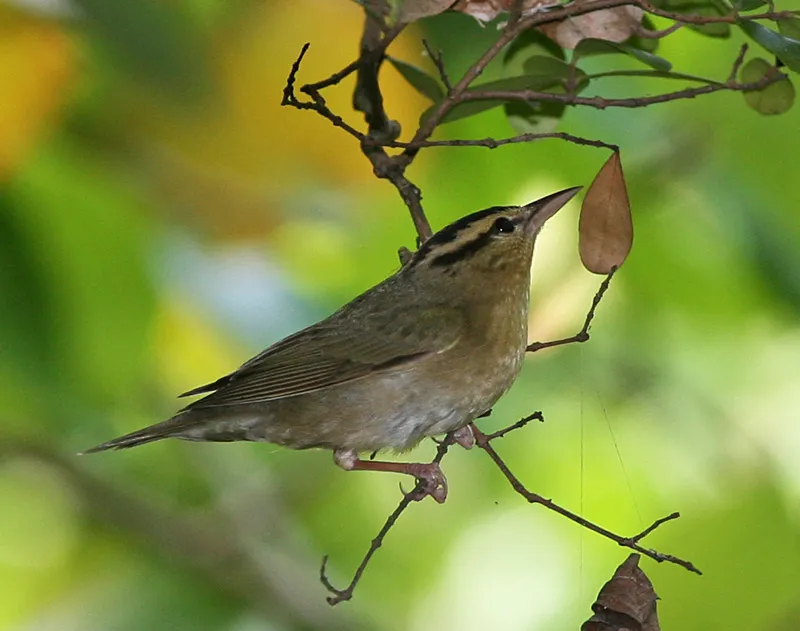
The worm-eating warbler is a small New World warbler. It is around 13 cm (5.1 in) in length and weighs 11.8–17.4 g (0.42–0.61 oz). It is relatively plain with olive-brown upperparts and light-coloured underparts, but has black and light brown stripes on its head. It has a slim pointed bill and pink legs. In immature birds, the head stripes are brownish. The male's song is a short high-pitched trill. This bird's call is a chip or tseet. Worm-eating warblers are sexually monomorphic. Males and females can only reliably be sexed during the breeding season by the presence of a brood patch in females or a cloacal protuberance in males. These birds are also difficult to age. Hatch year/second year birds have rusty tips on tertials that wear off by March of the following year. Juveniles can be distinguished by duskier head markings, and cinnamon wingbars.
Text from Wikipedia — Worm-eating warbler, revision 1361296289, CC BY-SA 4.0, retrieved 2026-09-04. Encyclopedic text reused under CC BY-SA 4.0. Sentences about hunting or regulation are removed: on this site, the rule comes from Québec.ca.
Other names
French
English
Former scientific names
Presence in Quebec
- Origin
- Indigène
- Occurrence
- Accidentel/non régulier
- Population status
- Migrateur
- Certainty
- Confirmé
Conservation
Québec.ca
Official periods
Source: Québec.ca — tables reproduced as published (retrieved 2026-08-30).
Regulations change. Always check Québec.ca before hunting or trapping.
Where this data comes from
This species is listed in an official government dataset. The identification and status shown in the data sheet are reproduced from it.
Source: List of Quebec’s vertebrate wildlife (LFVQ) — Ministère de l’Environnement, de la Lutte contre les changements climatiques, de la Faune et des Parcs. File LFVQ_25_03_2026.csv, retrieved 2026-08-30 · CC BY 4.0.
Measurements, habitat, diet and reproduction are not shown: no official source is attached to them yet.