
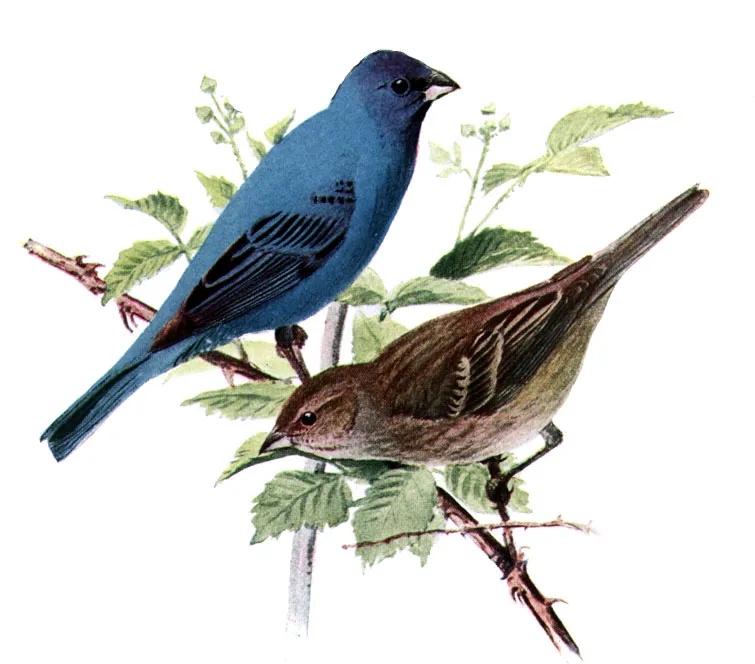
Passerin indigo— Quebec wildlife
Passerina cyanea
CardinalidaeNo period published by Québec.ca
Québec.ca publishes no hunting or trapping period for this species. Check the official regulations.
Wikipedia
Passerin indigo
The indigo bunting (Passerina cyanea) is a small seed-eating bird in the cardinal family, Cardinalidae. It is migratory, ranging from southern Canada to northern Florida during the breeding season, and from southern Florida to northern South America during the winter. It often migrates by night, using the stars to navigate. Its habitat is farmland, brush areas, and open woodland. The indigo bunting is closely related to the lazuli bunting and interbreeds with the species where their ranges overlap. The indigo bunting is a small bird, measuring 11.5–13 cm (4.5–5.1 in) in length. It displays sexual dimorphism in its coloration; the male is vibrant blue in the summer, with brightly colored plumage during the breeding season to attract a mate. It is brown during the winter months, while the female is brown year-round. Nest-building and incubation are done solely by the female. The diet of the indigo bunting consists primarily of insects during the summer months and seeds during the winter months.
Description
The indigo bunting is a smallish songbird, around the size of a small sparrow. It measures 11.5–15 cm (4.5–5.9 in) long, with a wingspan of 18–23 cm (7.1–9.1 in). Body mass averages 14.5 g (0.51 oz), with a reported range of 11.2–21.4 g (0.40–0.75 oz). During the breeding season, the adult male appears mostly a vibrant cerulean blue. Only the head is indigo. The wings and tail are black with cerulean blue edges. In fall and winter plumage, the male has brown edges to the blue body and head feathers, which overlap to make the bird appear mostly brown. The adult female is brown on the upperparts and lighter brown on the underparts. It has indistinct wing bars and is faintly streaked with darker markings underneath. The immature bird resembles the female in coloring, although a male may have hints of blue on the tail and shoulders and have darker streaks on the underside. The beak is short and conical. In the adult female, the beak is light brown tinged with blue, and in the adult male the upper half is brownish-black while the lower is light blue. The feet and legs are black or gray. First years and adult males are distinguishable through close observations of the skull and its degree of ossification. Juvenile skulls have a slightly pinkish color that gives under pressure due to its singular layer. Adults instead have a double layer skull, which gives more resistance when applying pressure. First year birds also tend to have a fleshy, yellow gape in the corner of the mouth, apparent in all months except October and November. When comparing males to females that both have brown molt, increased wing length and weight typically indicate a bunting is a male. As indicated by data collected from Charles H. Blake from his banding experiments in Hillsborough, NC, the Indigo Bunting has a weighted annual survival rate of 0.585. Using his own methods (Blake 1967, p.
Text from Wikipedia — Indigo bunting, revision 1354820315, CC BY-SA 4.0, retrieved 2026-09-04. Encyclopedic text reused under CC BY-SA 4.0. Sentences about hunting or regulation are removed: on this site, the rule comes from Québec.ca.
Other names
French
English
Presence in Quebec
- Origin
- Indigène
- Occurrence
- Régulier
- Population status
- Reproducteur
- Certainty
- Confirmé
Conservation
Québec.ca
Official periods
Source: Québec.ca — tables reproduced as published (retrieved 2026-08-30).
Regulations change. Always check Québec.ca before hunting or trapping.
Where this data comes from
This species is listed in an official government dataset. The identification and status shown in the data sheet are reproduced from it.
Source: List of Quebec’s vertebrate wildlife (LFVQ) — Ministère de l’Environnement, de la Lutte contre les changements climatiques, de la Faune et des Parcs. File LFVQ_25_03_2026.csv, retrieved 2026-08-30 · CC BY 4.0.
Measurements, habitat, diet and reproduction are not shown: no official source is attached to them yet.