
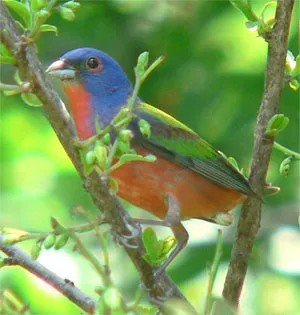
Passerin nonpareil— Quebec wildlife
Passerina ciris
CardinalidaeNo period published by Québec.ca
Québec.ca publishes no hunting or trapping period for this species. Check the official regulations.
Wikipedia
Passerin nonpareil
The painted bunting (Passerina ciris) is a species of bird in the cardinal family, Cardinalidae. It is native to North America. The bright plumage of the male develops beginning in the second year of life; in the first year, they can be distinguished from the female only by close inspection.
Description
The male painted bunting is often described as the most beautiful bird in North America and as such has been nicknamed nonpareil, or "without equal". Its colors, dark blue head, green back, red rump, and underparts, make it extremely easy to identify, but it can still be difficult to spot since it often skulks in foliage even when it is singing. The plumage of female and juvenile painted buntings is green and yellow-green, serving as camouflage. Once seen, the adult female is still distinctive, since it is a brighter, truer green than other similar songbirds. Adult painted buntings can measure 12–14 cm (4.7–5.5 in) in length, span 21–23 cm (8.3–9.1 in) across the wings and weigh 13–19 g (0.46–0.67 oz). The juveniles have two inserted molts in their first autumn, each yielding plumage like an adult female. The first starts a few days after fledging, replacing the juvenile plumage with an auxiliary formative plumage; and the second a month or so later giving the formative plumage. Painted bunting eggs are pale blue-white speckled or spotted with brown. Three to four eggs (or occasionally five) appear from March to July in cup-shaped nests usually built in brush or low trees, usually 3 to 6 feet from the ground but up to 12 feet.
Text from Wikipedia — Painted bunting, revision 1363277630, CC BY-SA 4.0, retrieved 2026-09-04. Encyclopedic text reused under CC BY-SA 4.0. Sentences about hunting or regulation are removed: on this site, the rule comes from Québec.ca.
Presence in Quebec
- Origin
- Indigène
- Occurrence
- Accidentel/non régulier
- Population status
- Migrateur
- Certainty
- Confirmé
Conservation
Québec.ca
Official periods
Source: Québec.ca — tables reproduced as published (retrieved 2026-08-30).
Regulations change. Always check Québec.ca before hunting or trapping.
Where this data comes from
This species is listed in an official government dataset. The identification and status shown in the data sheet are reproduced from it.
Source: List of Quebec’s vertebrate wildlife (LFVQ) — Ministère de l’Environnement, de la Lutte contre les changements climatiques, de la Faune et des Parcs. File LFVQ_25_03_2026.csv, retrieved 2026-08-30 · CC BY 4.0.
Measurements, habitat, diet and reproduction are not shown: no official source is attached to them yet.