
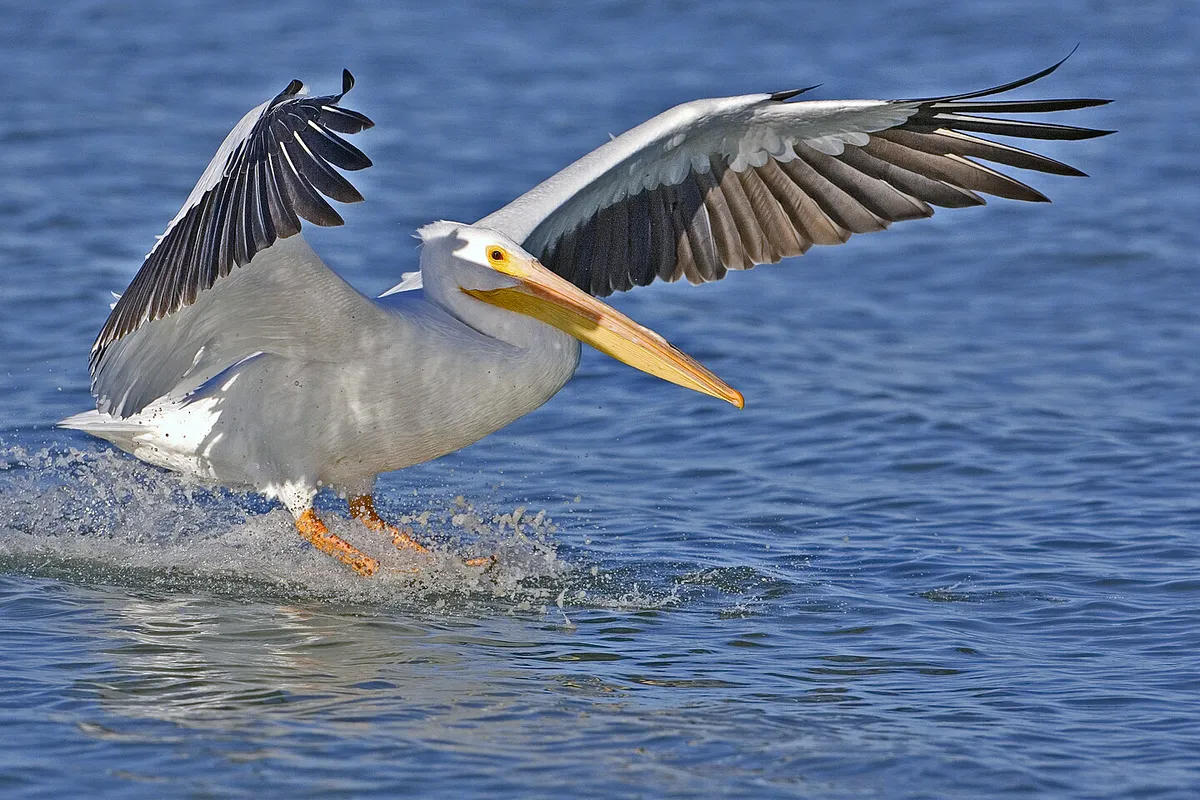
Pélican d'Amérique— Quebec wildlife
Pelecanus erythrorhynchos
PelecanidaeNo period published by Québec.ca
Québec.ca publishes no hunting or trapping period for this species. Check the official regulations.
Wikipedia
Pélican d'Amérique
The American white pelican (Pelecanus erythrorhynchos) is a large aquatic soaring bird from the order Pelecaniformes. It breeds in interior North America, moving south and to the coasts, as far as Costa Rica, in winter.
Description
The American white pelican rivals the trumpeter swan, with a similar overall length, as one of the longest birds native to North America. Both very large and plump, it has an overall length of about 50–70 in (130–180 cm), courtesy of the huge beak which measures 11.3–15.2 in (290–390 mm) in males and 10.3–14.2 in (260–360 mm) in females. It has a wingspan of about 95–120 in (240–300 cm). The species also has the second-largest average wingspan of any North American bird, after the California condor. This large wingspan allows the bird to use soaring flight for migration easily. Body weight can range between 7.7 and 30 lb (3.5 and 13.6 kg), although typically these birds average between 11 and 20 lb (5.0 and 9.1 kg). One mean body mass of 15.4 lb (7.0 kg) was reported. Another study found mean weights to be somewhat lower than expected, with eleven males averaging 13.97 lb (6.34 kg) and six females averaging 10.95 lb (4.97 kg). Among standard measurements, the wing chord measures 20–26.7 in (51–68 cm) and the tarsus measures 3.9–5.4 in (9.9–13.7 cm) long. The plumage is almost entirely bright white, except for the black primary and secondary remiges, which are hardly visible except in flight. From early spring until after breeding has finished in mid-late summer, the breast feathers have a yellowish hue. After molting into the eclipse plumage, the upper head often has a grey hue, as blackish feathers grow between the small wispy white crest. The bill is huge and flat on the top, with a large throat sac below, and, in the breeding season, is vivid orange in color, as is the bare skin around the eye and the feet. Iris coloration depends upon age and season, ranging from bright white to hazel to blue-gray. In the breeding season, both sexes grow a laterally flattened keratinous "horn" on the upper bill, located about one-third the bill's length behind the tip. This is the only one of the eight species of pelican to have a bill "horn". The horn is shed after the birds mate and lay their eggs. Outside the breeding season, the bare parts become duller in color, with the naked facial skin yellow and the bill, pouch, and feet a dull pink-orange. Apart from the difference in size, males and females look exactly alike. Immature birds have light grey plumage with a darker brownish nape and remiges. Their bare parts are dull grey. Chicks are naked at first, then grow white down feathers all over, before molting to the immature plumage.
Text from Wikipedia — American white pelican, revision 1360610123, CC BY-SA 4.0, retrieved 2026-09-04. Encyclopedic text reused under CC BY-SA 4.0. Sentences about hunting or regulation are removed: on this site, the rule comes from Québec.ca.
Other names
French
English
Presence in Quebec
- Origin
- Indigène
- Occurrence
- Régulier
- Population status
- Non reproducteur
- Certainty
- Confirmé
Conservation
Québec.ca
Official periods
Source: Québec.ca — tables reproduced as published (retrieved 2026-08-30).
Regulations change. Always check Québec.ca before hunting or trapping.
Where this data comes from
This species is listed in an official government dataset. The identification and status shown in the data sheet are reproduced from it.
Source: List of Quebec’s vertebrate wildlife (LFVQ) — Ministère de l’Environnement, de la Lutte contre les changements climatiques, de la Faune et des Parcs. File LFVQ_25_03_2026.csv, retrieved 2026-08-30 · CC BY 4.0.
Measurements, habitat, diet and reproduction are not shown: no official source is attached to them yet.