
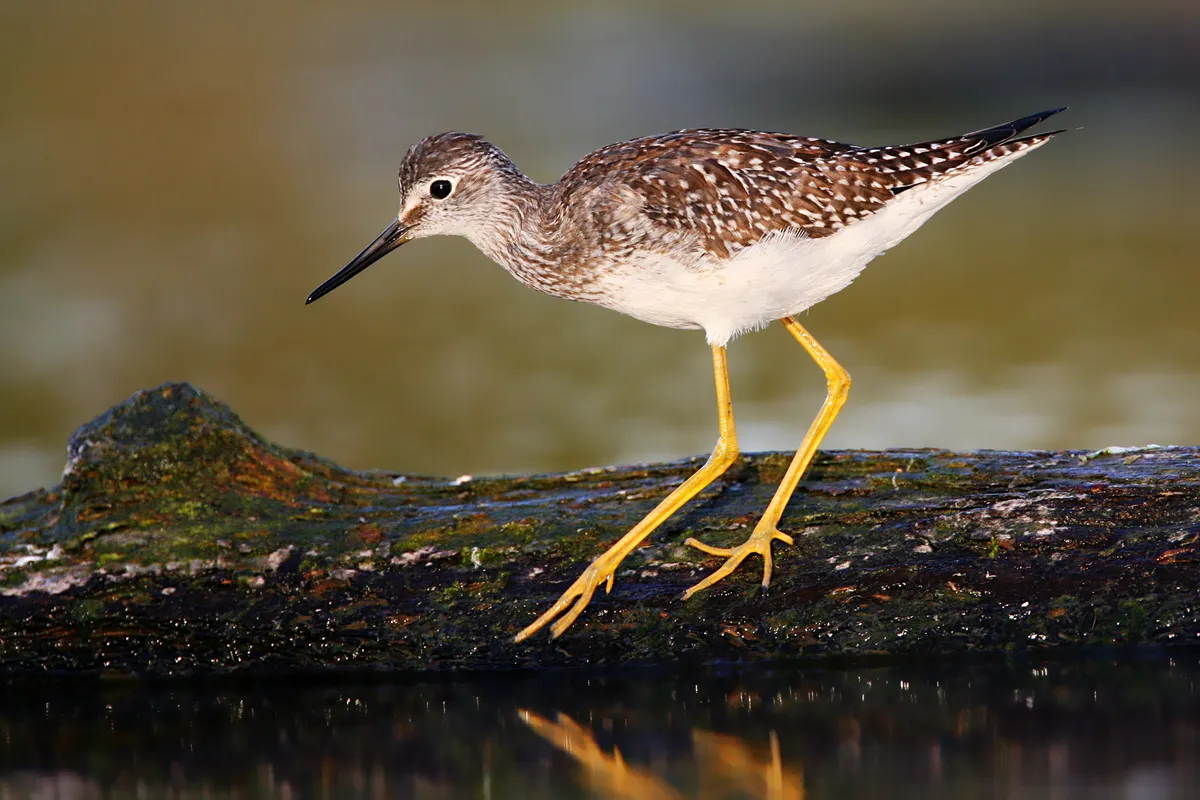
No period published by Québec.ca
Québec.ca publishes no hunting or trapping period for this species. Check the official regulations.
Wikipedia
Petit chevalier
The lesser yellowlegs (Tringa flavipes) is a medium-sized shorebird. It breeds in the boreal forest region of North America.
Description
The lesser yellowlegs is a medium-large shorebird, 23–25 cm (9.1–9.8 in) in overall length and with a wingspan of 59–64 cm (23–25 in) and a weight of 67–94 g (2.4–3.3 oz). The sexes are similar both in plumage and in overall size. In breeding plumage, the upperparts are mottled with gray-brown, black and white. The underparts are white with irregular brown streaking on the breast and neck. In non-breeding plumage, the upperparts are more uniform gray-brown. The legs are yellow. Compared to the greater yellowlegs, the bill is shorter (visually about the same length as the head), slim, straight, and uniformly dark. The breast is streaked and the flanks are finely marked with short bars. This species is similar in appearance to the larger greater yellowlegs, although it is more closely related to the much larger willet; the fine, clear, and dense pattern of the neck shown in breeding plumage indicates these species' actual relationships. The call of this bird is softer than that of the greater yellowlegs.
Text from Wikipedia — Lesser yellowlegs, revision 1372981665, CC BY-SA 4.0, retrieved 2026-09-04. Encyclopedic text reused under CC BY-SA 4.0. Sentences about hunting or regulation are removed: on this site, the rule comes from Québec.ca.
Other names
French
English
Presence in Quebec
- Origin
- Indigène
- Occurrence
- Régulier
- Population status
- Reproducteur
- Certainty
- Confirmé
Conservation
Québec.ca
Official periods
Source: Québec.ca — tables reproduced as published (retrieved 2026-08-30).
Regulations change. Always check Québec.ca before hunting or trapping.
Where this data comes from
This species is listed in an official government dataset. The identification and status shown in the data sheet are reproduced from it.
Source: List of Quebec’s vertebrate wildlife (LFVQ) — Ministère de l’Environnement, de la Lutte contre les changements climatiques, de la Faune et des Parcs. File LFVQ_25_03_2026.csv, retrieved 2026-08-30 · CC BY 4.0.
Measurements, habitat, diet and reproduction are not shown: no official source is attached to them yet.