
No period published by Québec.ca
Québec.ca publishes no hunting or trapping period for this species. Check the official regulations.
Wikipedia
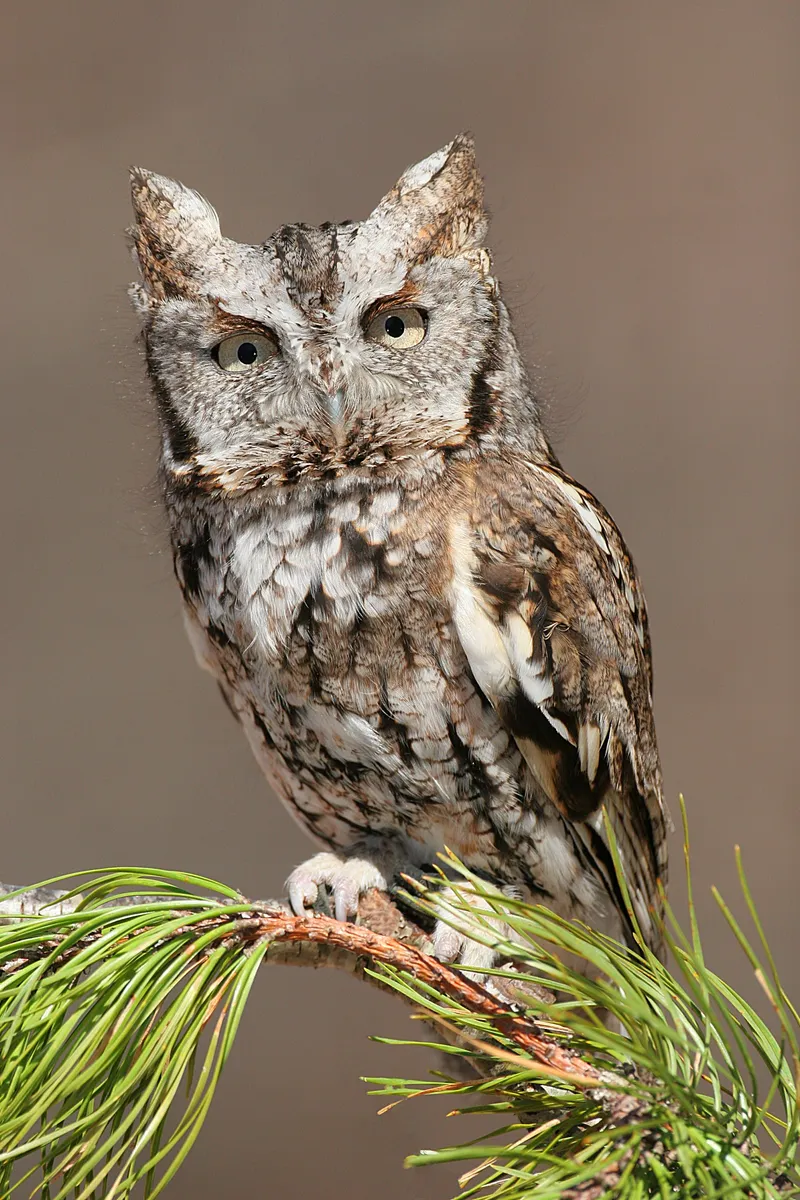
Petit-duc maculé
The eastern screech owl (Megascops asio) or eastern screech-owl is a stocky, short-tailed owl that is relatively common in Eastern North America, from Mexico to Canada. Mid-sized for a screech owl, the species resides in most types of woodland habitats across its range and is relatively adaptable to urban and developed areas compared to other owls. Although it often lives in close proximity to humans, the eastern screech owl frequently avoids detection due to its strictly nocturnal habits.
Description
Adults range from 16 to 25 cm (6+1⁄2 to 10 in) in length and weigh 121–244 g (4+1⁄4–8+5⁄8 oz). Among the differently sized races, length can average from 19.5 to 23.8 cm (7+11⁄16 to 9+3⁄8 in). The wingspan can range from 46 to 61 cm (18 to 24 in). In Ohio, male owls average 166 g (5+7⁄8 oz) and females 194 g (6+7⁄8 oz) while in central Texas, they average 157 g (5+1⁄2 oz) and 185 g (6+1⁄2 oz), respectively. They have either rusty or dark gray intricately patterned plumage with streaking on the underparts. Midsized by screech owl standards, these birds are stocky, short-tailed (tail averages from 6.6 to 8.6 cm (2+5⁄8 to 3+3⁄8 in) in length) and broad-winged (wing chord averages from 14.5 to 17 cm (5+3⁄4 to 6+3⁄4 in) in length) as is typical of the genus. They have a large, round head with prominent ear tufts, yellow eyes, and a yellowish beak, which measures on average 1.45 cm (9⁄16 in) in length. The feet are relatively large and powerful compared to more southern screech owls and are typically feathered down to the toes, although the southernmost populations only have remnant bristles rather than full feathering on the legs and feet. The eastern screech owl (and its western counterpart) are actually some of the heaviest screech owls; the largest tropical screech owls do not exceed them in average or maximal weight, but (due to the eastern screech owls' relatively short tails), they are surpassed in length by Balsas (M. seductus), long-tufted (M. sanctaecatarinae), white-throated (M. albogularis), and rufescent owls (M. ingens), in roughly increasing order. Two color variations are referred to as "red or rufous morphs" and "gray morphs" by bird watchers and ornithologists. Rusty birds are more common in the southern parts of the range; pairings of the two color variants do occur. While the gray morph provides remarkably effective camouflage against the bark of hardwood trees, red morphs may find security in certain pine trees and the colorful leaves of changing deciduous trees. The highest percentage of red morphs is known from Tennessee (79% of population) and Illinois (78% of population). A rarer "brown morph" is known, recorded exclusively in the south (i.e. Florida), which may be the occasional product of hybridation between the morphs. In Florida, brown morphs are typically reported in the more humid portions of the state, whereas they appear to be generally absent in the northern and northwestern parts of the state.
Text from Wikipedia — Eastern screech owl, revision 1366849113, CC BY-SA 4.0, retrieved 2026-09-04. Encyclopedic text reused under CC BY-SA 4.0. Sentences about hunting or regulation are removed: on this site, the rule comes from Québec.ca.
Other names
French
English
Former scientific names
Presence in Quebec
- Origin
- Indigène
- Occurrence
- Régulier
- Population status
- Toute l'année
- Certainty
- Confirmé
Conservation
Québec.ca
Official periods
Source: Québec.ca — tables reproduced as published (retrieved 2026-08-30).
Regulations change. Always check Québec.ca before hunting or trapping.
Where this data comes from
This species is listed in an official government dataset. The identification and status shown in the data sheet are reproduced from it.
Source: List of Quebec’s vertebrate wildlife (LFVQ) — Ministère de l’Environnement, de la Lutte contre les changements climatiques, de la Faune et des Parcs. File LFVQ_25_03_2026.csv, retrieved 2026-08-30 · CC BY 4.0.
Measurements, habitat, diet and reproduction are not shown: no official source is attached to them yet.