
No period published by Québec.ca
Québec.ca publishes no hunting or trapping period for this species. Check the official regulations.
Wikipedia
Petit fuligule
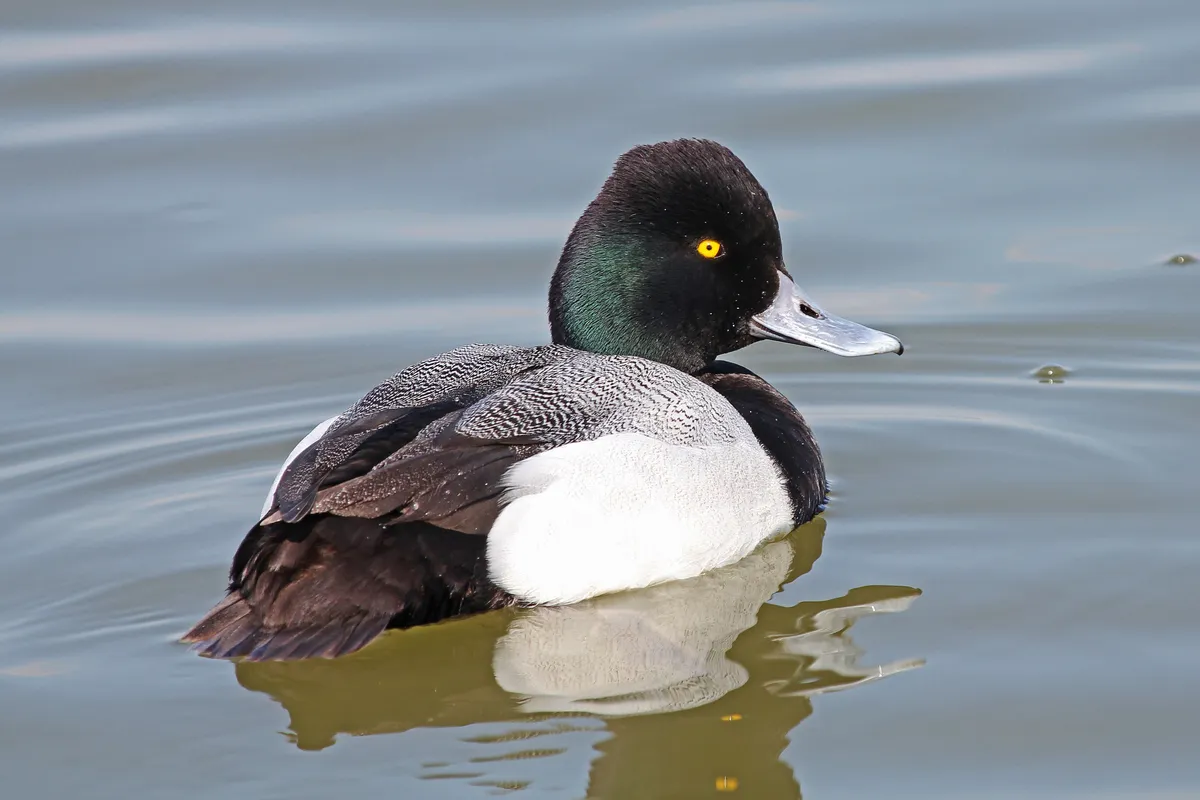
The lesser scaup (Aythya affinis) is a small North American diving duck that migrates south as far as Central America in winter. It is colloquially known as the little bluebill or broadbill because of its distinctive blue bill. The origin of the name scaup may stem from the bird's preference for feeding on scalp—the Scottish word for clams, oysters, and mussels; however, some credit it to the female's discordant scaup call as the name's source. It is apparently a very close relative of the Holarctic greater scaup or "bluebill" (A. marila), with which it forms a superspecies. The scientific name is derived from Ancient Greek and Latin, with aithuia being an Ancient Greek term for an unidentified seabird, used by Hesychius and Aristotle, among other authors, and affinis, Latin for "related to", from the lesser scaup's resemblance to the greater scaup.
Description
Adults are 38–48 cm (15–19 in) long, 41.7–43 cm (16.4–16.9 in) on average. The species can weigh 454–1,089 g (1.001–2.401 lb); males weigh 820 g (1.81 lb) on average while females weigh noticeably less, at 730 g (1.61 lb) on average. Wing lengths (not wingspans) are about 7.5–7.9 in (19–20 cm) in males and 7.3–7.8 in (19–20 cm) in females. The tarsus is about 1.4–1.5 in (3.6–3.8 cm) long, and the bill is 1.4–1.7 in (3.6–4.3 cm). The wingspan is 68–78 cm (27–31 in). The adult males (drakes) in definitive basic (breeding) plumage have a black, iridescent head and a small tuft at the hindcrown, a black breast, a whitish-grey back, wings with darker vermiculations and black outer and greyish-brown inner primary remiges. The underparts are white with some olive vermiculations on the flanks, and the rectrices and tail coverts are black. Adult females (hens) have a white band at the base of the bill and often a lighter ear region, and are otherwise dark brown all over, shading to white on the mid-belly. Drakes in eclipse plumage look similar, but with a very dark head and breast, little or no white on the head and usually some greyish vermiculations on the wings. Immature birds resemble the adult females, but are duller and have hardly any white at the bill base. Both sexes have white secondary remiges, a blue-grey bill with a smallblack "nail" at the tip and grey feet; the drakes have a bright yellow iris, while that of females is orange to yellow varying with age and that of immatures is brown. Downy hatchlings look much like those of related species, with dark brown upperparts and pale buff underparts, chin, supercilium and back spots. These birds are not very vocal, at least compared to dabbling ducks. Hens give the namesake discordant scaup, scaup call; in courtship drakes produce weak whistles. Hens vocalize more often than those of the greater scaup—particularly during flight—but their call is weaker, a guttural brrtt, brrtt.
Text from Wikipedia — Lesser scaup, revision 1356839610, CC BY-SA 4.0, retrieved 2026-09-04. Encyclopedic text reused under CC BY-SA 4.0. Sentences about hunting or regulation are removed: on this site, the rule comes from Québec.ca.
Other names
French
English
Presence in Quebec
- Origin
- Indigène
- Occurrence
- Régulier
- Population status
- Reproducteur
- Certainty
- Confirmé
Conservation
Québec.ca
Official periods
Source: Québec.ca — tables reproduced as published (retrieved 2026-08-30).
Regulations change. Always check Québec.ca before hunting or trapping.
Where this data comes from
This species is listed in an official government dataset. The identification and status shown in the data sheet are reproduced from it.
Source: List of Quebec’s vertebrate wildlife (LFVQ) — Ministère de l’Environnement, de la Lutte contre les changements climatiques, de la Faune et des Parcs. File LFVQ_25_03_2026.csv, retrieved 2026-08-30 · CC BY 4.0.
Measurements, habitat, diet and reproduction are not shown: no official source is attached to them yet.