
No period published by Québec.ca
Québec.ca publishes no hunting or trapping period for this species. Check the official regulations.
Wikipedia
Petit pingouin
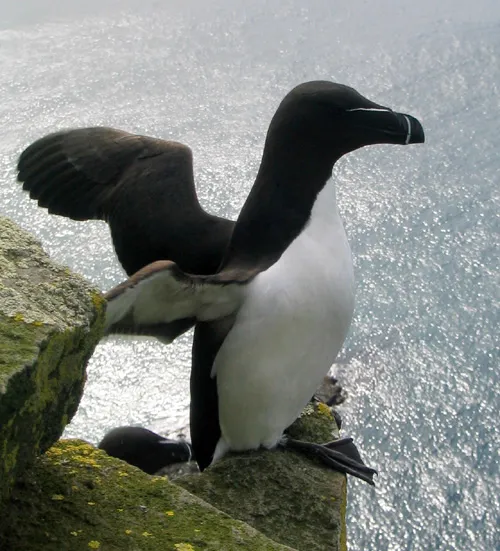
The razorbill (Alca torda) is a North Atlantic colonial seabird and the only extant member of the genus Alca of the family Alcidae, the auks. It is the closest living relative of the extinct great auk (Pinguinus impennis). Historically, it has also been known as "auk", "razor-billed auk" and "lesser auk". Razorbills are primarily black with a white underside. The male and female are identical in plumage; however, males are generally larger than females. This agile bird, which is capable of both flight and diving, has a predominantly aquatic lifestyle and only comes to land in order to breed. It is monogamous, choosing one partner for life. Females lay one egg per year. Razorbills nest along coastal cliffs in enclosed or slightly exposed crevices. The parents spend equal amounts of time incubating, and once the chick has hatched, they take turns foraging for their young. Presently, this species faces major threats, including the destruction of breeding sites, oil spills, and deterioration of food quality. As a result, razorbills have on occasion been seen outside of their normal range as they search for alternative food sources. The IUCN records the population of the species as fluctuating. It decreased from 2015 to 2021, and appears to be increasing or stable at the present. It is estimated that the current global razorbill population lies between 838,000 and 1,600,000 mature individuals. In 1918, the razorbill was protected in the United States by the Migratory Bird Treaty Act.
Description
The razorbill has a white belly and a black head, neck, back, and feet during the breeding season. A thin white line also extends from the eyes to the end of the bill. Its head is darker than that of a common murre. During the non-breeding season, the throat and face behind the eye become white, and the white line on the face and bill becomes less prominent. The bill is black, deep and laterally compressed, with a blunt end. It has several vertical grooves or furrows near the curved tip, one of them adorned with a white, broken vertical line. The bill is thinner and the grooves are less marked during the non-breeding season. It is a large and thick-set bird for an alcid, and its mean weight ranges from 505 to 890 g (17+3⁄4 to 31+1⁄2 oz). The female and male adults are very similar, having only small differences such as wing length. It is 37–39 cm in body length, the wing length of adult males ranges from 201–216 mm (7+15⁄16–8+1⁄2 in) while that of females ranges from 201 to 213 mm (7+15⁄16 to 8+3⁄8 in). During incubation, this species has a horizontal stance and the tail feathers are slightly longer in the center in comparison to other alcids. This makes the razorbill have a distinctly long tail which is not common for an auk. In-flight, the feet do not protrude beyond the tail. Though the razorbill's average lifespan is roughly 13 years, a bird ringed in the UK in 1967 survived for at least 41 years, a record for the species.
Text from Wikipedia — Razorbill, revision 1362853442, CC BY-SA 4.0, retrieved 2026-09-04. Encyclopedic text reused under CC BY-SA 4.0. Sentences about hunting or regulation are removed: on this site, the rule comes from Québec.ca.
Other names
French
English
Presence in Quebec
- Origin
- Indigène
- Occurrence
- Régulier
- Population status
- Reproducteur
- Certainty
- Confirmé
Conservation
Québec.ca
Official periods
Source: Québec.ca — tables reproduced as published (retrieved 2026-08-30).
Regulations change. Always check Québec.ca before hunting or trapping.
Where this data comes from
This species is listed in an official government dataset. The identification and status shown in the data sheet are reproduced from it.
Source: List of Quebec’s vertebrate wildlife (LFVQ) — Ministère de l’Environnement, de la Lutte contre les changements climatiques, de la Faune et des Parcs. File LFVQ_25_03_2026.csv, retrieved 2026-08-30 · CC BY 4.0.
Measurements, habitat, diet and reproduction are not shown: no official source is attached to them yet.