
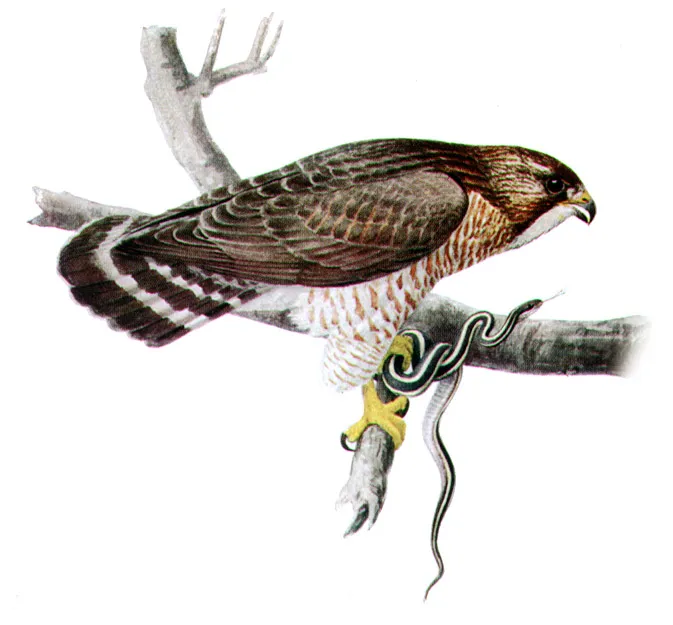
Petite buse— Quebec wildlife
Buteo platypterus
AccipitridaeNo period published by Québec.ca
Québec.ca publishes no hunting or trapping period for this species. Check the official regulations.
Wikipedia
Petite buse
The broad-winged hawk (Buteo platypterus) is a medium-sized hawk of the genus Buteo. During the summer, some subspecies are distributed over eastern North America, as far west as British Columbia and Texas; they then migrate south to winter in the Neotropics from Mexico south to southern Brazil. Other subspecies are all-year residents on Caribbean islands. As in most raptors, females are slightly larger than males. Broad-winged hawks' wings are relatively short and broad with a tapered, somewhat pointed appearance. The two types of coloration are a dark morph with fewer white areas and a light morph that is more pale overall. Although the broad-winged hawk's overall population is increasing, populations are declining in some parts of its breeding range because of forest fragmentation.
Description
The broad-winged hawk is a relatively small Buteo, with a body size from 32 to 44 cm (13 to 17 in) in length and weighing 265 to 560 g (9.3 to 19.8 oz). The tail is relatively short, measuring 14.5–19.0 cm (5.7–7.5 in) in length. The tarsus measures from 5.6 to 6.6 cm (2.2 to 2.6 in). As in most raptors, females are slightly larger than males. Broad-winged hawks have relatively short and broad wings, pointed at the end, which have a tapered appearance unique to the species. The wingspan can range from 74 to 100 cm (29 to 39 in), with the extended wing bone (standard measurement) measuring 22.7–30 cm (8.9–11.8 in). An adult's body is a dark brown with a white belly and chest containing horizontal barring. Its tail can be a dark grey-black with white lines along the middle, base, and tip. The young hawks have a slightly different coloring with more white and longitudinal barring instead of horizontal barring. The two types of coloration are a dark morph with fewer white areas and a light morph that is more pale overall. The light morph of this bird is most likely to be confused with the red-shouldered hawk, which has a longer, more heavily barred tail and wings with a solid rufous color in the adult, which are usually distinctive. Rare dark morphs are a darker brown on both upperparts and underparts. Dark-morph short-tailed hawks are similar, but are whitish under the tail with a single subterminal band.
Text from Wikipedia — Broad-winged hawk, revision 1354820232, CC BY-SA 4.0, retrieved 2026-09-04. Encyclopedic text reused under CC BY-SA 4.0. Sentences about hunting or regulation are removed: on this site, the rule comes from Québec.ca.
Other names
French
English
Presence in Quebec
- Origin
- Indigène
- Occurrence
- Régulier
- Population status
- Reproducteur
- Certainty
- Confirmé
Conservation
Québec.ca
Official periods
Source: Québec.ca — tables reproduced as published (retrieved 2026-08-30).
Regulations change. Always check Québec.ca before hunting or trapping.
Where this data comes from
This species is listed in an official government dataset. The identification and status shown in the data sheet are reproduced from it.
Source: List of Quebec’s vertebrate wildlife (LFVQ) — Ministère de l’Environnement, de la Lutte contre les changements climatiques, de la Faune et des Parcs. File LFVQ_25_03_2026.csv, retrieved 2026-08-30 · CC BY 4.0.
Measurements, habitat, diet and reproduction are not shown: no official source is attached to them yet.