
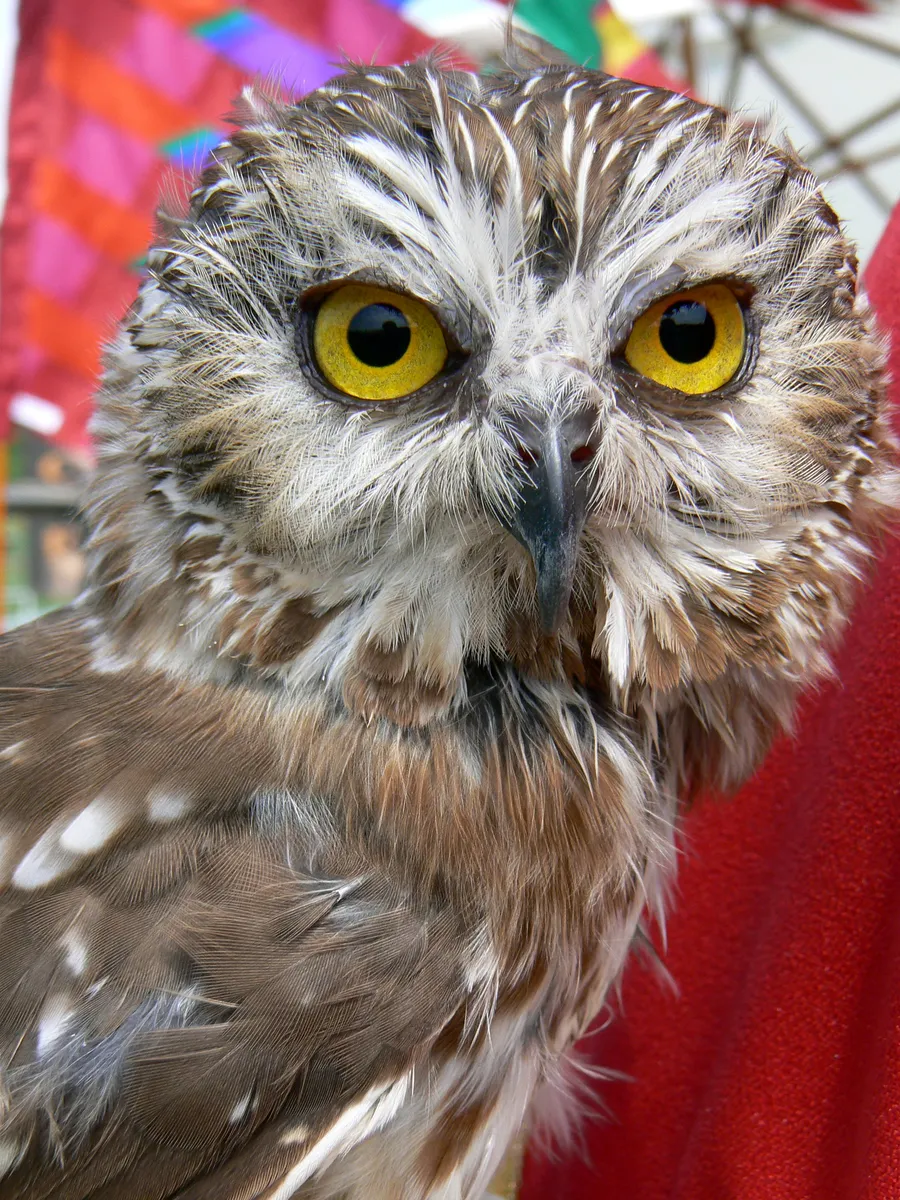
Petite nyctale— Quebec wildlife
Aegolius acadicus
StrigidaeNo period published by Québec.ca
Québec.ca publishes no hunting or trapping period for this species. Check the official regulations.
Wikipedia
Petite nyctale
The northern saw-whet owl (Aegolius acadicus) is a species of small owl in the family Strigidae. The species is native to North America. Saw-whet owls of the genus Aegolius are some of the smallest owl species in North America. They can be found in dense thickets, often at eye level, although they can also be found some 20 ft (6.1 m) up. Saw-whets are often in danger of being preyed upon by larger birds of prey. The northern saw-whet owl is a migratory bird without any strict pattern.
Description
Adults are 17–22 cm (6.7–8.7 in) long with a 42–56.3 cm (16.5–22.2 in) wingspan. They can weigh from 54 to 151 g (1.9 to 5.3 oz) with an average of around 80 g (2.8 oz), making them one of the smallest owls in North America. They are similar in size to the American robin (78.5 g). Northern saw-whet owls do not exhibit sexual dimorphism in their plumage, so are often sexed by size dimorphism—females are larger than males. Females on average weigh 100 g and males on average weigh 75 g. Northern saw-whet owls have porphyrin pigments in their flight feathers. When exposed to a UV light, feathers on the ventral side of the wing fluoresce a neon pink. This is used in order to estimate molt and age in adults. The northern saw-whet owl has a round, light, white face with brown and cream streaks; they also have a dark beak and yellow eyes. The underparts are pale with dark shaded areas; the upper parts are brown or reddish with white spots. Juveniles have a dark brown head and wings, and a tawny rust-colored breast and belly. There is also a distinct white, Y-shaped coloration between their eyes. Saw-whet owls can be confused with boreal owls, but are distinguishable by their larger size, bill color, and lack of a spotted forehead. CornellLab's All About Birds entry says these small owls are "common and widespread", but their secretive lifestyle makes them hard to spot and makes population trends difficult to track. Partners in Flight estimates a global breeding population of 2 million and rate them 8 out of 20 on the Continental Concern Score, indicating a species of low conservation concern. However, their general population has probably declined in past decades due to habitat loss, and they are doing even worse locally in places like North Carolina, South Dakota, and in the Queen Charlotte Islands of British Columbia which are home to an endemic subspecies. Saw-whets take readily to nest boxes, which can be used to mitigate the loss of natural sites.
Text from Wikipedia — Northern saw-whet owl, revision 1357853052, CC BY-SA 4.0, retrieved 2026-09-04. Encyclopedic text reused under CC BY-SA 4.0. Sentences about hunting or regulation are removed: on this site, the rule comes from Québec.ca.
Other names
French
English
Presence in Quebec
- Origin
- Indigène
- Occurrence
- Régulier
- Population status
- Reproducteur
- Certainty
- Confirmé
Conservation
Québec.ca
Official periods
Source: Québec.ca — tables reproduced as published (retrieved 2026-08-30).
Regulations change. Always check Québec.ca before hunting or trapping.
Where this data comes from
This species is listed in an official government dataset. The identification and status shown in the data sheet are reproduced from it.
Source: List of Quebec’s vertebrate wildlife (LFVQ) — Ministère de l’Environnement, de la Lutte contre les changements climatiques, de la Faune et des Parcs. File LFVQ_25_03_2026.csv, retrieved 2026-08-30 · CC BY 4.0.
Measurements, habitat, diet and reproduction are not shown: no official source is attached to them yet.