
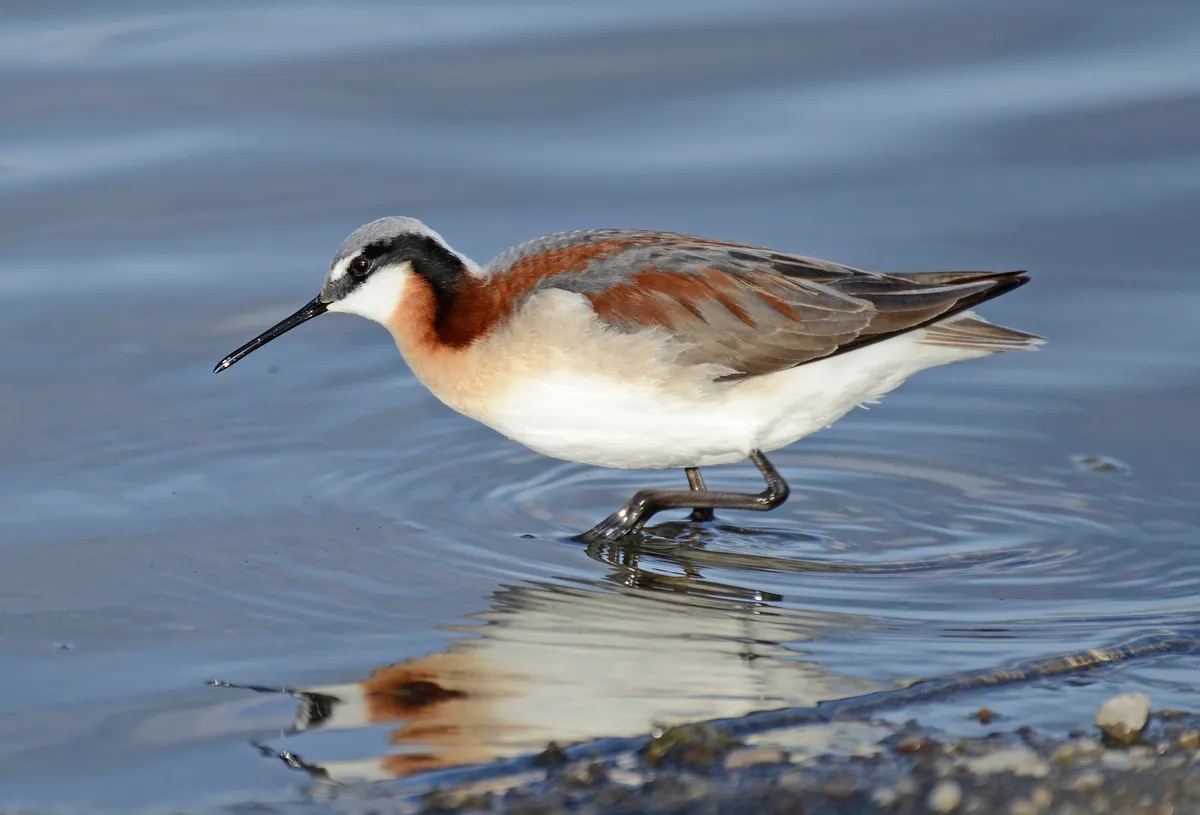
Phalarope de Wilson— Quebec wildlife
Phalaropus tricolor
ScolopacidaeNo period published by Québec.ca
Québec.ca publishes no hunting or trapping period for this species. Check the official regulations.
Wikipedia
Phalarope de Wilson
Wilson's phalarope (Phalaropus tricolor) is a small wader. This bird, the largest of the phalaropes, breeds in the prairies of North America in western Canada and the western United States. It is migratory, wintering in inland salt lakes near the Andes in Argentina. They are passage migrants through Central America around March/April and again during September/October. The species is a rare vagrant to western Europe. This species is often very tame and approachable. Sometimes it is placed in a monotypic genus Steganopus.
Description
Wilson's phalarope is slightly larger than the red phalarope at about 23 cm (9.1 in) in length. It is a dainty shorebird with lobed toes and a straight fine black bill. The breeding female is predominantly grey and brown above, with white underparts, a reddish neck and reddish flank patches. The breeding male is a duller version of the female, with a brown back, and the reddish patches reduced or absent. Measurements: Length: 22–24 cm (8.7–9.4 in) Weight: male 30–110 g (1.1–3.9 oz), female 52–128 g (1.8–4.5 oz) Wingspan: 35–38 cm (14–15 in) In a study of breeding phalaropes in the province of Saskatchewan, Canada, females were found to average around 10% larger in standard measurements and to weigh around 30% more than the males. Females weighed from 68 to 79 g (2.4 to 2.8 oz), whereas males average 51.8 g (1.83 oz). Young birds are grey and brown above, with whitish underparts and a dark patch through the eye. In winter, the plumage is essentially grey above and white below, but the dark eyepatch is always present. The average longevity in the wild is 10 years.
Text from Wikipedia — Wilson's phalarope, revision 1365131914, CC BY-SA 4.0, retrieved 2026-09-04. Encyclopedic text reused under CC BY-SA 4.0. Sentences about hunting or regulation are removed: on this site, the rule comes from Québec.ca.
Other names
French
English
Former scientific names
Presence in Quebec
- Origin
- Indigène
- Occurrence
- Régulier
- Population status
- Reproducteur
- Certainty
- Confirmé
Conservation
Québec.ca
Official periods
Source: Québec.ca — tables reproduced as published (retrieved 2026-08-30).
Regulations change. Always check Québec.ca before hunting or trapping.
Where this data comes from
This species is listed in an official government dataset. The identification and status shown in the data sheet are reproduced from it.
Source: List of Quebec’s vertebrate wildlife (LFVQ) — Ministère de l’Environnement, de la Lutte contre les changements climatiques, de la Faune et des Parcs. File LFVQ_25_03_2026.csv, retrieved 2026-08-30 · CC BY 4.0.
Measurements, habitat, diet and reproduction are not shown: no official source is attached to them yet.