
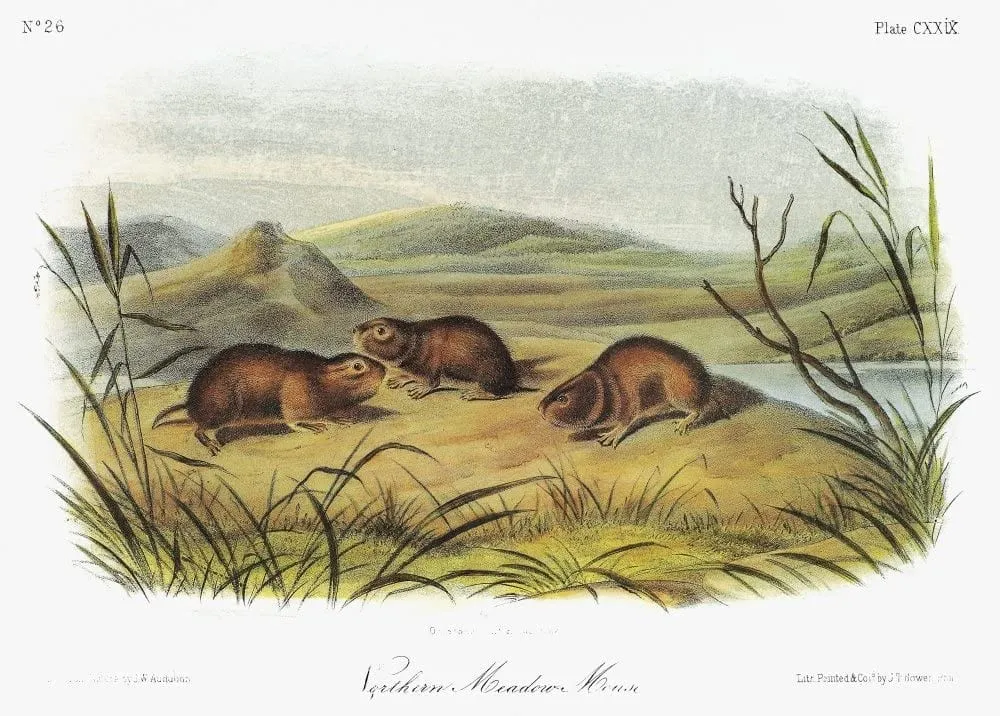
Phénacomys— Quebec wildlife
Phenacomys ungava
CricetidaeNo period published by Québec.ca
Québec.ca publishes no hunting or trapping period for this species. Check the official regulations.
Wikipedia
Phénacomys
The eastern heather vole (Phenacomys ungava) is a small North American vole. Until recently, this species was considered to belong to the same species as the western heather vole (P. intermedius). It is also called the Ungava vole. Though some studies have indicated that P. ungava is "rare" or "uncommon," other researchers have found that the animal can be common locally, and others have suggested that the population may undergo cyclic abundance.
Description
Eastern heather voles are relatively small among vole species, measuring 11 to 15 cm (4.3 to 5.9 in) from nose to tail and weighing between 15 and 47 g (0.53 and 1.66 oz). They are very similar in appearance to the western heather vole, and can only be distinguished from them by subtle features of the coat color and the shape of the skull. The fur is long and soft. The coat is brownish with a slight yellowish wash over the back and head, with pale grey underparts and feet, and brighter, almost russet, fur on the rump and flanks. The face and snout of adults have a more pronounced yellowish cast, contrasting with the rest of the head and body. The tail is short, measuring about a quarter of the animal's total length, and is paler underneath than on the upper surface. The ears are very small, and barely visible above the long fur. Males have scent glands on their flanks, which can reach up to 28 mm (1.1 in) across. Females have eight teats.
Reproduction
Eastern heather voles breed from June to July, and produce litters of two to eight young after a gestation period of 21 days. The young are born hairless and blind, developing fur by day six, crawling by day eight, and opening their eyes by day fourteen of life. They are weaned by day seventeen, but do not reach the full adult size for over three months. Females become sexually mature four to six weeks after birth, but males do not breed during their first summer. Normally, only a single litter is born each year, but, in at least some localities, a second litter may be born in August. They live for up to four years.
Text from Wikipedia — Eastern heather vole, revision 1314276835, CC BY-SA 4.0, retrieved 2026-09-04. Encyclopedic text reused under CC BY-SA 4.0. Sentences about hunting or regulation are removed: on this site, the rule comes from Québec.ca.
Other names
French
English
Presence in Quebec
- Origin
- Indigène
- Occurrence
- Régulier
- Population status
- Toute l'année
- Certainty
- Confirmé
Conservation
Québec.ca
Official periods
Source: Québec.ca — tables reproduced as published (retrieved 2026-08-30).
Regulations change. Always check Québec.ca before hunting or trapping.
Where this data comes from
This species is listed in an official government dataset. The identification and status shown in the data sheet are reproduced from it.
Source: List of Quebec’s vertebrate wildlife (LFVQ) — Ministère de l’Environnement, de la Lutte contre les changements climatiques, de la Faune et des Parcs. File LFVQ_25_03_2026.csv, retrieved 2026-08-30 · CC BY 4.0.
Measurements, habitat, diet and reproduction are not shown: no official source is attached to them yet.