
No period published by Québec.ca
Québec.ca publishes no hunting or trapping period for this species. Check the official regulations.
Wikipedia
Pic à dos rayé
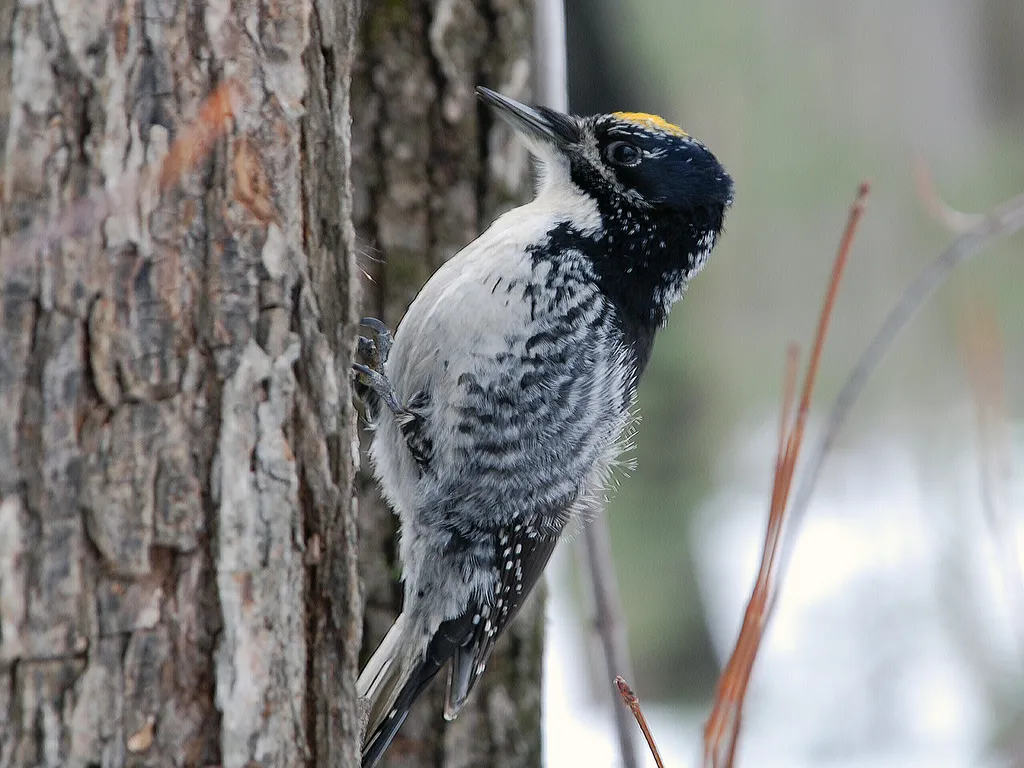
The American three-toed woodpecker (Picoides dorsalis) is a medium-sized woodpecker (family Picidae), which is native to North America.
Description
This woodpecker has a length between 21 – 23 cm (8.3 – 9.1 in) and a wingspan between 37 – 39 cm (14.6 – 15.3 in). Males have an average weight of 58.3 g (2.06 oz), and females are slightly smaller, averaging 52 g (1.8 oz). Its maximum lifespan in the wild is 6 years. It closely resembles the black-backed woodpecker, which is also three-toed. Until recently, it was considered to be the same species as the Eurasian three-toed woodpecker, P. tridactylus. Adults are black on the head, wings and rump, and white from the throat to the belly; the flanks are white with black bars. The back is white with black bars and the tail is black with the white outer feathers barred with black. The adult male has a yellow cap.
Reproduction
The breeding habitat is coniferous forests across western Canada, Alaska and the western and extreme northeastern United States. It has also been seen in Michigan's upper peninsula, and has been recorded breeding in the extreme north of Wisconsin and Minnesota on extremely rare occasions. The female lays 3 to 7 but most often 4 eggs in a nest cavity in a dead conifer or sometimes a live tree or pole. The pair excavates a new nest each year. American three-toed woodpeckers rely on disturbed, old-growth forests and are strongly associated with active spruce beetle infestations, with beetle-infested trees being important for the woodpeckers and other species that depend on the cavities they excavate.
Text from Wikipedia — American three-toed woodpecker, revision 1355979359, CC BY-SA 4.0, retrieved 2026-09-04. Encyclopedic text reused under CC BY-SA 4.0. Sentences about hunting or regulation are removed: on this site, the rule comes from Québec.ca.
Other names
French
English
Former scientific names
Presence in Quebec
- Origin
- Indigène
- Occurrence
- Régulier
- Population status
- Toute l'année
- Certainty
- Confirmé
Conservation
Québec.ca
Official periods
Source: Québec.ca — tables reproduced as published (retrieved 2026-08-30).
Regulations change. Always check Québec.ca before hunting or trapping.
Where this data comes from
This species is listed in an official government dataset. The identification and status shown in the data sheet are reproduced from it.
Source: List of Quebec’s vertebrate wildlife (LFVQ) — Ministère de l’Environnement, de la Lutte contre les changements climatiques, de la Faune et des Parcs. File LFVQ_25_03_2026.csv, retrieved 2026-08-30 · CC BY 4.0.
Measurements, habitat, diet and reproduction are not shown: no official source is attached to them yet.