
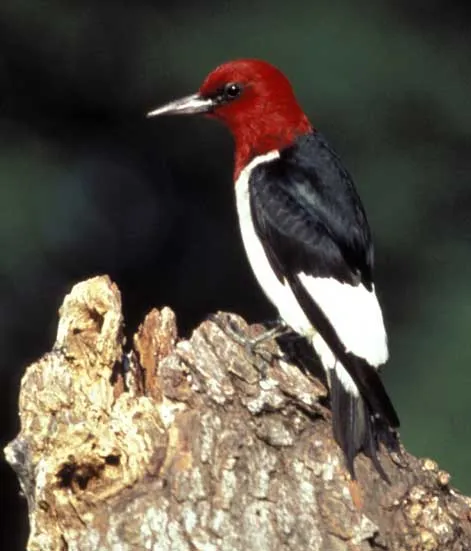
Pic à tête rouge— Quebec wildlife
Melanerpes erythrocephalus
PicidaeNo period published by Québec.ca
Québec.ca publishes no hunting or trapping period for this species. Check the official regulations.
Wikipedia
Pic à tête rouge
The red-headed woodpecker (Melanerpes erythrocephalus) is a mid-sized woodpecker found in temperate North America. Its breeding habitat is open country across southern Canada and the east-central United States. It is rated as least concern on the International Union for Conservation of Nature (IUCN)'s Red List of Endangered species, having been down-listed from near threatened in 2018. The red-headed woodpecker should not be confused with the red-bellied woodpecker, which is similar in size but has a vibrant orange-red crown and nape; the red-bellied woodpecker is named for the pale reddish blush of its lower belly and has a distinctly patterned black and white back rather than the solid black one of the red-headed woodpecker.
Description
Adults are distinctly tricolored, with a black back and tail, a white belly and rump, and a red head and neck. The wings are black with white secondary remiges. Adult males and females are identical in plumage. Juveniles have similar markings, but their heads are grey. Red-headed woodpeckers are entirely crimson above their shoulders. These are mid-sized woodpeckers. Both sexes measure from 19 to 25 cm (7.5 to 9.8 in) in length, with a wingspan of 42.5 cm (16.7 in). They weigh from 56 to 97 g (2.0 to 3.4 oz), with an average of 76 g (2.7 oz). Each wing measures 12.7–15 cm (5.0–5.9 in); the tail measures 6.6–8.5 cm (2.6–3.3 in), the bill measures 2.1–3 cm (0.83–1.18 in) and the tarsus measures 1.9–2.5 cm (0.75–0.98 in). The maximum longevity in the wild is 9.9 years. This species gives a tchur-tchur call or a drum on its territory.
Text from Wikipedia — Red-headed woodpecker, revision 1344811636, CC BY-SA 4.0, retrieved 2026-09-04. Encyclopedic text reused under CC BY-SA 4.0. Sentences about hunting or regulation are removed: on this site, the rule comes from Québec.ca.
Other names
French
English
Former scientific names
Presence in Quebec
- Origin
- Indigène
- Occurrence
- Régulier
- Population status
- Reproducteur
- Certainty
- Confirmé
Conservation
Québec.ca
Official periods
Source: Québec.ca — tables reproduced as published (retrieved 2026-08-30).
Regulations change. Always check Québec.ca before hunting or trapping.
Where this data comes from
This species is listed in an official government dataset. The identification and status shown in the data sheet are reproduced from it.
Source: List of Quebec’s vertebrate wildlife (LFVQ) — Ministère de l’Environnement, de la Lutte contre les changements climatiques, de la Faune et des Parcs. File LFVQ_25_03_2026.csv, retrieved 2026-08-30 · CC BY 4.0.
Measurements, habitat, diet and reproduction are not shown: no official source is attached to them yet.