
No period published by Québec.ca
Québec.ca publishes no hunting or trapping period for this species. Check the official regulations.
Wikipedia
Pic à ventre roux
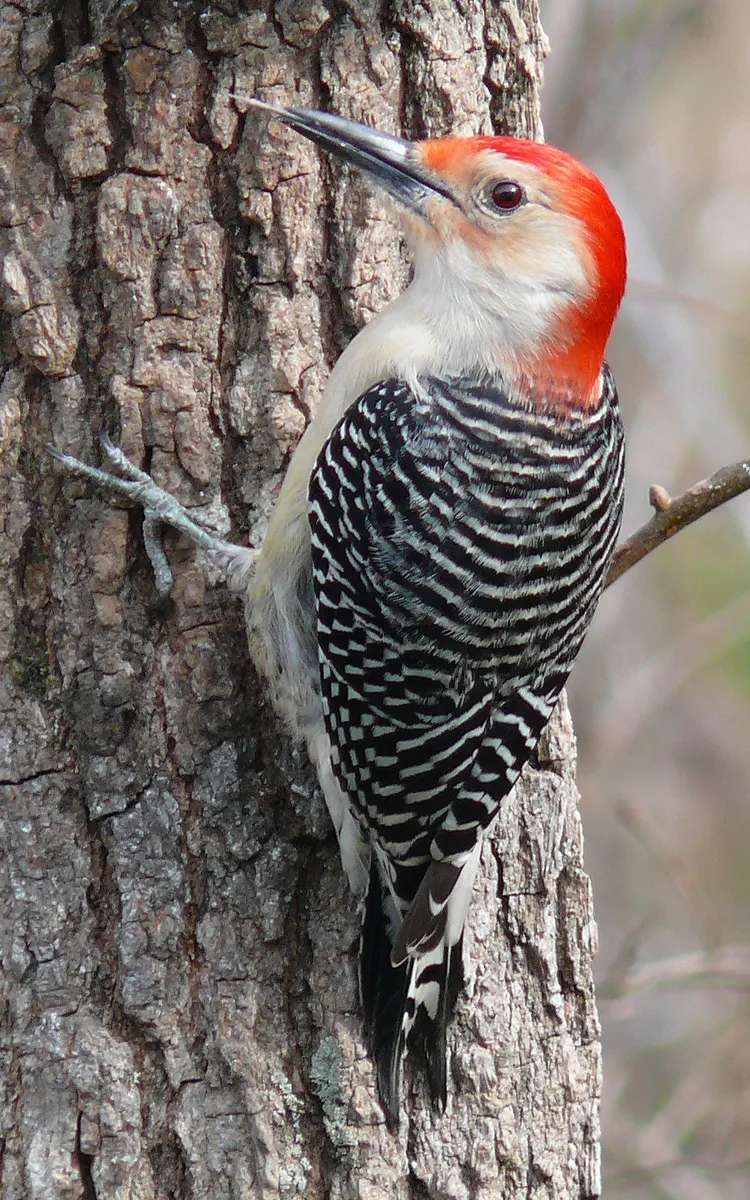
The red-bellied woodpecker (Melanerpes carolinus) is a medium-sized woodpecker of the family Picidae. It breeds mainly in the eastern United States, ranging as far south as Florida and as far north as Canada. Though it has a vivid orange-red crown and nape it is not to be confused with the red-headed woodpecker, a separate species of woodpecker in the same genus with an entirely red head and neck that sports a solid black back and white belly. The red-bellied earns its name from the pale reddish tint on its lower underside.
Description
Adults are mainly light gray on the face and underparts; they have black and white barred patterns on their back, wings and tail. Adult males have a red cap going from the bill to the nape; females have a red patch on the nape and another above the bill. The reddish tinge on the belly that gives the bird its name is difficult to see in field identification. White patches become visible on the wings in flight. Red-bellied woodpeckers are 22.85 to 26.7 cm (9.00 to 10.51 in) long, have a wingspan of 38 to 46 cm (15 to 18 in), and weigh 2.0–3.2 oz (57–91 g).
Text from Wikipedia — Red-bellied woodpecker, revision 1361279200, CC BY-SA 4.0, retrieved 2026-09-04. Encyclopedic text reused under CC BY-SA 4.0. Sentences about hunting or regulation are removed: on this site, the rule comes from Québec.ca.
Other names
French
English
Presence in Quebec
- Origin
- Indigène
- Occurrence
- Régulier
- Population status
- Toute l'année
- Certainty
- Confirmé
Conservation
Québec.ca
Official periods
Source: Québec.ca — tables reproduced as published (retrieved 2026-08-30).
Regulations change. Always check Québec.ca before hunting or trapping.
Where this data comes from
This species is listed in an official government dataset. The identification and status shown in the data sheet are reproduced from it.
Source: List of Quebec’s vertebrate wildlife (LFVQ) — Ministère de l’Environnement, de la Lutte contre les changements climatiques, de la Faune et des Parcs. File LFVQ_25_03_2026.csv, retrieved 2026-08-30 · CC BY 4.0.
Measurements, habitat, diet and reproduction are not shown: no official source is attached to them yet.