
No period published by Québec.ca
Québec.ca publishes no hunting or trapping period for this species. Check the official regulations.
Wikipedia
Pic chevelu
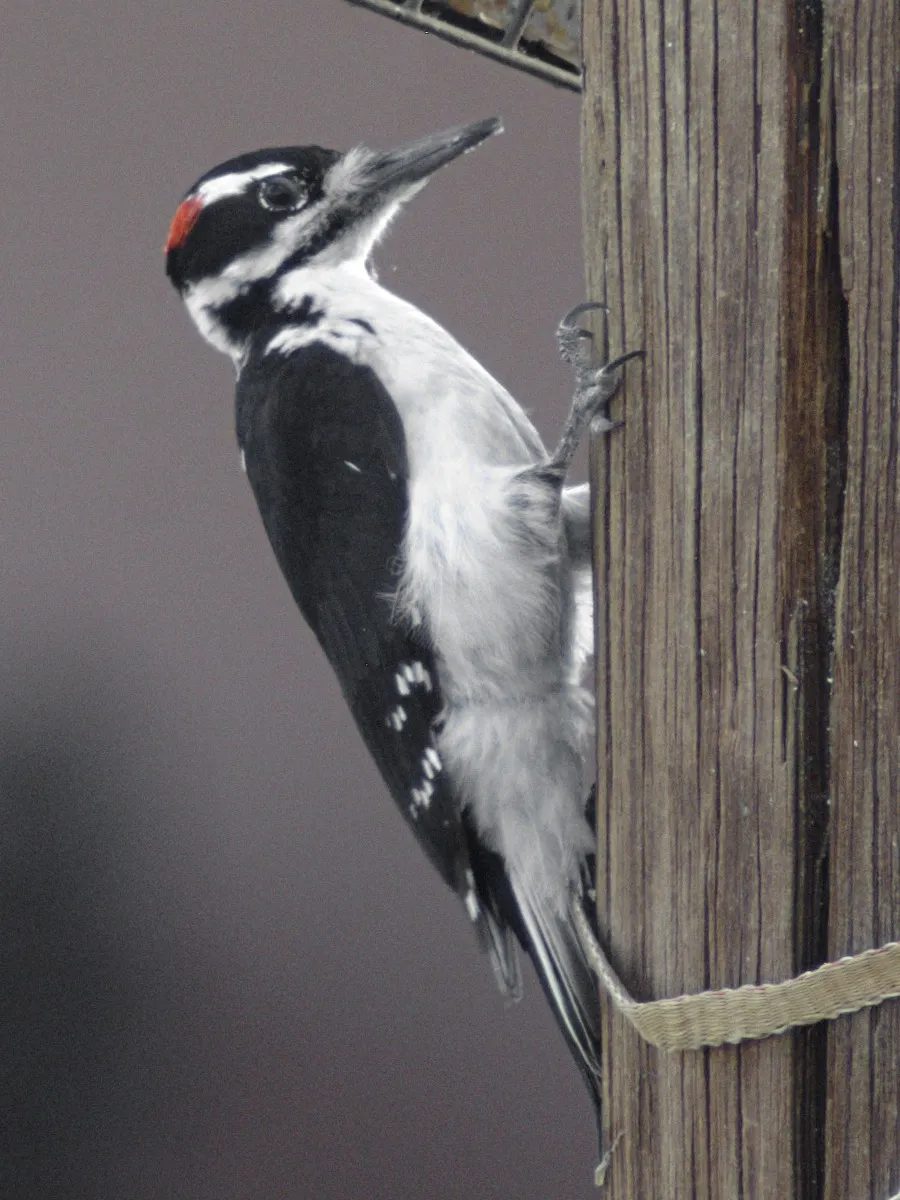
The hairy woodpecker (Leuconotopicus villosus) is a medium-sized woodpecker that is found over a large area of North America. It is approximately 250 mm (9.8 in) in length with a 380 mm (15 in) wingspan. With an estimated population in 2020 of almost nine million individuals, the hairy woodpecker is listed by the IUCN as a species of least concern. The species was previously placed in the genus Dryobates.
Description
Adults are mainly black on the upper parts and wings, with a white or pale back and white spotting on the wings; the throat and belly vary from white to sooty brown, depending on subspecies. There is a white bar above and one below the eye. They have a black tail with white outer feathers. Adult males have a red patch or two side-by-side patches on the back of the head; juvenile males have red or rarely orange-red on the crown. The hairy woodpecker measures from 18–26 cm (7.1–10.2 in) in length, 33–43 cm (13–17 in) in wingspan and 40–95 g (1.4–3.4 oz) in weight. It is virtually identical in plumage to the smaller downy woodpecker. The downy has a shorter bill relative to the size of its head, which is, other than size and voice, the best way to distinguish them in the field. These two species are not closely related, however, and are likely to be separated in different genera. Another way to tell the two species apart is the lack of spots on its white tail feathers (present in the downy). Their outward similarity is a spectacular example of convergent evolution. As to the reason for this convergence, only tentative hypotheses have been advanced; in any case, because of the considerable size difference, ecological competition between the two species is slight.
Text from Wikipedia — Hairy woodpecker, revision 1357303594, CC BY-SA 4.0, retrieved 2026-09-04. Encyclopedic text reused under CC BY-SA 4.0. Sentences about hunting or regulation are removed: on this site, the rule comes from Québec.ca.
Other names
French
English
Presence in Quebec
- Origin
- Indigène
- Occurrence
- Régulier
- Population status
- Toute l'année
- Certainty
- Confirmé
Conservation
Québec.ca
Official periods
Source: Québec.ca — tables reproduced as published (retrieved 2026-08-30).
Regulations change. Always check Québec.ca before hunting or trapping.
Where this data comes from
This species is listed in an official government dataset. The identification and status shown in the data sheet are reproduced from it.
Source: List of Quebec’s vertebrate wildlife (LFVQ) — Ministère de l’Environnement, de la Lutte contre les changements climatiques, de la Faune et des Parcs. File LFVQ_25_03_2026.csv, retrieved 2026-08-30 · CC BY 4.0.
Measurements, habitat, diet and reproduction are not shown: no official source is attached to them yet.