
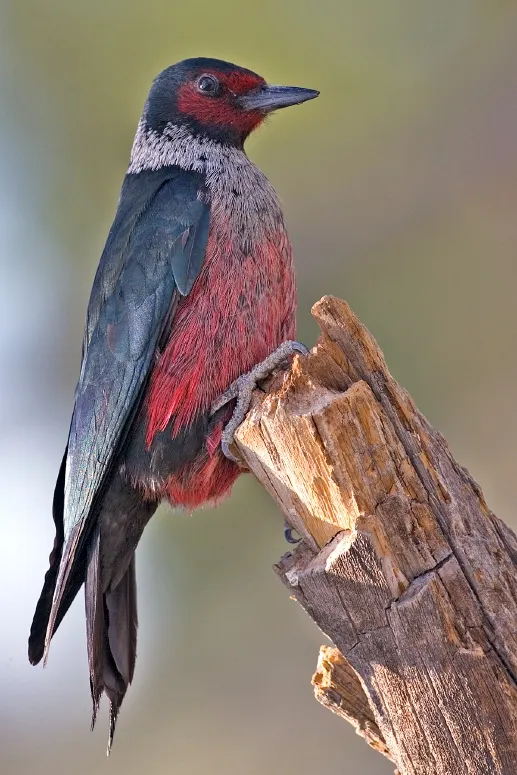
Pic de Lewis— Quebec wildlife
Melanerpes lewis
PicidaeNo period published by Québec.ca
Québec.ca publishes no hunting or trapping period for this species. Check the official regulations.
Wikipedia
Pic de Lewis
Lewis's woodpecker (Melanerpes lewis) is a large North American species of woodpecker which ornithologist Alexander Wilson named after Meriwether Lewis. Lewis was one of the explorers who surveyed the areas bought by the United States of America as part of the Louisiana Purchase and first described this species of bird.
Description
One of the largest species of American woodpeckers, Lewis's woodpecker can measure up to 10–11 inches (25–28 cm) in length. It is mainly reddish-breasted, blackish-green in color, with a black rump. It has a gray collar and upper breast, with a pinkish belly, and a red face. The wings are much broader than those of other woodpeckers, and it flies at a much more sluggish pace with slow, but even flaps similar to those of a crow. Its calls have a harsh sound relative to other woodpeckers', and it may use a repertoire of several phrases. They are one of the three largest Melanerpes woodpeckers in the world, being similar in size to the white woodpecker and the Jamaican woodpecker. Measurements: Length: 10.2–11.0 in (26–28 cm) Weight: 3.1–4.9 oz (88–139 g) Wingspan: 19.3–20.5 in (49–52 cm)
Diet
Lewis's woodpecker engages in some rather un-woodpecker-like behavior in its gregarious feeding habits. Although it does forage for insects by boring into trees with its chisel-like bill, the bird also catches insects in the air during flight (typical insect hawking). This is a habit that only a few other woodpeckers, such as the acorn woodpecker, the red-headed woodpecker, and the northern flicker, engage in. Lewis's woodpecker also feeds on berries and nuts, and will even shell and store nuts in cracks and holes in wood to store until winter. It will also feed at flat, open bird feeders, where it might act aggressively toward other birds.
Reproduction
Lewis's woodpecker nests in a cavity excavated from a dead tree branch. The Lewis's woodpecker, however, will not excavate its cavity, but instead nest in a pre-existing cavity in a tree. The nest is usually made around 1 to 52 meters high from the ground. The female will lay between 5 and 9 eggs, which are plain white in coloration. Both mates incubate—the female during the day and the male at night. Incubation lasts approximately 12 days, after which the young will hatch. Both parents take turns equally caring for their young. After the young hatch, the parents give them insects "directly from the beak". The young leave the nest four to five weeks after hatching. If breeding was successful, the two lifelong mates may return to the same nest the following year.
Text from Wikipedia — Lewis's woodpecker, revision 1352017038, CC BY-SA 4.0, retrieved 2026-09-04. Encyclopedic text reused under CC BY-SA 4.0. Sentences about hunting or regulation are removed: on this site, the rule comes from Québec.ca.
Presence in Quebec
- Origin
- Indigène
- Occurrence
- Accidentel/non régulier
- Population status
- Migrateur
- Certainty
- Confirmé
Conservation
Québec.ca
Official periods
Source: Québec.ca — tables reproduced as published (retrieved 2026-08-30).
Regulations change. Always check Québec.ca before hunting or trapping.
Where this data comes from
This species is listed in an official government dataset. The identification and status shown in the data sheet are reproduced from it.
Source: List of Quebec’s vertebrate wildlife (LFVQ) — Ministère de l’Environnement, de la Lutte contre les changements climatiques, de la Faune et des Parcs. File LFVQ_25_03_2026.csv, retrieved 2026-08-30 · CC BY 4.0.
Measurements, habitat, diet and reproduction are not shown: no official source is attached to them yet.