
No period published by Québec.ca
Québec.ca publishes no hunting or trapping period for this species. Check the official regulations.
Wikipedia
Pic flamboyant
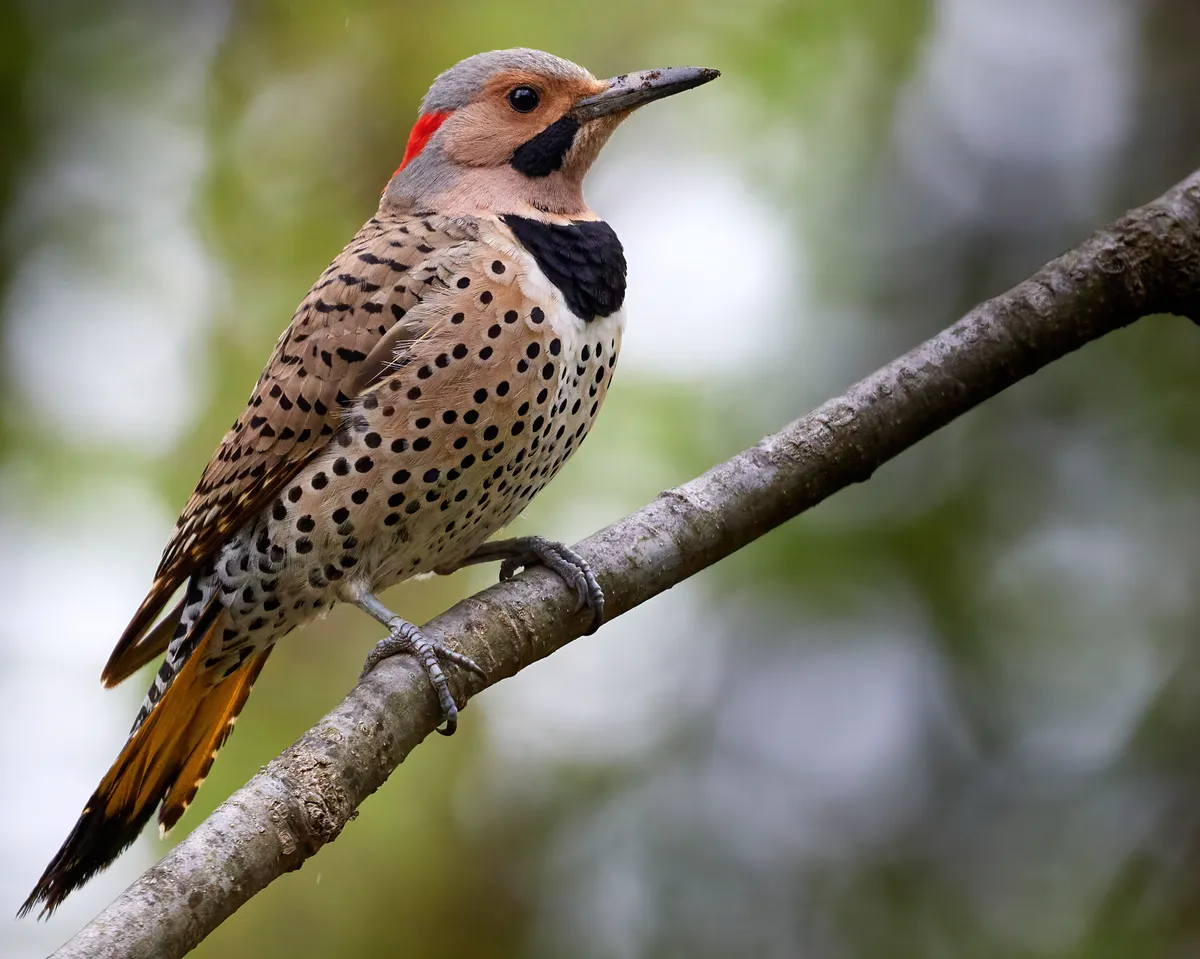
The northern flicker or common flicker (Colaptes auratus) is a medium-sized bird of the woodpecker family. It is native to most of North America, parts of Central America, Cuba, and the Cayman Islands, and is one of the few woodpecker species that migrate. Over 100 common names for the northern flicker are known, including yellowhammer (not to be confused with the Eurasian yellowhammer (Emberiza citrinella)), clape, gaffer woodpecker, harry-wicket, heigh-ho, wake-up, walk-up, wick-up, yarrup, and gawker bird. Many of these names derive from attempts to imitate some of its calls.
Description
Adults are brown with black bars on the back and wings. A mid- to large-sized northern flicker measures 28–36 cm (11–14 in) in length and 42–54 cm (16+1⁄2–21+1⁄2 in) in wingspan. The body mass can vary from 86 to 167 g (3 to 5+7⁄8 oz). Among standard scientific measurements, the wing bone measures 12.2–17.1 cm (4+13⁄16–6+3⁄4 in), the tail measures 7.5–11.5 cm (3–4+1⁄2 in), the bill measures 2.2–4.3 cm (7⁄8–1+11⁄16 in) and the tarsus measures 2.2–3.1 cm (7⁄8–1+1⁄4 in). The largest-bodied specimens have been found within the species' northern range at the latitudes of Alaska and Labrador, while the smallest specimens have been recorded being found in Grand Cayman. A necklace-like black patch occupies the upper breast, while the lower breast and belly are beige with black spots. Males can be identified by a black (in the eastern part of the species' range) or red (in the western part) mustachial stripe at the base of the beak, while females lack this stripe. The tail is dark on top, transitioning to a white rump which is conspicuous in flight. Subspecific plumage is variable.
Habitat and range
The northern flicker may be observed in open habitats near trees, including woodlands, edges, yards, and parks. In the western United States, one can find it in mountain forests all the way up to the tree line. The northern flicker generally nests in holes in trees like other woodpeckers. Occasionally, it has been found nesting in old, earthen burrows vacated by belted kingfishers (Megaceryle alcyon) or sand martins (Riparia riparia). Both sexes help with the nest excavation. The entrance hole is about 8 cm (3 in) in diameter, and the cavity is 33–41 cm (13–16 in) deep. The cavity widens at the bottom to make room for the eggs and the incubating adult. Inside, the cavity is bare except for a bed of wood chips for the eggs and chicks to rest on. Once the nestlings are about 17 days old, they begin clinging to the cavity wall rather than lying on the floor. They can create cavities inside homes, especially homes of stucco or weak wooden siding.
Diet
According to the Audubon field guide, "flickers are the only woodpeckers that frequently feed on the ground", probing with their beak, also sometimes catching insects in flight. Although they eat fruits, berries, seeds, and nuts, their primary food is insects. Ants alone can make up 45% of their diet.
Text from Wikipedia — Northern flicker, revision 1365548060, CC BY-SA 4.0, retrieved 2026-09-04. Encyclopedic text reused under CC BY-SA 4.0. Sentences about hunting or regulation are removed: on this site, the rule comes from Québec.ca.
Other names
French
Presence in Quebec
- Origin
- Indigène
- Occurrence
- Régulier
- Population status
- Reproducteur
- Certainty
- Confirmé
Conservation
Québec.ca
Official periods
Source: Québec.ca — tables reproduced as published (retrieved 2026-08-30).
Regulations change. Always check Québec.ca before hunting or trapping.
Where this data comes from
This species is listed in an official government dataset. The identification and status shown in the data sheet are reproduced from it.
Source: List of Quebec’s vertebrate wildlife (LFVQ) — Ministère de l’Environnement, de la Lutte contre les changements climatiques, de la Faune et des Parcs. File LFVQ_25_03_2026.csv, retrieved 2026-08-30 · CC BY 4.0.
Measurements, habitat, diet and reproduction are not shown: no official source is attached to them yet.