
No period published by Québec.ca
Québec.ca publishes no hunting or trapping period for this species. Check the official regulations.
Wikipedia
Pic maculé
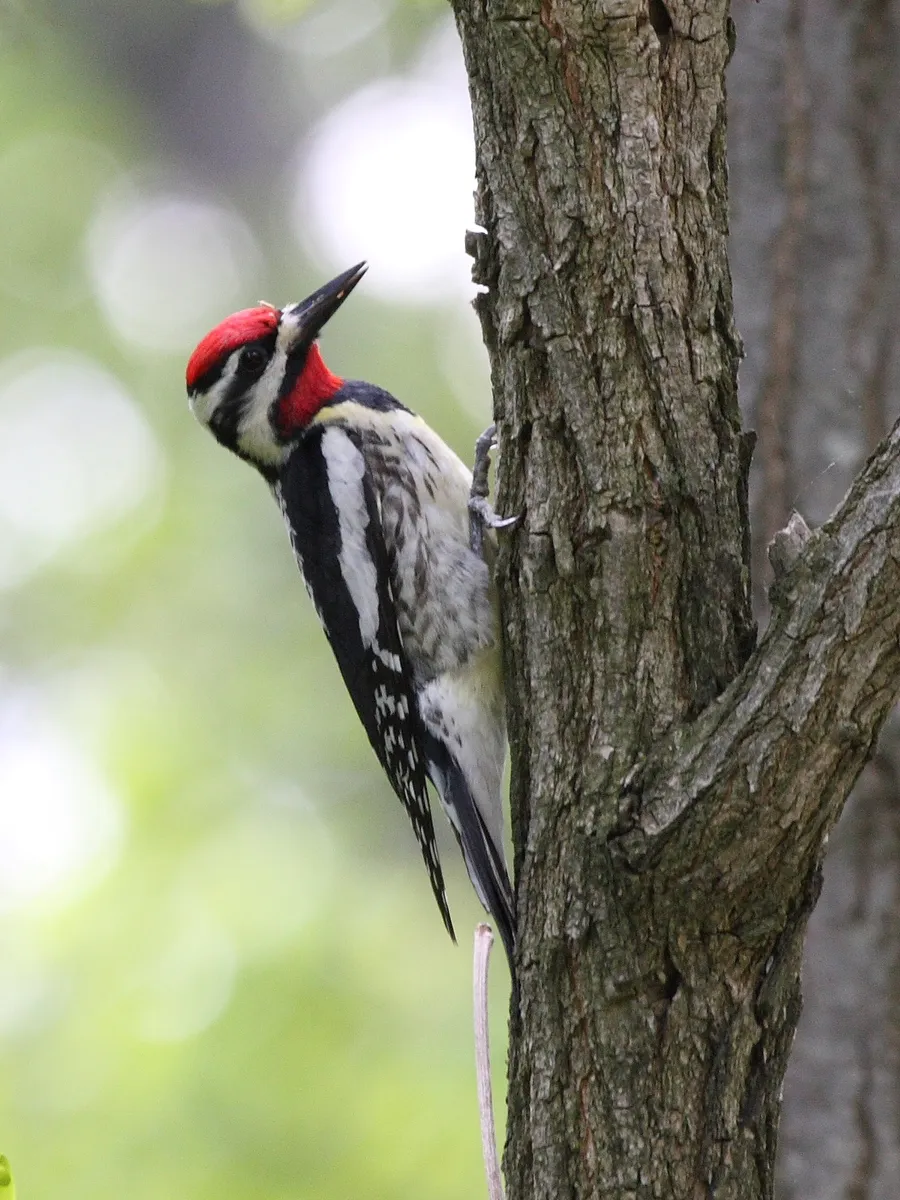
The yellow-bellied sapsucker (Sphyrapicus varius) is a medium-sized woodpecker that breeds in Canada and the northeastern United States.
Description
The yellow-bellied sapsucker has a length of around 19 to 21 centimetres (7+1⁄2 to 8+1⁄4 in), and an average weight of 50.3 grams (1.77 oz), although this can range anywhere from 35 to 62 grams (1.2 to 2.2 oz). The yellow-bellied sapsucker has a wingspan that ranges from 34 to 40 centimetres (13+1⁄2 to 15+3⁄4 in). The forehead is coloured bright red in the male (and very occasionally yellow), and a lighter shade of red in the female. Sometimes, this is the only place on the head a female will have red colouration, if it has any at all, as the female rarely has a black head with a few buff spots. The crown is bordered black, and is usually red, and is sometimes mixed with black in the female. There is a white stripe, starting above the eye, that extends and widens to the nape, being broken up by a thin black line on the hindneck. There is a broad black stripe going through the ear-coverts and down to the side of the neck. Below this black stripe is a white stripe that goes from the nasal tufts to the side of the breast. The throat and chin can be used to differentiated between the sexes, as they are white in the female, and red in the male. The mantle of this sapsucker is white, and there are irregular black bars that extend from it to the rump. The lower rump is white, and the uppertail-coverts are white with some black webbing. The wing coverts are black, and there is a white panel on the medians and central greater-wing coverts. The flight feathers are black with white tips. The innermost tertials are white and black. The underwing is barred greyish and white. The uppertail is black, with some white webbing and white tips sometimes being present on the outer feathers. The underparts, excluding the pale breast and above, are tinged yellow, transitioning to a whiter colour in the lower region of them. The side of the breast down to the undertail coverts have black arrowhead-shaped markings. The chisel-tipped bill is relatively short and straight, with a slate to blackish colour. The legs are blue-grey to green-grey in colour, and the irides are a deep brown. The juvenile is a dark olive-brown colour overall, with a buff-striped head and a streaked crown. The throat is usually white, although in the male, there may be some red. The upperparts are generally a mottled pale and blackish colour. The breast is scaly, and the central part of the belly is a very pale yellow colour. The tail is barred more than in the adult.
Text from Wikipedia — Yellow-bellied sapsucker, revision 1368641490, CC BY-SA 4.0, retrieved 2026-09-04. Encyclopedic text reused under CC BY-SA 4.0. Sentences about hunting or regulation are removed: on this site, the rule comes from Québec.ca.
Other names
French
English
Presence in Quebec
- Origin
- Indigène
- Occurrence
- Régulier
- Population status
- Reproducteur
- Certainty
- Confirmé
Conservation
Québec.ca
Official periods
Source: Québec.ca — tables reproduced as published (retrieved 2026-08-30).
Regulations change. Always check Québec.ca before hunting or trapping.
Where this data comes from
This species is listed in an official government dataset. The identification and status shown in the data sheet are reproduced from it.
Source: List of Quebec’s vertebrate wildlife (LFVQ) — Ministère de l’Environnement, de la Lutte contre les changements climatiques, de la Faune et des Parcs. File LFVQ_25_03_2026.csv, retrieved 2026-08-30 · CC BY 4.0.
Measurements, habitat, diet and reproduction are not shown: no official source is attached to them yet.