
No period published by Québec.ca
Québec.ca publishes no hunting or trapping period for this species. Check the official regulations.
Wikipedia
Pic mineur
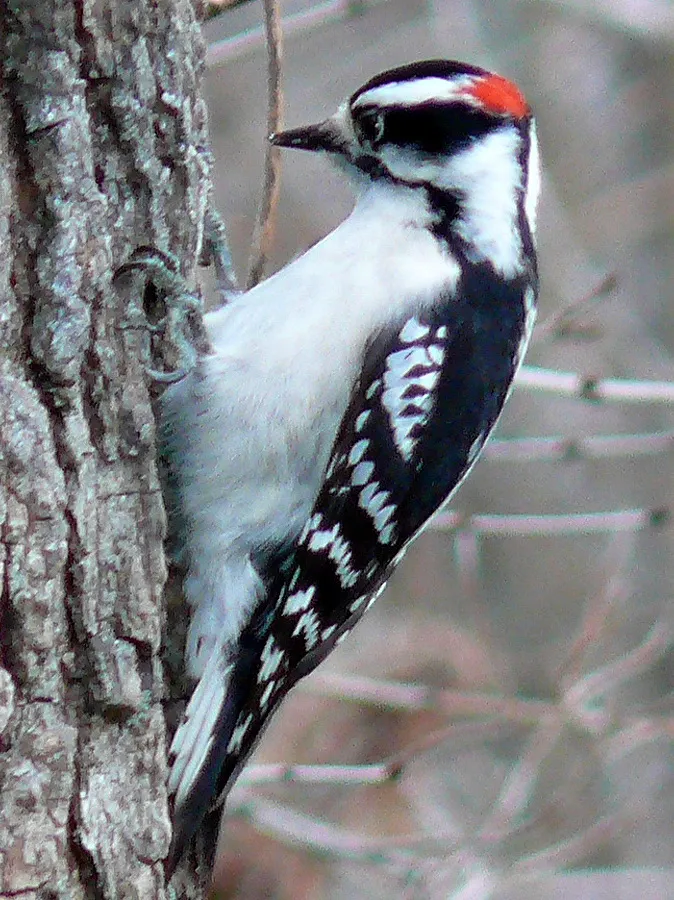
The downy woodpecker (Dryobates pubescens) is a species of woodpecker, the smallest in North America. Length ranges from 14 to 18 cm (5.5 to 7.1 in). Downy woodpeckers primarily live in forested areas throughout the United States and Canada, with the exception of deserts in the southwest and the northern tundra. The bird nests in tree cavities and feeds primarily on insects, although it supplements its diet with seeds and berries. The downy woodpecker is very similar in appearance to the hairy woodpecker, although they are not closely related.
Description
Adult downy woodpeckers are the smallest of North America's woodpeckers, but there are many smaller species elsewhere, especially the piculets. The total length of the species ranges from 14 to 18 cm (5.5 to 7.1 in) and the wingspan from 25 to 31 cm (9.8 to 12.2 in). Body mass ranges from 20 to 33 g (0.71 to 1.16 oz). Standard measurements are as follows: the wing chord is 8.5–10 cm (3.3–3.9 in), the tail is 4–6 cm (1.6–2.4 in), the bill is 1–1.8 cm (0.39–0.71 in) and the tarsus is 1.1–1.7 cm (0.43–0.67 in). The downy woodpecker is mainly black on the upperparts and wings, with a white back, throat and belly and white spotting on the wings. There is one white bar above the eye, and one below. They have a black tail with white outer feathers barred with black. Adult males have a red patch on the back of the head whereas juvenile males display a red cap. The downy woodpecker is virtually identical in plumage pattern to the larger hairy woodpecker, but it can be distinguished from the hairy by the presence of black spots on its white tail feathers and the length of its bill. The downy woodpecker's bill is shorter than its head, whereas the hairy woodpecker's bill is approximately equal to head length.
Reproduction
Downy woodpeckers will start breeding in their first possible season and will return to a site within 2 hectares of where they were born. They breed every year of their mature life, possibly returning to the same nest holes that they used in years prior. Barring the presence of an existing hole, downy woodpeckers will create a cavity in a tree roughly 2.4 to 15.3 m (8 to 50 ft) above the ground, with the male woodpecker pecking the hole for roughly half of the daylight hours, in 20 minute work sessions. The nest hole takes about two or three weeks to create, and normally measures 12 to 15 cm wide and about 20 to 30 cm deep. A female will typically lay 4–5 white eggs, but can lay up to 7. During waking hours, both birds will incubate, or warm the eggs for 15 minute periods, taking turns in alternating shifts. At night, the male woodpecker typically will rest on the eggs for their continued warmth. This incubation period lasts for about 12 days. When the eggs hatch, the infant woodpeckers weigh about 1.6 grams, which will rise to around 3.2 grams over the course of its first day of life. They will appear fully grown by the 17th or 18th day.
Text from Wikipedia — Downy woodpecker, revision 1371443514, CC BY-SA 4.0, retrieved 2026-09-04. Encyclopedic text reused under CC BY-SA 4.0. Sentences about hunting or regulation are removed: on this site, the rule comes from Québec.ca.
Other names
French
English
Presence in Quebec
- Origin
- Indigène
- Occurrence
- Régulier
- Population status
- Toute l'année
- Certainty
- Confirmé
Conservation
Québec.ca
Official periods
Source: Québec.ca — tables reproduced as published (retrieved 2026-08-30).
Regulations change. Always check Québec.ca before hunting or trapping.
Where this data comes from
This species is listed in an official government dataset. The identification and status shown in the data sheet are reproduced from it.
Source: List of Quebec’s vertebrate wildlife (LFVQ) — Ministère de l’Environnement, de la Lutte contre les changements climatiques, de la Faune et des Parcs. File LFVQ_25_03_2026.csv, retrieved 2026-08-30 · CC BY 4.0.
Measurements, habitat, diet and reproduction are not shown: no official source is attached to them yet.