
No period published by Québec.ca
Québec.ca publishes no hunting or trapping period for this species. Check the official regulations.
Wikipedia
Pie d'Amérique
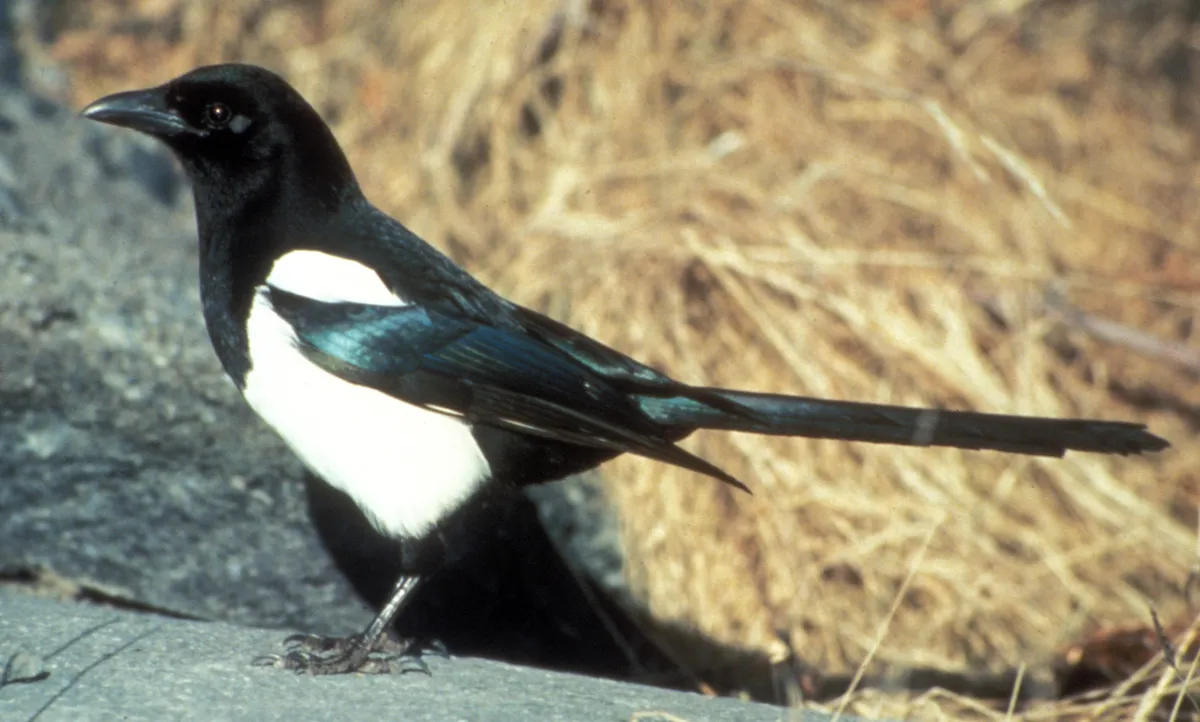
The black-billed magpie (Pica hudsonia), also known as the American magpie, is a bird in the corvid family found in the western half of North America. It is black and white, with the wings and tail showing black areas and iridescent hints of blue and blue-green. It was formerly treated as a subspecies of Pica pica (Eurasian magpie), but was separated as a species in its own in 2000 based on genetic studies. This species prefers generally open habitats with clumps of trees, but can also commonly be found in farmlands and suburban areas. Historically associated with bison herds, it now lands on the backs of cattle to glean ticks and insects from them. Black-billed magpies commonly follow large predators, such as wolves, to scavenge from their kills. The species also walks or hops on the ground, where it obtains food items such as beetles, grasshoppers, worms, and small rodents. The black-billed magpie builds domed nests which are made up of twigs and are located near the top of trees, usually housing six to seven eggs. Incubation, by the female only, starts when the clutch is complete, and lasts 16–21 days. The nestling period is three to four weeks. Black-billed magpies in the wild have a lifespan of six to seven years. Black-billed magpies have a long history with humans, being featured in stories told by Indigenous tribes of the Great Plains. Where persecuted it becomes very wary, but otherwise it is fairly tolerant of human presence. Today, they are considered a species of least concern by the IUCN, and they are commonly seen throughout their range.
Description
The black-billed magpie is an unmistakable bird within its range. It is a medium-sized bird that measures 45–60 cm (18–24 in) from tip to tail. It is largely black, with white scapulars, belly, and primaries, and the wings and tail are an iridescent blue-green. The tail is made up of long, layered feathers, the middle pair of which extend further than the rest. The beak is uniformly black, oblong, and weakly curved toward the tip. Adults also have black irises. Unlike most other members of the family Corvidae, the black-billed magpie is dimorphic in size and weight, though there can be overlap between the sexes. Males are, on average, 6–9% larger and 16–24% heavier than females, at 167–216 g (5.9–7.6 oz), an individual wing chord of 205–219 mm (8.1–8.6 in), and tail lengths of 230–320 mm (9.1–12.6 in). Females weigh between 141–179 g (5.0–6.3 oz), have individual wing chords of 175–210 mm (6.9–8.3 in), and tail lengths of 232–300 mm (9.1–11.8 in). Juveniles have less iridescence on their wings and tail, buffier scapulars and belly, and they lack the distinctive long tail feathers. Their rectrices are typically rounder and narrower, and have more black on their wing-tips compared to mature adults. They also have pink mouth-linings and grey irises. All juvenile features will typically be gone by the first year's moult.
Text from Wikipedia — Black-billed magpie, revision 1363122346, CC BY-SA 4.0, retrieved 2026-09-04. Encyclopedic text reused under CC BY-SA 4.0. Sentences about hunting or regulation are removed: on this site, the rule comes from Québec.ca.
Other names
French
English
Former scientific names
Presence in Quebec
- Origin
- Indigène
- Occurrence
- Accidentel/non régulier
- Population status
- Migrateur
- Certainty
- Confirmé
Conservation
Québec.ca
Official periods
Source: Québec.ca — tables reproduced as published (retrieved 2026-08-30).
Regulations change. Always check Québec.ca before hunting or trapping.
Where this data comes from
This species is listed in an official government dataset. The identification and status shown in the data sheet are reproduced from it.
Source: List of Quebec’s vertebrate wildlife (LFVQ) — Ministère de l’Environnement, de la Lutte contre les changements climatiques, de la Faune et des Parcs. File LFVQ_25_03_2026.csv, retrieved 2026-08-30 · CC BY 4.0.
Measurements, habitat, diet and reproduction are not shown: no official source is attached to them yet.