
No period published by Québec.ca
Québec.ca publishes no hunting or trapping period for this species. Check the official regulations.
Wikipedia
Pie-grièche boréale
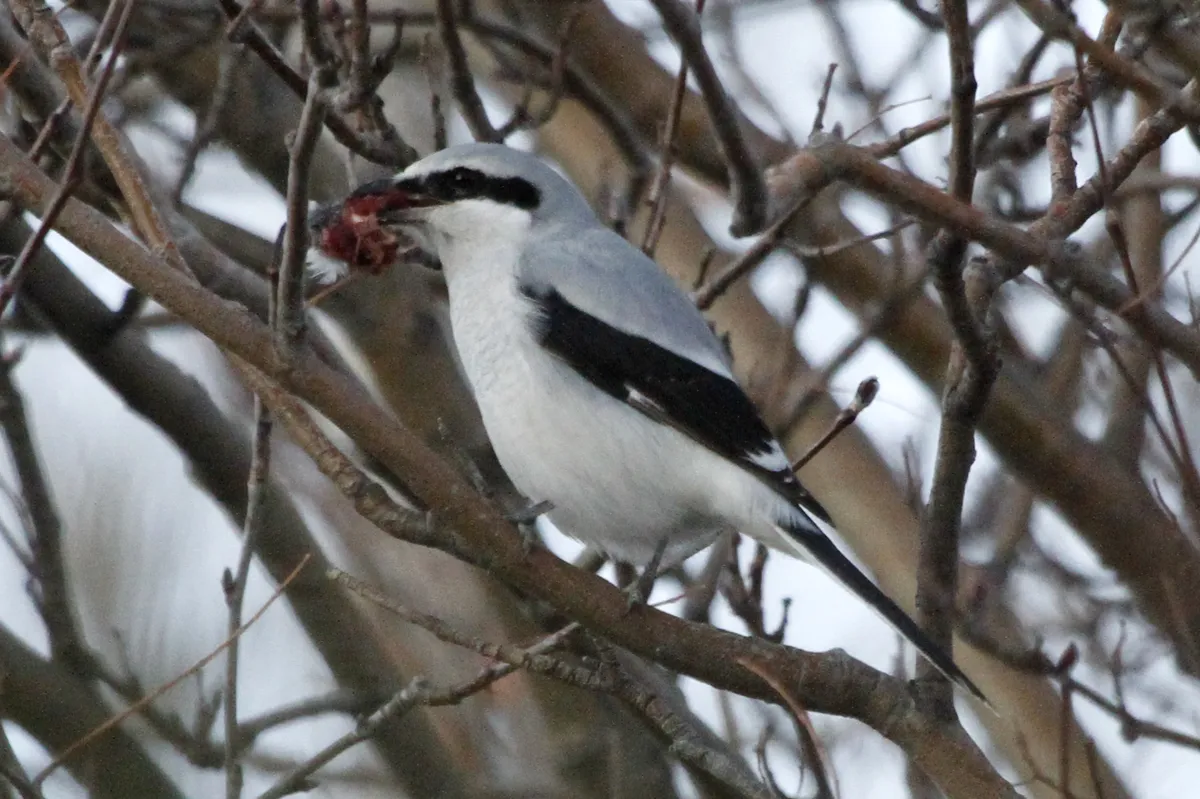
The northern shrike (Lanius borealis) is a large songbird species in the shrike family (Laniidae) native to North America and Siberia. Long considered a subspecies of the great grey shrike, it was classified as a distinct species in 2017. Six subspecies are recognised.
Description
The loggerhead shrike can be distinguished from the northern shrike by its smaller size, darker grey plumage and larger black face mask that covers the eye completely. It also has a shorter bill with less prominent hook. Their calls are similar. Measurements: Length: 9.1–9.4 in (23–24 cm) Weight: 2.0–2.8 oz (57–79 g) Wingspan: 11.8–13.8 in (30–35 cm)
Diet
Northern shrikes often sit on tall poles and branches surveying for food. They prey on arthropods such as spiders, beetles, bugs, and grasshoppers, and small vertebrates. Prey identified include passerine birds such as horned lark, black-capped chickadee, common starling, brewer's sparrow, white-crowned sparrow, dark-eyed junco, pine siskin, house sparrow, small mammals such as the vagrant shrew, western harvest mouse, deer mouse, long-tailed vole, meadow vole and house mouse, and reptiles such as spiny lizards. They are known to lure small birds by imitating their calls.
Text from Wikipedia — Northern shrike, revision 1322344985, CC BY-SA 4.0, retrieved 2026-09-04. Encyclopedic text reused under CC BY-SA 4.0. Sentences about hunting or regulation are removed: on this site, the rule comes from Québec.ca.
Other names
French
English
Former scientific names
Presence in Quebec
- Origin
- Indigène
- Occurrence
- Régulier
- Population status
- Reproducteur
- Certainty
- Confirmé
Conservation
Québec.ca
Official periods
Source: Québec.ca — tables reproduced as published (retrieved 2026-08-30).
Regulations change. Always check Québec.ca before hunting or trapping.
Where this data comes from
This species is listed in an official government dataset. The identification and status shown in the data sheet are reproduced from it.
Source: List of Quebec’s vertebrate wildlife (LFVQ) — Ministère de l’Environnement, de la Lutte contre les changements climatiques, de la Faune et des Parcs. File LFVQ_25_03_2026.csv, retrieved 2026-08-30 · CC BY 4.0.
Measurements, habitat, diet and reproduction are not shown: no official source is attached to them yet.