
No period published by Québec.ca
Québec.ca publishes no hunting or trapping period for this species. Check the official regulations.
Wikipedia
Pigeon ramier
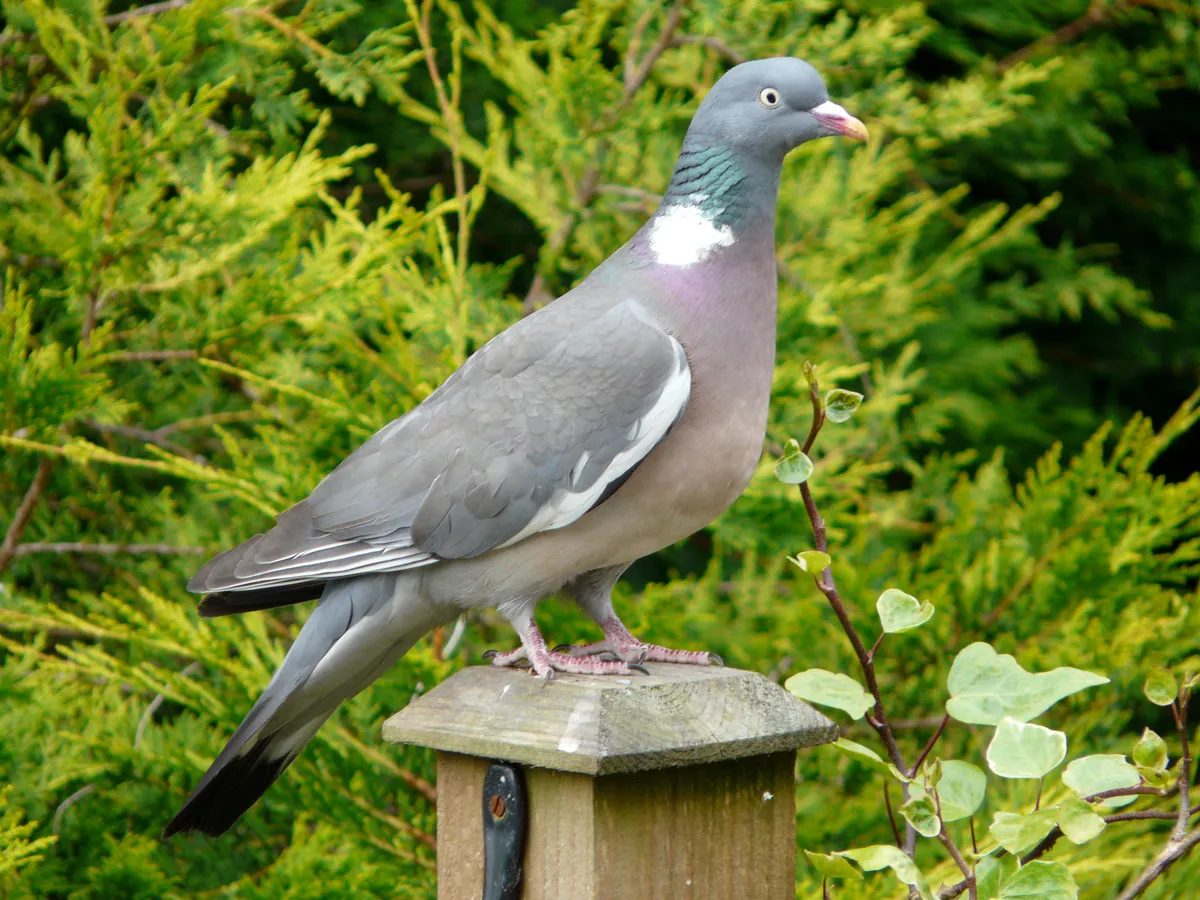
The common wood pigeon (Columba palumbus), also known simply as the wood pigeon, is a large pigeon native to the western Palearctic. It belongs to the genus Columba, which includes closely related species such as the rock dove (Columba livia). It has a flexible diet, feeding mainly on plant material, including cereals, and is therefore considered an agricultural pest.
Description
The three Western European Columba pigeons, common wood pigeon, stock dove and rock dove, though superficially alike, have very distinctive characteristics; the common wood pigeon may be identified at once by its larger size at 38–44.5 cm (15–17+1⁄2 in) and weight 300–615 g (10+5⁄8–21+3⁄4 oz), and the white on its neck and wing. It is otherwise a basically grey bird, with a pinkish breast. The wingspan can range from 68 to 80 cm (27 to 31 in) and the wing chord measures 24 to 25.4 cm (9+1⁄2 to 10 in). The tail measures 13.8 to 15 cm (5+1⁄2 to 6 in), the bill is 1.9 to 2.2 cm (3⁄4 to 7⁄8 in) and the tarsus is 2.5 to 2.8 cm (1 to 1+1⁄8 in). Adult birds bear a series of green and white patches on their necks, and a pink patch on their chest. The eye colour is a pale yellow, in contrast to that of rock doves, which is orange-red, and the stock dove, which is dark grey-brown to black. Juveniles lack the white patches on either side of the neck. When they are around six months old (about three months after leaving the nest), they develop small white patches on either side of the neck. These gradually increase in size until they are fully formed when the bird is about 6–8 months of age. Juveniles also have a greyer bill and an overall lighter grey appearance than adults.
Text from Wikipedia — Common wood pigeon, revision 1358214024, CC BY-SA 4.0, retrieved 2026-09-04. Encyclopedic text reused under CC BY-SA 4.0. Sentences about hunting or regulation are removed: on this site, the rule comes from Québec.ca.
Presence in Quebec
- Origin
- Indigène
- Occurrence
- Accidentel/non régulier
- Population status
- Migrateur
- Certainty
- Confirmé
Conservation
Québec.ca
Official periods
Source: Québec.ca — tables reproduced as published (retrieved 2026-08-30).
Regulations change. Always check Québec.ca before hunting or trapping.
Where this data comes from
This species is listed in an official government dataset. The identification and status shown in the data sheet are reproduced from it.
Source: List of Quebec’s vertebrate wildlife (LFVQ) — Ministère de l’Environnement, de la Lutte contre les changements climatiques, de la Faune et des Parcs. File LFVQ_25_03_2026.csv, retrieved 2026-08-30 · CC BY 4.0.
Measurements, habitat, diet and reproduction are not shown: no official source is attached to them yet.