
Pioui de l'Ouest— Quebec wildlife
Contopus sordidulus
TyrannidaeNo period published by Québec.ca
Québec.ca publishes no hunting or trapping period for this species. Check the official regulations.
Wikipedia
Pioui de l'Ouest
Description
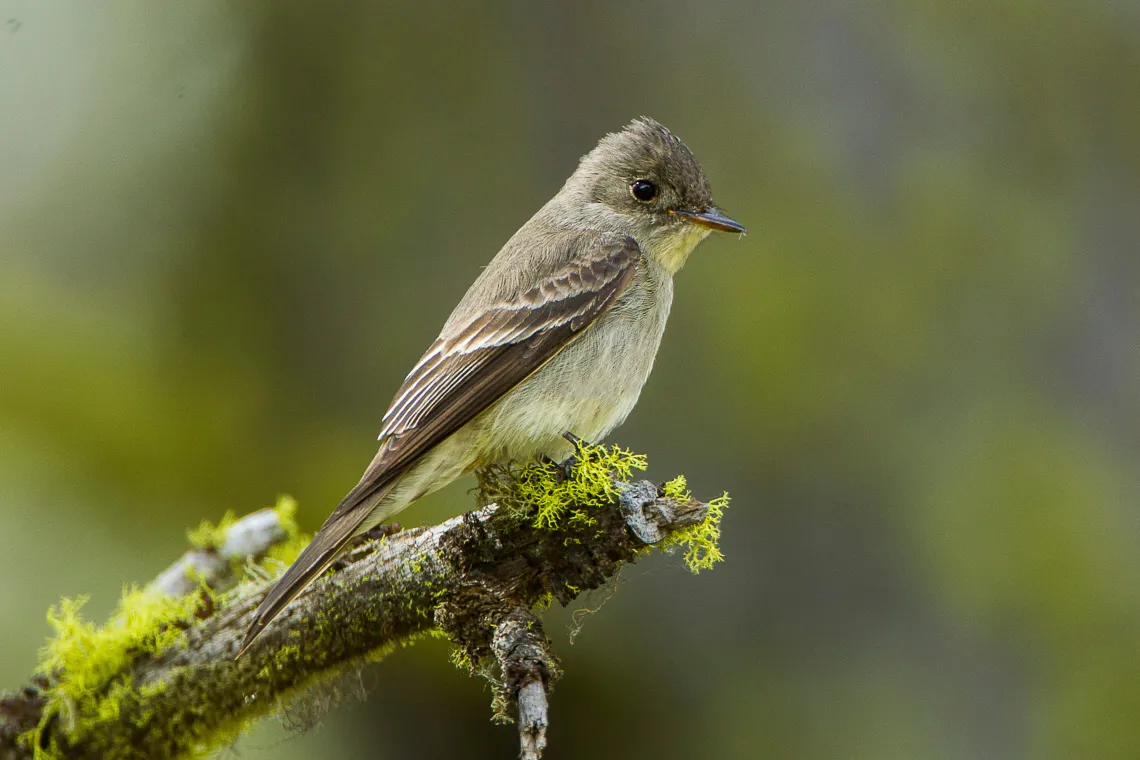
Adults are gray-olive on the upperparts with light underparts, washed with olive on the breast. They have two wing bars and a dark bill with yellow at the base of the lower mandible. This bird is very similar in appearance to the eastern wood pewee; the two birds were formerly considered to be one species. The call of C. sordidulus is a loud buzzy peeer; the song consists of three rapid descending tsees ending with a descending peeer. The bird is about 5.5–6.3 in (14–16 cm) in length, 0.4–0.5 oz (11–14 g) in weight, and has a wingspan of 10.2 in (26 cm).
Text from Wikipedia — Western wood pewee, revision 1365335714, CC BY-SA 4.0, retrieved 2026-09-04. Encyclopedic text reused under CC BY-SA 4.0. Sentences about hunting or regulation are removed: on this site, the rule comes from Québec.ca.
Presence in Quebec
- Origin
- Indigène
- Occurrence
- Accidentel/non régulier
- Population status
- Migrateur
- Certainty
- Confirmé
Conservation
Québec.ca
Official periods
Source: Québec.ca — tables reproduced as published (retrieved 2026-08-30).
Regulations change. Always check Québec.ca before hunting or trapping.
Where this data comes from
This species is listed in an official government dataset. The identification and status shown in the data sheet are reproduced from it.
Source: List of Quebec’s vertebrate wildlife (LFVQ) — Ministère de l’Environnement, de la Lutte contre les changements climatiques, de la Faune et des Parcs. File LFVQ_25_03_2026.csv, retrieved 2026-08-30 · CC BY 4.0.
Measurements, habitat, diet and reproduction are not shown: no official source is attached to them yet.