No period published by Québec.ca
Québec.ca publishes no hunting or trapping period for this species. Check the official regulations.
Wikipedia
Pipistrelle de l'Est
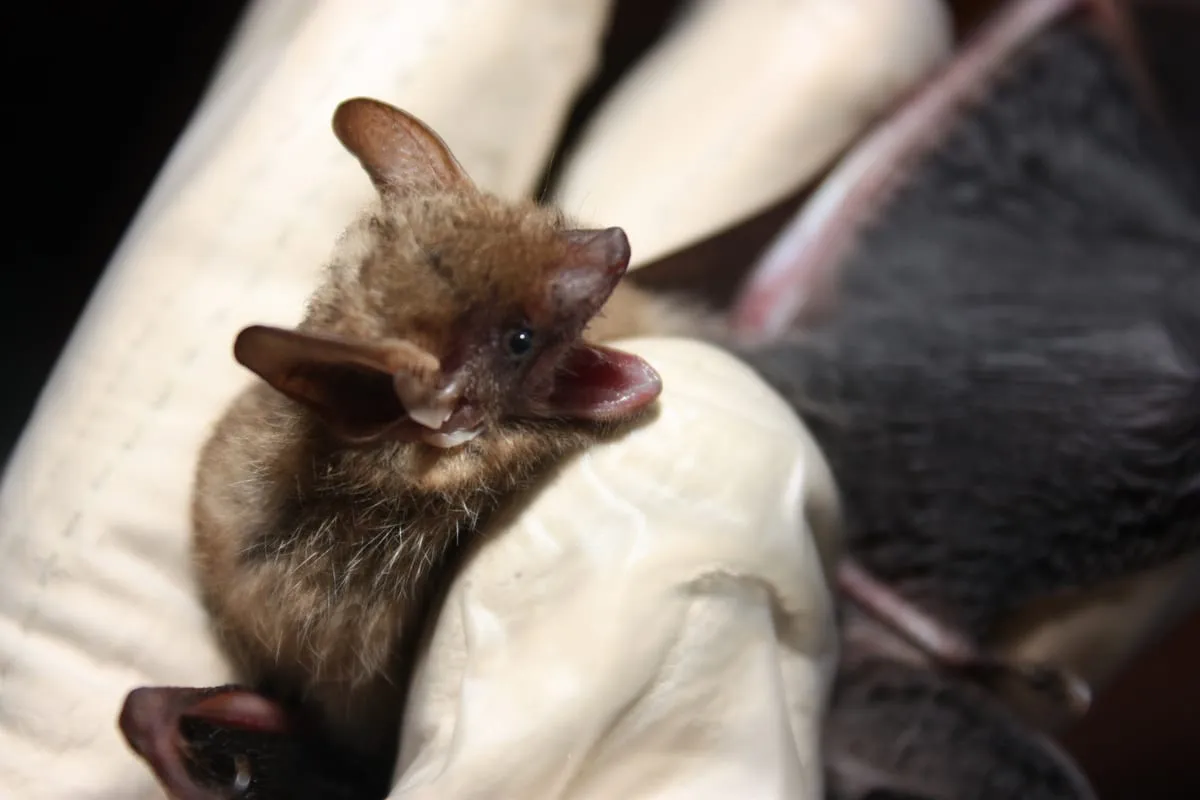
The tricolored bat (Perimyotis subflavus) or American perimyotis is a species of microbat native to eastern North America. Formerly known as the eastern pipistrelle, based on the incorrect belief that it was closely related to European Pipistrellus species, the closest known relative of the tricolored bat is now recognized as the canyon bat. Its common name "tricolored bat" derives from the coloration of the hairs on its back, which have three distinct color bands. It is the smallest bat species in the eastern and midwestern US, with individuals weighing only 4.6–7.9 g (0.16–0.28 oz). This species mates in the fall before hibernation, though due to sperm storage, females do not become pregnant until the spring. Young are born helpless, though rapidly develop, flying and foraging for themselves by four weeks old. It has a relatively long lifespan, and can live nearly fifteen years. In the summer, females roost in small groups and males roost solitarily in tree foliage or beard lichen. It eats a diverse array of insects, foraging with a slow, erratic flight and navigating via echolocation. Though once considered one of the most common bat species in its range, its populations have declined rapidly since 2006 with the introduction of the fungal disease white-nose syndrome. It was listed as an endangered species in 2012 in Canada, and has been petitioned for inclusion on the US endangered species list. Along with the silver-haired bat, the tricolored bat is one of two bat species whose rabies variants have most frequently been implicated in human rabies deaths in the US, with sixteen deaths from 1958–2000.
Description
The tricolored bat has blond fur that is distinctly tricolored on its back. Individual hairs tricolored: dark gray at the base, buffy (yellowish brown) in the middle, and brown or reddish brown at the tip. It is the smallest bat species found in the eastern and midwestern US. Individuals have a forearm length of 31.4–34.1 mm (1.24–1.34 in) and weigh 4.6–7.9 g (0.16–0.28 oz). Its forearms are reddish, contrasting sharply with the black membranes of its wings. Its wingspan is 21–26 cm (8.3–10.2 in). It has a dental formula of 2.1.2.33.1.2.3 for a total of 34 teeth.
Text from Wikipedia — Tricolored bat, revision 1368892333, CC BY-SA 4.0, retrieved 2026-09-04. Encyclopedic text reused under CC BY-SA 4.0. Sentences about hunting or regulation are removed: on this site, the rule comes from Québec.ca.
Other names
English
Former scientific names
Presence in Quebec
- Origin
- Indigène
- Occurrence
- Régulier
- Population status
- Toute l'année
- Certainty
- Confirmé
Conservation
Québec.ca
Official periods
Source: Québec.ca — tables reproduced as published (retrieved 2026-08-30).
Regulations change. Always check Québec.ca before hunting or trapping.
Where this data comes from
This species is listed in an official government dataset. The identification and status shown in the data sheet are reproduced from it.
Source: List of Quebec’s vertebrate wildlife (LFVQ) — Ministère de l’Environnement, de la Lutte contre les changements climatiques, de la Faune et des Parcs. File LFVQ_25_03_2026.csv, retrieved 2026-08-30 · CC BY 4.0.
Measurements, habitat, diet and reproduction are not shown: no official source is attached to them yet.