
Plectrophane des neiges— Quebec wildlife
Plectrophenax nivalis
CalcariidaeNo period published by Québec.ca
Québec.ca publishes no hunting or trapping period for this species. Check the official regulations.
Wikipedia
Plectrophane des neiges
The snow bunting (Plectrophenax nivalis) is a passerine bird in the family Calcariidae. It is an Arctic specialist, with a circumpolar Arctic breeding range throughout the northern hemisphere. There are small isolated populations on a few high mountain tops south of the Arctic region, including the Cairngorms in central Scotland and the Saint Elias Mountains on the southern Alaska-Yukon border, as well as the Cape Breton Highlands. The snow bunting is the most northerly recorded passerine in the world.
Description
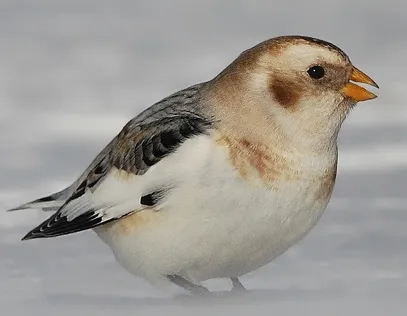
The snow bunting is a sexually dimorphic, medium-sized passerine bird. It is ground-dwelling, and walks, runs and can hop if needed. It is fairly large and long-winged for a bunting. It measures 15 cm with a wingspan of 32–38 cm (13–15 in) and weights 30 to 40 grams. The bill is normally yellow with a black tip, however in males, the bill is all black in the summer. The plumage is white underneath and the wings and back have black and white on them. The female and male have different plumage; during the breeding season, the male is white with black wingtips and a black back, while the female has black wingtips and the black feathers on the back fringed with brown. During the winter, they both have broad orangey-brown fringes on the back feathers. In the spring, the buntings do not moult as many other passerines do; instead the breeding colours come with the wearing and abrasion of the brown fringes to show just the black centres of the feathers. Unlike most passerines, it has feathered tarsi, an adaptation to its harsh cold environment. No other passerine can winter as far north as this species, apart from the common raven. This species is easily confused with McKay's bunting due to the similarity of their plumage and the occurrence of hybrids. It can also be confused with the Lapland longspur, which differs mainly in having minimal white in the wing; their calls are similar, but the snow bunting has more 'liquid' rippling tone, while Lapland longspur has a drier, more rattling tone. Another species that it may occur with is the horned lark, although that has a conspicuous black-and-yellow head pattern, a longer, partly black tail and no white on the wings.
Text from Wikipedia — Snow bunting, revision 1354819038, CC BY-SA 4.0, retrieved 2026-09-04. Encyclopedic text reused under CC BY-SA 4.0. Sentences about hunting or regulation are removed: on this site, the rule comes from Québec.ca.
Other names
French
English
Presence in Quebec
- Origin
- Indigène
- Occurrence
- Régulier
- Population status
- Reproducteur
- Certainty
- Confirmé
Conservation
Québec.ca
Official periods
Source: Québec.ca — tables reproduced as published (retrieved 2026-08-30).
Regulations change. Always check Québec.ca before hunting or trapping.
Where this data comes from
This species is listed in an official government dataset. The identification and status shown in the data sheet are reproduced from it.
Source: List of Quebec’s vertebrate wildlife (LFVQ) — Ministère de l’Environnement, de la Lutte contre les changements climatiques, de la Faune et des Parcs. File LFVQ_25_03_2026.csv, retrieved 2026-08-30 · CC BY 4.0.
Measurements, habitat, diet and reproduction are not shown: no official source is attached to them yet.