
No period published by Québec.ca
Québec.ca publishes no hunting or trapping period for this species. Check the official regulations.
Wikipedia
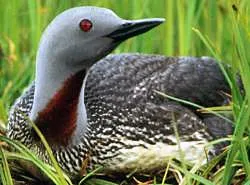
Plongeon catmarin
The red-throated loon (North America) or red-throated diver (Britain and Ireland) (Gavia stellata) is a migratory aquatic bird found in the Northern Hemisphere. The most widely distributed member of the loon or diver family, it breeds primarily in Arctic regions, and it winters in northern coastal waters. Ranging from 55 to 67 centimetres (22 to 26 in) in length, the red-throated loon is the smallest and lightest of the world's loons. In winter, it is a nondescript bird, greyish above, fading to white below. During the breeding season, it acquires the distinctive reddish throat patch, which is the basis for its common name. Fish form the bulk of its diet, though amphibians, invertebrates, and plant material are sometimes eaten as well. A monogamous species, red-throated loons form long-term pair bonds. Both members of the pair help to build the nest, incubate the eggs (generally two per clutch), and feed the hatched young. The red-throated loon has a large global population and a significant global range, though some populations are declining. Oil spills, habitat degradation, pollution, and fishing nets are among the major threats this species faces. Natural predators—including various gull species, and both red and Arctic foxes, will take eggs and young. The species is protected by international treaties.
Description
Like the other members of its genus, the red-throated loon is well adapted to its aquatic environment: its dense bones help it to submerge, its legs—in their set-back position—provide excellent propulsion, and its body is long and streamlined. Even its sharply pointed bill may help its underwater streamlining. Its feet are large, its front three toes are fully webbed, and its tarsus is flattened, which reduces drag and allows the leg to move easily through the water. The red-throated loon is the smallest and lightest of the world's loon species, ranging from 53 to 69 cm (21 to 27 in) in length with a 91–120 cm (36–47 in) wingspan, and weighing 1–2.7 kg (2.2–6.0 lb). Like all loons, it is long-bodied and short-necked, with its legs set far back on its body. The sexes are similar in appearance, although males tend to be slightly larger and heavier than females. In breeding plumage, the adult has a dark grey head and neck (with narrow black and white stripes on the back of the neck), a triangular red throat patch, white underparts, and a dark grey-brown mantle. It is the only loon with an all-dark back in breeding plumage. The non-breeding plumage is drabber with the chin, foreneck, and much of the face white, the top of the head and back of the neck grey, and considerable white speckling on the dark mantle. Its iris is carmine-red to burgundy in colour, its legs are black on the outer half and pale on the inner half, and the webs of its feet are pinkish-brown, with darker margins. Its bill is thin, straight, and sharp, and often held at an uptilted angle.
Text from Wikipedia — Red-throated loon, revision 1360619947, CC BY-SA 4.0, retrieved 2026-09-04. Encyclopedic text reused under CC BY-SA 4.0. Sentences about hunting or regulation are removed: on this site, the rule comes from Québec.ca.
Other names
French
English
Presence in Quebec
- Origin
- Indigène
- Occurrence
- Régulier
- Population status
- Reproducteur
- Certainty
- Confirmé
Conservation
Québec.ca
Official periods
Source: Québec.ca — tables reproduced as published (retrieved 2026-08-30).
Regulations change. Always check Québec.ca before hunting or trapping.
Where this data comes from
This species is listed in an official government dataset. The identification and status shown in the data sheet are reproduced from it.
Source: List of Quebec’s vertebrate wildlife (LFVQ) — Ministère de l’Environnement, de la Lutte contre les changements climatiques, de la Faune et des Parcs. File LFVQ_25_03_2026.csv, retrieved 2026-08-30 · CC BY 4.0.
Measurements, habitat, diet and reproduction are not shown: no official source is attached to them yet.