
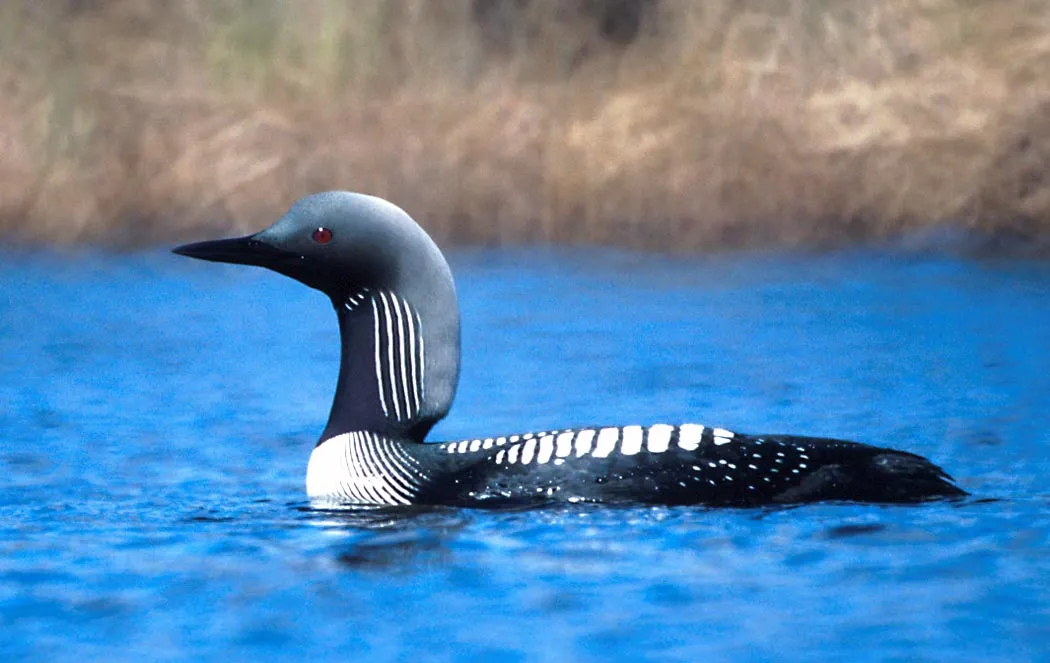
Plongeon du Pacifique— Quebec wildlife
Gavia pacifica
GaviidaeNo period published by Québec.ca
Québec.ca publishes no hunting or trapping period for this species. Check the official regulations.
Wikipedia
Plongeon du Pacifique
The Pacific loon or Pacific diver (Gavia pacifica) is a medium-sized member of the loon, or diver, family.
Description
Breeding adults are like a smaller sleeker version of common loon. They measure 58–74 cm (23–29 in) in length, 110–128 cm (43–50 in) in wingspan and weigh 1–2.5 kg (2.2–5.5 lb). They have a grey head, black throat, white underparts and chequered black-and-white mantle. The black throat has purple reflections. Non-breeding plumage is drabber with the chin and foreneck white. Its bill is grey or whitish and dagger-shaped. In all plumages, lack of a white flank patch distinguishes this species from the otherwise very similar black-throated loon. The Pacific loon can be differentiated from the red-throated loon in winter by the latter's paler look, the fact that the red-throated loon has less of a contrast between both the crown and hindneck and the throat, and the bill that looks to be upturned. Like other gaviiformes, the Pacific loon's legs are located towards the back of its body making it difficult for it to walk on land. The leg placement helps the loons efficiently forage for food underwater. The physiological structure of the Pacific loon makes taking off from land practically impossible, and the loon requires 30 to 50 yards (27 to 46 m) on the water to successfully attain flight. This distance requirement for takeoff limits the number of lakes the Pacific loon can realistically breed and forage on.
Text from Wikipedia — Pacific loon, revision 1362782434, CC BY-SA 4.0, retrieved 2026-09-04. Encyclopedic text reused under CC BY-SA 4.0. Sentences about hunting or regulation are removed: on this site, the rule comes from Québec.ca.
Other names
French
English
Presence in Quebec
- Origin
- Indigène
- Occurrence
- Régulier
- Population status
- Reproducteur
- Certainty
- Confirmé
Conservation
Québec.ca
Official periods
Source: Québec.ca — tables reproduced as published (retrieved 2026-08-30).
Regulations change. Always check Québec.ca before hunting or trapping.
Where this data comes from
This species is listed in an official government dataset. The identification and status shown in the data sheet are reproduced from it.
Source: List of Quebec’s vertebrate wildlife (LFVQ) — Ministère de l’Environnement, de la Lutte contre les changements climatiques, de la Faune et des Parcs. File LFVQ_25_03_2026.csv, retrieved 2026-08-30 · CC BY 4.0.
Measurements, habitat, diet and reproduction are not shown: no official source is attached to them yet.