
No period published by Québec.ca
Québec.ca publishes no hunting or trapping period for this species. Check the official regulations.
Wikipedia
Pluvier bronzé
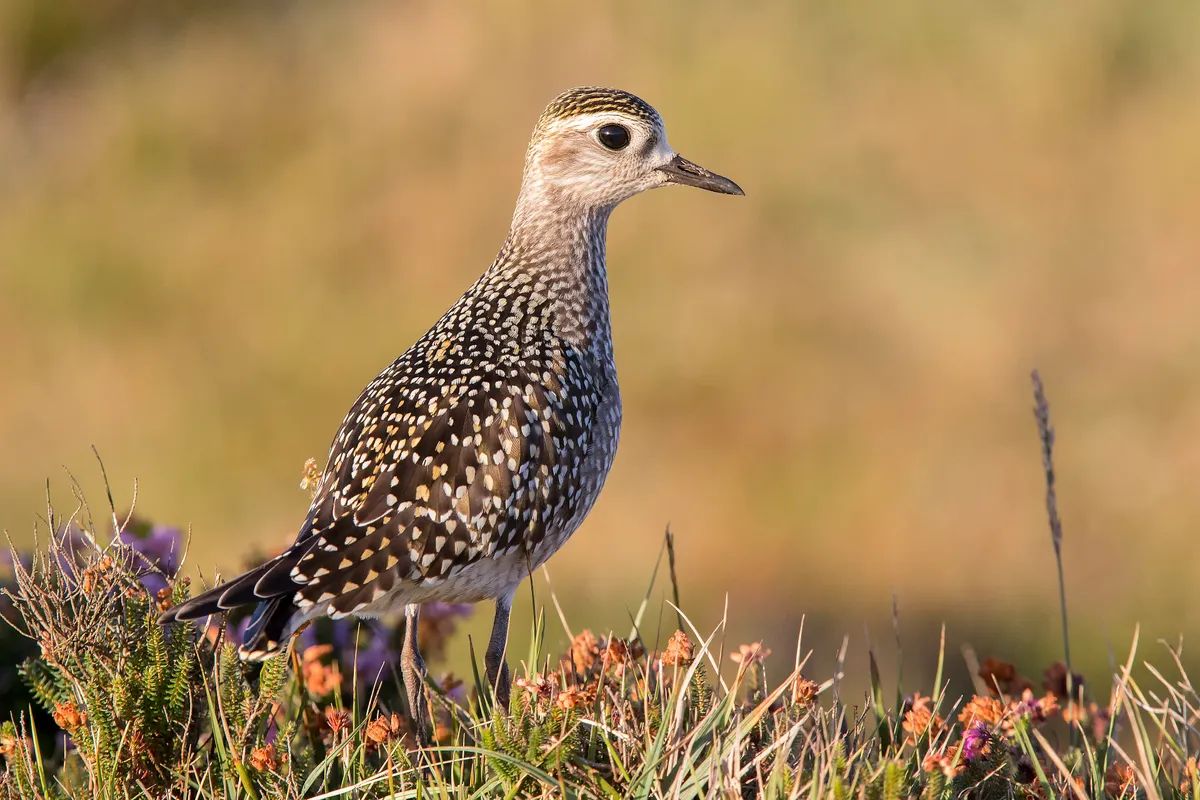
The American golden plover (Pluvialis dominica) is a medium-sized plover. The genus name is Latin and means relating to rain, from pluvia, "rain". It was believed that golden plovers flocked when rain was imminent. The species name dominica refers to Santo Domingo, now Hispaniola, in the West Indies.
Description
Measurements: Length: 24–28 cm (9+1⁄2–11 in) Weight: 122–194 g (4+5⁄16–6+13⁄16 oz) Wingspan: 65–67 cm (25+1⁄2–26+1⁄2 in) The breeding adult American golden plover has a black face, neck, breast, and belly, with a white crown and nape that extends to the side of the breast. The back is mottled black and white with pale, gold spots. The breeding female is similar, but with less black. When in winter plumage, both sexes have grey-brown upperparts, pale grey-brown underparts, and a whitish eyebrow. The head is small, along with the bill. It is similar to two other golden plovers, European and Pacific. The American golden plover is smaller, slimmer and relatively longer-legged than European golden plover (Pluvialis apricaria) which also has white axillary (armpit) feathers. It is more similar to Pacific golden plover (Pluvialis fulva) with which it shares grey axillary feathers; it was once considered conspecific under the name "lesser golden plover". The Pacific golden plover is slimmer than the American species, has a shorter primary projection, and longer legs, and is usually yellower on the back. In breeding plumage, the American golden plover has a solid black lower belly and undertail, while the Pacific and European golden plovers have at least some to extensive white on the flanks and undertail. However, first-summer immature birds often gain only partial summer plumage with incomplete black and can be confused more easily. Another useful distinction is that in fall, the post-breeding moult is a month or more later in American golden plover (September to October, on the wintering grounds) than in Pacific golden plover (August).
Habitat and range
The breeding habitat of American golden plover is Arctic tundra in northern Canada (Baffin Island west to Yukon and northernmost British Columbia) and Alaska. They nest on the ground in a dry open area. They are migratory and winter in southern South America. They follow an elliptical migration path; northbound birds pass through Central America from January to April and stage in great numbers in places like Illinois before their final push north. In fall, they take a more easterly route, flying mostly over the western Atlantic and Caribbean Sea to the wintering grounds in Patagonia. The bird has one of the longest known migratory routes of over 40,000 km (25,000 mi). Of this, 3,900 km (2,400 mi) is over open ocean where it cannot stop to feed or drink. It does this from body fat stores that it stocks up on prior to the flight. It is a regular though scarce fall migrant in western Europe, with typically 20–25 sightings annually in Great Britain; spring records are much rarer.
Text from Wikipedia — American golden plover, revision 1352508101, CC BY-SA 4.0, retrieved 2026-09-04. Encyclopedic text reused under CC BY-SA 4.0. Sentences about hunting or regulation are removed: on this site, the rule comes from Québec.ca.
Other names
French
English
Presence in Quebec
- Origin
- Indigène
- Occurrence
- Régulier
- Population status
- Reproducteur
- Certainty
- Confirmé
Conservation
Québec.ca
Official periods
Source: Québec.ca — tables reproduced as published (retrieved 2026-08-30).
Regulations change. Always check Québec.ca before hunting or trapping.
Where this data comes from
This species is listed in an official government dataset. The identification and status shown in the data sheet are reproduced from it.
Source: List of Quebec’s vertebrate wildlife (LFVQ) — Ministère de l’Environnement, de la Lutte contre les changements climatiques, de la Faune et des Parcs. File LFVQ_25_03_2026.csv, retrieved 2026-08-30 · CC BY 4.0.
Measurements, habitat, diet and reproduction are not shown: no official source is attached to them yet.