
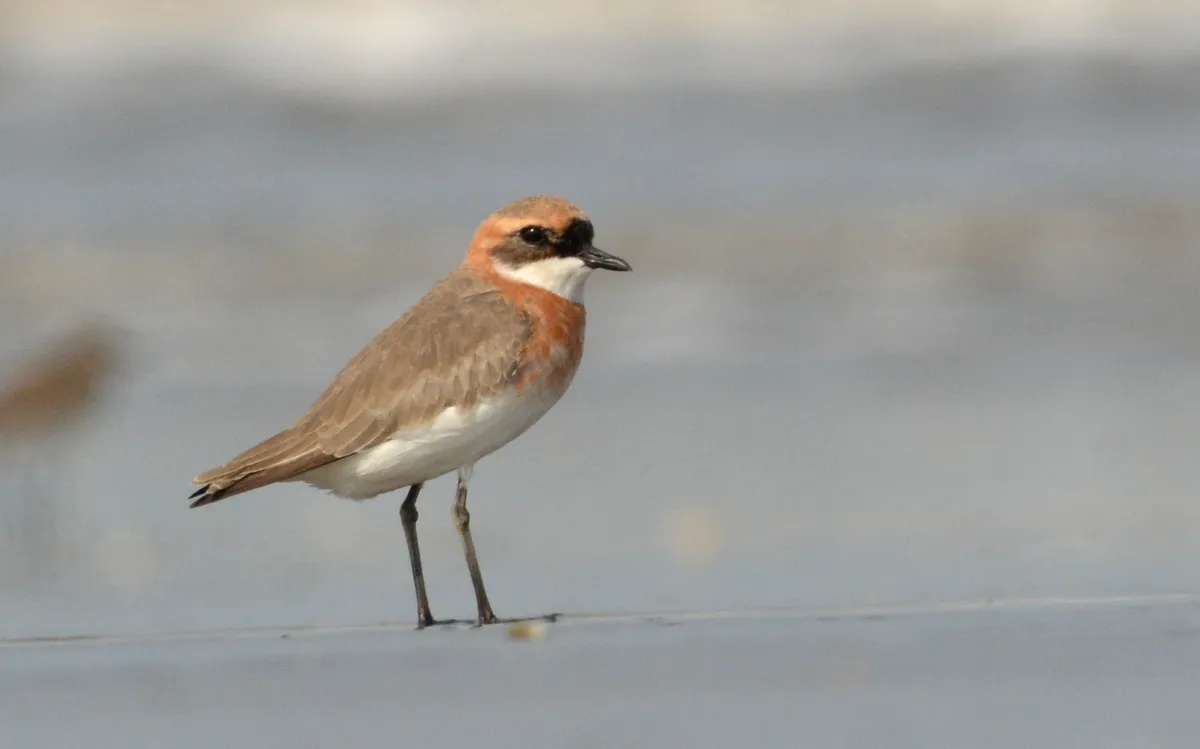
Pluvier de Mongolie— Quebec wildlife
Anarhynchus mongolus
CharadriidaeNo period published by Québec.ca
Québec.ca publishes no hunting or trapping period for this species. Check the official regulations.
Wikipedia
Pluvier de Mongolie
The Siberian sand plover (Anarhynchus mongolus) is a small wader in the plover family of birds. The International Ornithologists' Union split the Tibetan sand plover from the lesser sand plover and changed its vernacular name to Siberian sand plover. The specific mongolus is Latin and refers to Mongolia, which at the time of naming referred to a larger area than the present country.
Description
This chunky plover is long-legged and long-billed. Breeding males have grey backs and white underparts. The breast, forehead and nape are chestnut, and there is a black eye mask. The female is duller, and winter and juvenile birds lack the chestnut, apart from a hint of rufous on the head. Legs are dark and the bill black. In all plumages, this species is very similar to the greater sand plover, Charadrius leschenaultii. Separating the species may be straightforward in mixed wintering flocks on an Indian beach, where the difference in size and structure is obvious; it is more difficult to identify a lone vagrant to western Europe, where both species are very rare. The problem is compounded in that the Middle Eastern race of greater sand plover is the most similar to the lesser. The lesser usually has darker legs, a white forehead, and a more even white wing bar than the greater.
Habitat and range
It breeds discontinuously across bare coastal plains in north-eastern Siberia, with the Mongolian plover in the eastern part of the range; it has also bred in Alaska. It nests in a bare ground scrape, laying three eggs. This species is strongly migratory, wintering on sandy beaches in east and southeast Asia and Australia.
Text from Wikipedia — Siberian sand plover, revision 1345393331, CC BY-SA 4.0, retrieved 2026-09-04. Encyclopedic text reused under CC BY-SA 4.0. Sentences about hunting or regulation are removed: on this site, the rule comes from Québec.ca.
Other names
English
Former scientific names
Presence in Quebec
- Origin
- Indigène
- Occurrence
- Accidentel/non régulier
- Population status
- Migrateur
- Certainty
- Confirmé
Conservation
Québec.ca
Official periods
Source: Québec.ca — tables reproduced as published (retrieved 2026-08-30).
Regulations change. Always check Québec.ca before hunting or trapping.
Where this data comes from
This species is listed in an official government dataset. The identification and status shown in the data sheet are reproduced from it.
Source: List of Quebec’s vertebrate wildlife (LFVQ) — Ministère de l’Environnement, de la Lutte contre les changements climatiques, de la Faune et des Parcs. File LFVQ_25_03_2026.csv, retrieved 2026-08-30 · CC BY 4.0.
Measurements, habitat, diet and reproduction are not shown: no official source is attached to them yet.