
No period published by Québec.ca
Québec.ca publishes no hunting or trapping period for this species. Check the official regulations.
Wikipedia
Pluvier fauve
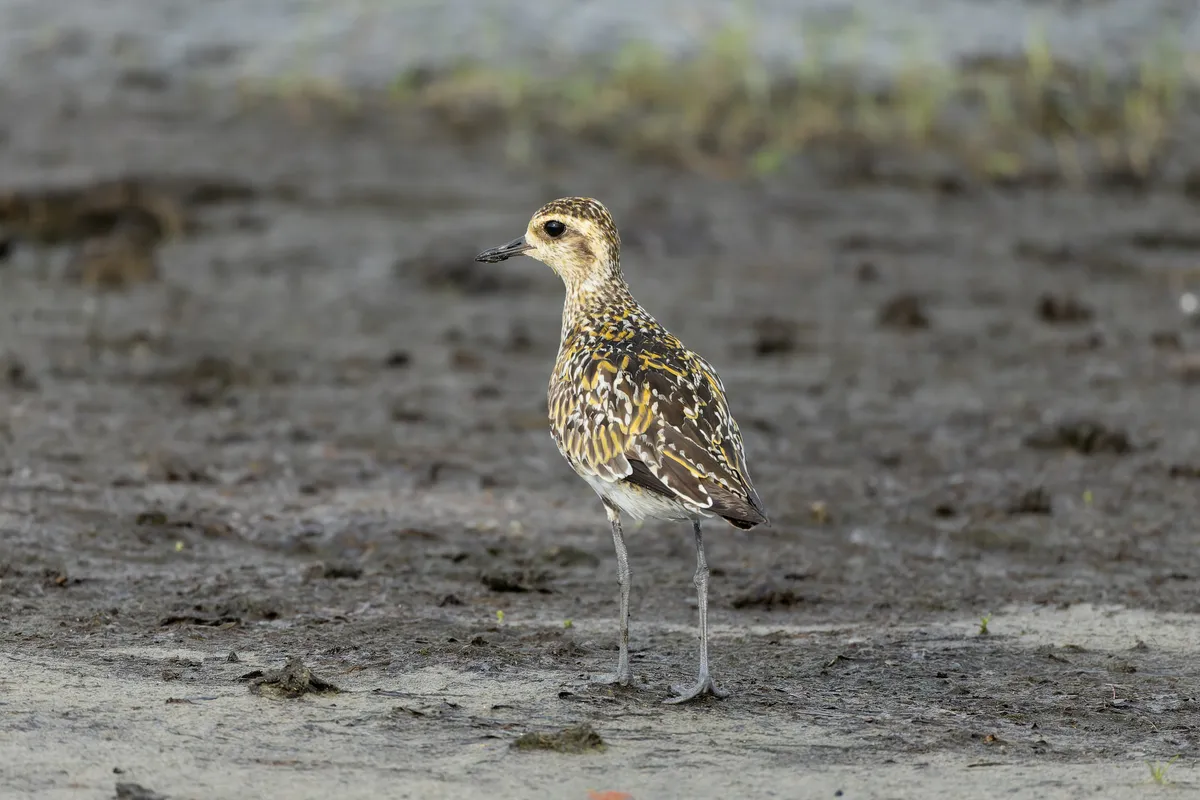
The Pacific golden plover (Pluvialis fulva) is a migratory shorebird that breeds during summer in Alaska and Siberia. During nonbreeding season, this medium-sized plover migrates widely across the Pacific.
Description
Adults are about 25 cm (9.8 in) long with a wingspan averaging 61 cm (24 in) At their lightest, fat free, the birds weigh around 135 g (4.8 oz) In March, the birds begin gaining weight. Before leaving for their Arctic breeding grounds, the birds weigh about 200 g (7.1 oz). In breeding plumage, the male is spotted gold and black on the crown, back, and wings. Face and neck are black bordered with white, breast is black, rump is dark. Bill is black, legs are gray to black. Female similar but black breast mottled and less distinct. In nonbreeding plumage, sexes look identical. The black on the face and breast bordered by white is replaced with dark brown, gray, and yellowish patterning and lighter underparts. Molt to breeding plumage begins in March and April, prior to migration. Molt to nonbreeding plumage begins in the Arctic during egg incubation. Downy chicks are spotted gold and black on head and back with whitish yellow underparts. Legs and feet are adult size at hatching. Similar birds are the European golden plover, Pluvialis apricaria, and the American golden plover, Pluvialis dominica. The Pacific golden plover is more similar to the American golden plover, with which it was once considered the lesser golden plover. The Pacific golden plover is slimmer than the American golden plover, has longer legs, and usually has more yellow on the back.
Text from Wikipedia — Pacific golden plover, revision 1346169847, CC BY-SA 4.0, retrieved 2026-09-04. Encyclopedic text reused under CC BY-SA 4.0. Sentences about hunting or regulation are removed: on this site, the rule comes from Québec.ca.
Presence in Quebec
- Origin
- Indigène
- Occurrence
- Accidentel/non régulier
- Population status
- Migrateur
- Certainty
- Confirmé
Conservation
Québec.ca
Official periods
Source: Québec.ca — tables reproduced as published (retrieved 2026-08-30).
Regulations change. Always check Québec.ca before hunting or trapping.
Where this data comes from
This species is listed in an official government dataset. The identification and status shown in the data sheet are reproduced from it.
Source: List of Quebec’s vertebrate wildlife (LFVQ) — Ministère de l’Environnement, de la Lutte contre les changements climatiques, de la Faune et des Parcs. File LFVQ_25_03_2026.csv, retrieved 2026-08-30 · CC BY 4.0.
Measurements, habitat, diet and reproduction are not shown: no official source is attached to them yet.